
Illustrated · 2 min

+1 contributors

In the previous lessons, we've talked about vertical translations, horizontal translations, vertical reflections, horizontal reflections, vertical dilations, and horizontal dilations.
This lesson will cover how to combine these transformations, dramatically changing a function from a parent function to a new, transformed function.
Order Matters:
Similar to solving functions and equations, there is an order in which we apply function transformations.
-
Do the horizontal shift, within the parentheses.
-
Do the stretch/compression, which is the constant multiplied by the parentheses.
-
Do the reflection across the - or -axis.
-
Lastly, do the vertical translation.
Basically, you're doing the operations from within the parentheses first, then moving to the constant sign multiplied by the parentheses, and then ending with the constant term added/subtracted from the parentheses.
One important note: the coefficient of has to be in order to accurately transform functions.
Let's walk through an example together!
Example
The parent function is:

Made using Desmos
Since we're working from inside outside, we will start with the horizontal shift. The parent function is shifted units to the left.
So far, we have:

Made using Desmos
Our next step is to stretch or compress the function, if needed. The parentheses are multiplied by , but we should tackle the before considering the negative sign. So, let's compress the function by a factor of .
So far, we have:

Made using Desmos
Next, we're going to apply that negative sign we ignored in the previous step. So, we will reflect the function over the -axis.
So far, we have:

Made using Desmos
Our last step is to do the vertical translation! We will translate our function down by units.
Finally, we have our original function:
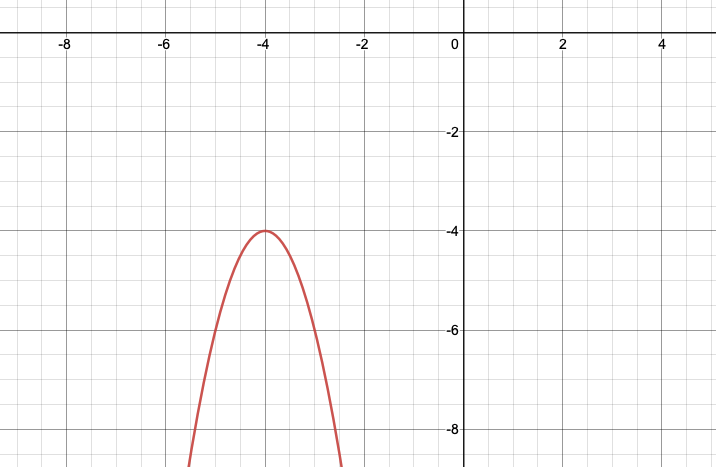
Made using Desmos
Look how much we have changed and moved the graph, compared to the parent function! They look completely different.
In Summary
When doing multiple transformations, you can have a parent function that is stretched horizontally, stretched vertically, have vertical or horizontal translations, or is reflected. This can dramatically change the shape of the graph.


