Transform Upside-Down: Reflect Polynomials About x-Axis

Before this, knowWhat Is a Polynomial Transformation?

Video

(Video) Graph Transformations About the xx- and yy-Axis

by PatrickJMT

The above video by PatrickJMT describes how to reflect about the x-axis and y-axis.

Summary

To reflect a polynomial over the xx-axis, we multiply the entire polynomial by −1-1.

y=−f(x)y=-f(x)

The negative sign in front of the entire polynomial flips the graph about the xx-axis.

Video

(Video) Reflections

by MrMaisonet

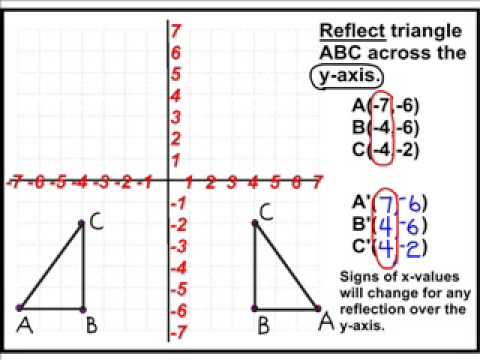
In the above video by MrMaisonet it is shown an intuitive example of what is happening with reflections. Triangles are used, but this can be generalized to functions, including polynomials.

Illustrated · 1 min

In this next lesson in the series of polynomial transformations, we will talk about reflecting polynomials about xx-axis. We've already learn about shifting from right to left, shifting up and down, and reflections.

Reflecting Polynomials About the xx-Axis

When we reflect a polynomial function about the xx-axis, we are essentially flipping the function upside down! That means that the yy-values get negated. So the points on top of the xx-axis flip to the bottom of the xx-axis, and vice versa.

f(x)=−f(x)f(x)=-f(x)

Example

Say we want to reflect the parent square root function, y=xy=\sqrt{x}, over the xx-axis.

Graph of y=sqrtx

Made using Desmos

If we want to flip this function over the xx-axis, we negate all yy values.

(0,0)→(0,0)(1,1)→(1,−1)(4,2)→(4,−2)(9,3)→(9,−3)\begin{align} (0,0) \rightarrow (0,0)\\ (1,1) \rightarrow (1,-1)\\ (4,2) \rightarrow (4,-2)\\ (9,3) \rightarrow (9,-3)\\ \end{align}
Graph of -y=\sqrtx

Made using Desmos

As we can see from the second graph, the function shape did not change, and it was not translated horizontally or vertically. The only feature that changed are the yy-values of the function.

Illustrated · 1 min

Reflect Polynomials About the xx-Axis

Reflect Polynomials About the x-Axis
Polynomials can be reflected over the x-axis!
In this example, we see the polynomial y=x^2 reflected over the x-axis.
The new polynomial is: y=-x^2

Made using Desmos

When we talk about reflecting a polynomial about the x-axis, we mean flipping it upside-down. This happens when we take each point on the graph of the polynomial and make its y-coordinate the opposite of what it was. For example, if we have a point at (3,4)(3,4), it will move to (3,−4)(3,-4). To do this to the whole graph, we multiply the polynomial by −1-1.

This changes the shape of the graph. If the polynomial was going upwards, it will now go downwards, and if it was going down, it will go upwards. Remember that this reflection doesn't change the xx-coordinates, only the yy-coordinates. So, when you reflect a polynomial about the xx-axis, you're flipping the graph up to down, but it still passes through the same xx-values. This is useful when you're analyzing how a function behaves or comparing different graphs.


Type a concept, like “slope” or “photosynthesis”.

↑ ↓ to choose · Enter to openSearch explanations and problems