Read · 1 min

Transformations of Ellipses
We are really moving forward quickly learning about the conic sections! Now that we have covered the basics of ellipses, such as the standard form, general form, the center, main points, and the foci, we can start taking ellipses a step further. In this lesson, we will learn about the transformations of ellipses, which is a very similar concept to the transformation of functions and polynomials.
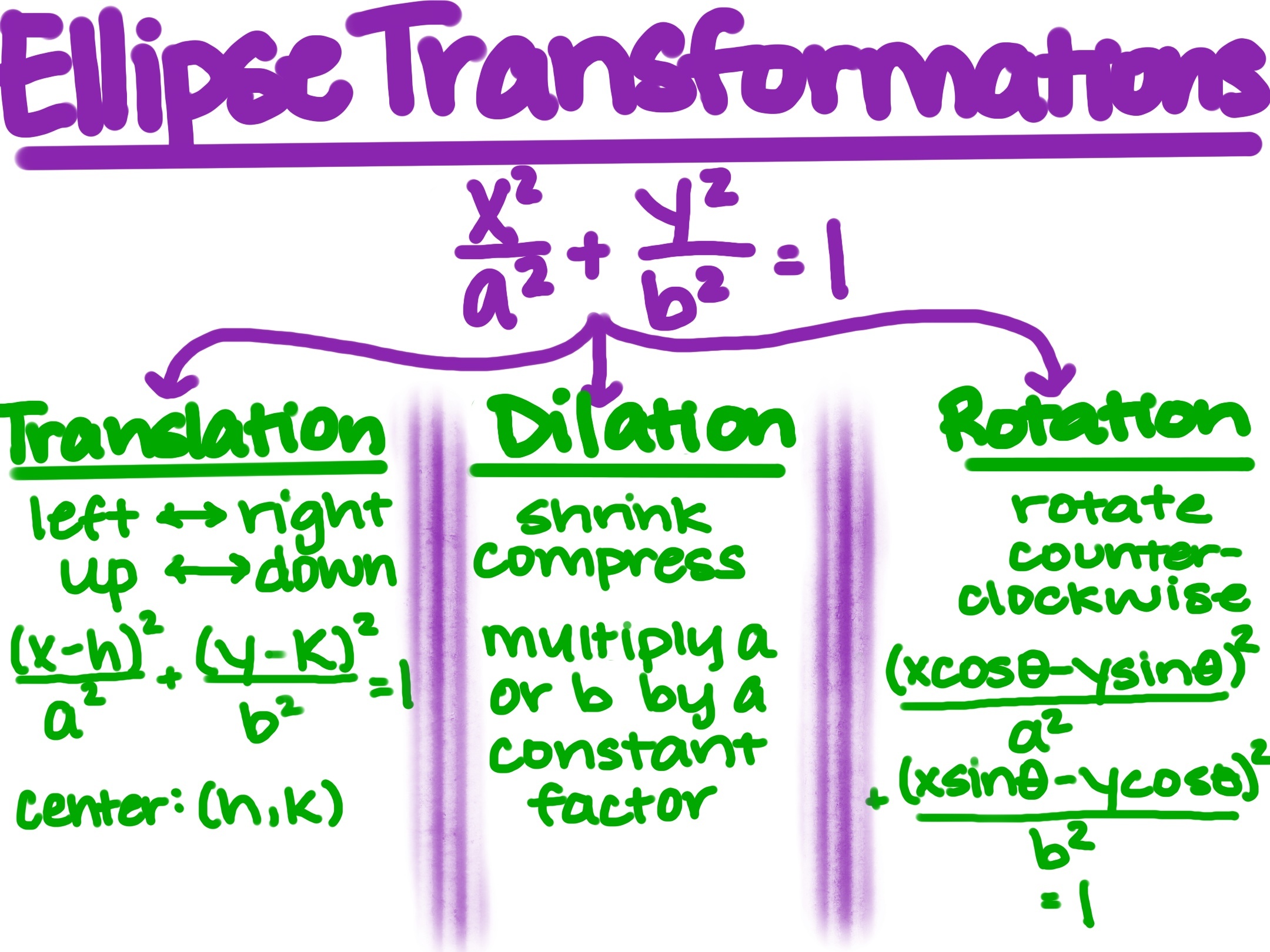
###Transformations Transformations of ellipses involve changing their size, shape, orientation, or position on the coordinate plane. Everything that we do in this lesson will aim to make those types of changes. These transformations happen through changes to the coefficients of the standard function of the ellipse. The standard equation of an ellipse centered at the origin is:
We have been working extensively with this formula, so it should look very familiar to you. Remember that is the length of the semi-major axis, and is the length of the semi-minor axis.
###Translations
A translation involves moving an ellipse left/right or up/down (horizontally or vertically). To translate an ellipse horizontally by units and vertically by units, the equation becomes:
represents the new center of the ellipse.
###Dilation
A dilation is when we shrink or compress an ellipse. Multiplying or by a constant will stretch or shrink the ellipse along the -axis or -axis, respectively. For example, multiplying by elongates the ellipse along the -axis, while multiplying by compresses it along the -axis.
###Rotation
To rotate an ellipse by an angle counterclockwise, the equation becomes:
This transformation is a little more complicated, in that it involves replacing each and with expressions involving and .