
Interactive · 3 questions
The first exoplanets to be discovered were found by radial velocity observations of the stars that they orbit, and in a few unusual cases by pulsar timing. But the majority of currently-known exoplanets have been found by planetary transits.
What Is A Transit?
A planetary transit is when a planet passes in front of a star. This means that it blocks some of the light from the star. If we repeatedly measure how bright the star appears to be, we will periodically see a temporary decrease each time that the planet passes in front of it:
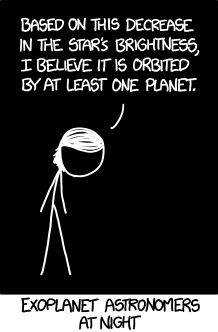
Using the transit technique, an astronomer discovers that Earth orbits the Sun.
via Randall Monroe
This is rather obvious in the case of Earth and the Sun, since we are so close to the planet. For exoplanets, though, both the planet and the star are very far away - so far away, in fact, that we cannot usually make an image of the star at all. Instead, it looks like a point. But the planet passing in front of the star will still block some of the star's light.
The fraction of a star light that is blocked by a planet is called the transit depth. It is determined by the cross-sectional areas of the planet and of the star:
Usually, a planet will block only a small fraction of a star's light. For example, Jupiter's radius is 69,911 km while the Sun's radius is 696,340 km. An alien astronomer watching Jupiter pass in front of the Sun would see a transit depth of . That is, the star would appear 99% as bright during the transit as at other times. Detecting planetary transits requires very careful repeated measurements of the brightness of each star being studied - and ideally observations of many transits by each planet to rule out other things that temporarily change the brightnesses of stars (such as starspots).
Earth's average radius is 6371 km. What transit depth would an alien astronomer see when watching Earth pass in front of the Sun?
Ground-based projects to find exoplanets via transits have primarily found Jupiter-sized planets around stars like the Sun, and smaller planets around smaller stars (such as red dwarfs).
To find Earth-sized or smaller planets around Sun-like stars requires reliably measuring the brightnesses of many stars to far better than one part in ten thousand, which has not been possible when observing those stars through the Earth's atmosphere. Space-based exoplanet observations, however, can reach the necessary precision. The Kepler spacecraft has found many hundreds of transiting exoplanets, some as small as Mars or Mercury.
Exoplanets are usually found by sophisticated computer programs which automatically identify transits in series of brightness measurements of each target star. But the programs are only so reliable - direct human inspection of Kepler spacecraft data finds a few planets that would otherwise be missed. If you want to help find exoplanets using transits, you can do so through the Planet Hunters project.
Which Planets Can Transits Find?
There is a key limitation to finding planets by transits: Each planet found must appear to pass in front of the star it is orbiting as seen from the direction we are looking at the star from. The orbital planes of planets within a planetary system may be relatively close to one another, but they are randomly distributed relative to where we are viewing them from. Most exoplanets do not transit as seen from any one place.
The probability that we will see a given planet transit depends on its distance from the star it orbits and on the size of the star. For a planet to pass in front of a star, we must be viewing it nearly in the plane of its orbit. The allowed offset in angle is , where is the semi-major axis of the planet's orbit. We can see the transit at angle the planet's orbit, which gives us the probability of a given planet transiting:
A hot Jupiter orbits 10,000,000 km from a Sun-like star. What is ?
That is, if we were to have a hundred Sun-like stars, each with such a hot Jupiter around them, we would expect to see only 7 of those planets to be on orbits that transit from our point of view. We could not find the remaining 93 planets by looking for transits, since they would never pass between us and the stars that they orbit.
The Earth orbits the Sun with a semi-major axis of about 149,513,000 km. What is the probability of us seeing a planet with the same semi-major axis transit a star the size of the Sun?
All of this means that in order to find many exoplanets using transits, we need to observe a great many stars. For example, the Kepler spacecraft measured the brightnesses of 146,000 stars for three and a half years to find a few thousand planets.
It also means that there is a discovery bias: planets on orbits very near to their stars are far more likely to be discovered than planets further away. We need to take this into account when determining how many planets are actually on orbits close to their stars as compared to how many planets actually orbit further away. For example: We have discovered more hot Jupiter planets than we have found small exoplanets on Earth-like orbits. But in the actual population of exoplanets, only about 1% of stars have hot Jupiters orbiting them while ~5% of stars have small exoplanets orbiting them on Earth-like orbits.
What Do Transits Tell Us About Planets?
We learn a couple of things immediately when we discover a planet transiting a star. First, we learn the planet's orbital period: the time between one transit and the next is equal to the time it takes the planet to go around its orbit once. Second, we learn how large the planet is relative to the star from the transit depth.
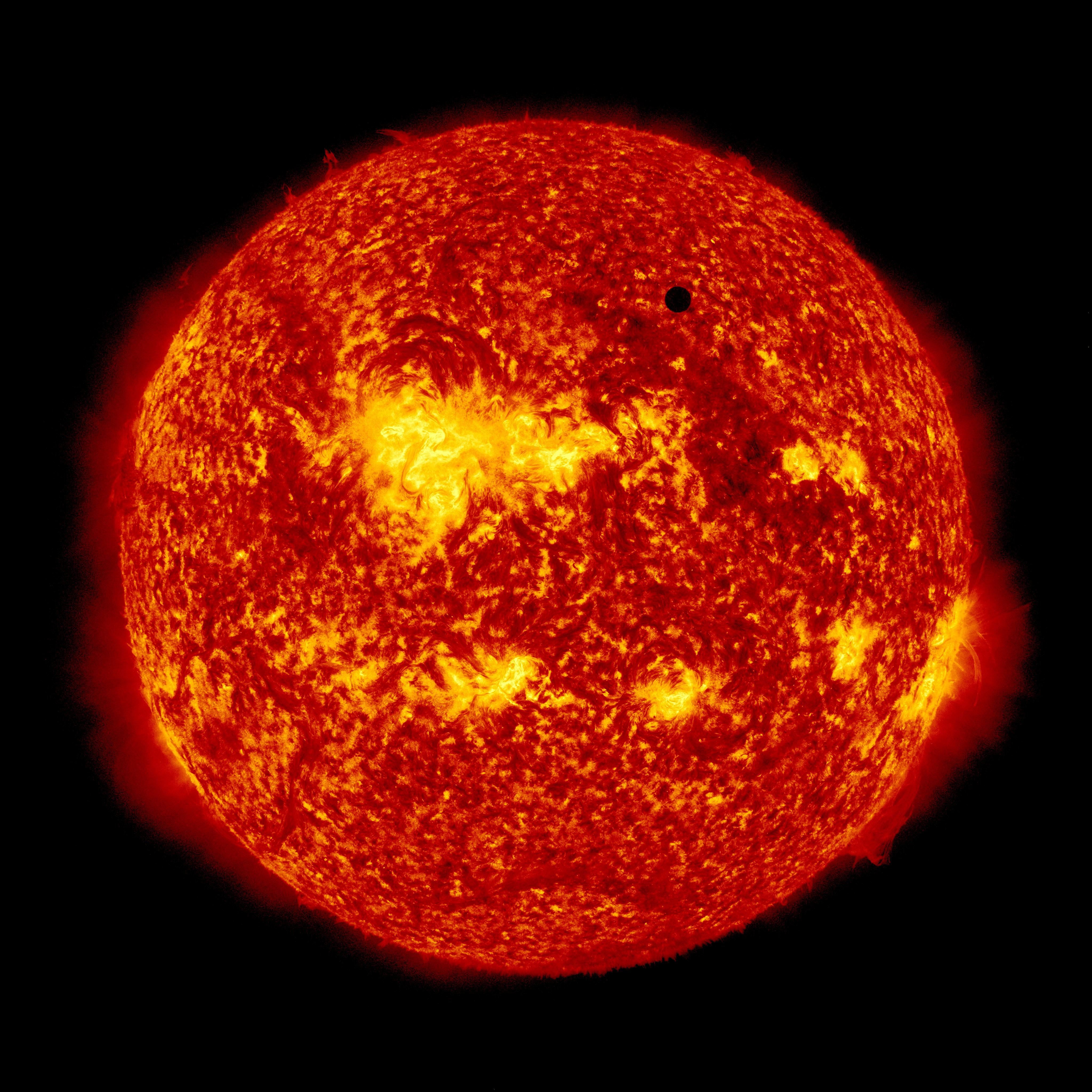
Venus transits the Sun as seen from near Earth, in 2012. An exoplanet transit would look much like this, if we could zoom in far enough.
Image from the Solar Dynamics Observatory spacecraft. Variations in brightness across the Sun have been enhanced.
From our knowledge of stellar structure, we can determine the size and mass of a star from its brightness and spectrum. Given those and the planet's orbital period, we know both the planet's actual physical size and its semi-major axis. If we have both radial velocity and transit data, we can determine the planet's orbit and mass uniquely.
When we know the size and mass of planets, we can determine their overall densities. This gives us very approximate information on their compositions: planets that are mainly metal & rock, those that are mainly water, and those that are mainly hydrogen and helium.
And with exceptionally careful observations, we can measure how light of different colors is gradually blocked as a planet begins to transit a star and gradually unblocked as it begins to move out of the way again. This gives us information on the structure and composition of the atmospheres of those planets.