Transmission (DNA Replication) — Definition & Overview

Before this, knowConservation of Genetic Material — DNA Replication

Video

(Video) The Story of Fido's Physical Traits

by Wisdom Panel Canine DNA Tests

Why is your cat fluffy and white while your neighbor's cat has short calico fur? Why is your dog big with floppy ears but your best friend's dog is a tiny, little chihuahua? It's all about gene transmission or heredity.

This video examines where your furry friends' traits come from.

Check Yourself\color{#8925AE}{\text{Check Yourself}}\\

Which of these does not affect your phenotype?
Choose one answer

Illustrated · 1 min

How is DNA transmitted? Each person has a unique set of DNA. This set includes two copies of each chromosome. Each person creates a cell that carries just one copy of each gene. This is the sperm or egg cell. When an egg is fertilized, the two copies from each parent come together in a new cell called a zygote. This cell multiplies and eventually creates an entire new organism. The new organism has a mix of DNA from both parents, but can have new traits that are completely different from either parent due to the way DNA can be expressed.

Image source: By Gabi Slizewska

Illustrated · 1 min

DNA Transmission

A family of Huskies

Image source: By will30 CC0, via pixabay.com

Each of us inherits the traits that make us who we are from our parents.

An organism's DNA is transferred to its offspring through a process called transmission. This word is somewhat synonymous with heredity because it describes how genetic information is passed down through generations.

As you might already know, the process of meiosis produces gametes. These are sex cells, like the sperm or egg. When the egg of a female and sperm of a male combine, we call this fertilization.

During fertilization, a new cell is formed. This cell now contains a set of DNA from the sperm and a set from the egg. The interaction of the different version of genes in your genome will determine how you look and behave.

Transmission helps us understand why children often look like their parents.

Illustrated · 1 min

How Does DNA Transmission Work?

Genes are transmitted from one generation of an organism to the next. For this to be possible, DNA from the parent organisms must be packaged and sorted carefully during cellular division. If any error is made during meiosis or mitosis, then the offspring might have some missing or messed up genetic information.

A cross between an unaffected "carrier" father and an unaffected "carrier" mother, both heterozygous Rr. There is a one in four chance they will have an unaffected child, heterozygous RR. There is a two in four chance they will have an unaffected "carrier", heterozygous Rr. There is a one in four chance they will have an affected child, homozygous rr.

Image source: By Cburnett CC BY-SA 3.0, via Wikimedia Commons

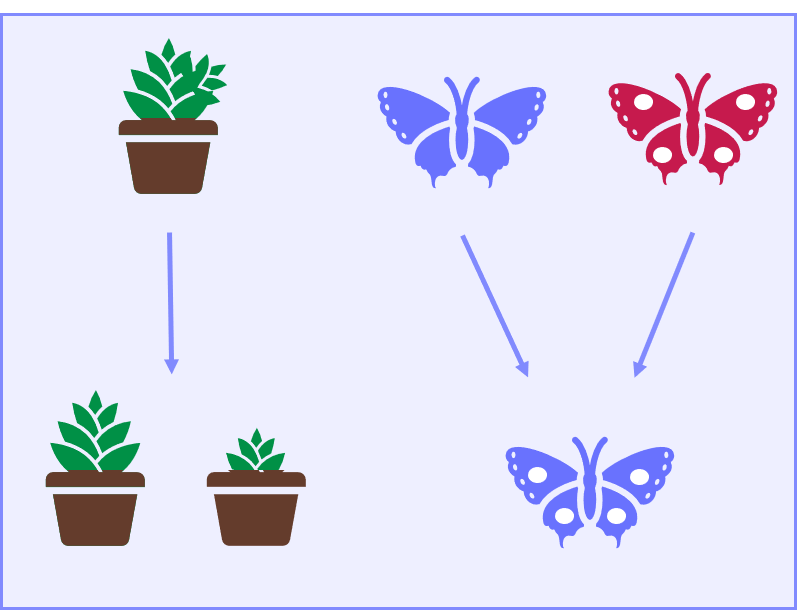
DNA can be passed down to offspring by either sexual or asexual reproduction. Asexual reproduction is mitosis, where a cell is divided into two identical daughter cells. Sexual reproduction is the way in which you were made. This type of reproduction is dependent on meiosis for genetic variation because it combines the DNA of two separate organisms. Basically, organisms are different from one another because their DNA is a mix of their parents'.

Vocabulary Review:\color{#8925AE}{\text{Vocabulary Review:}}

DNA\color{#8925AE}{\text{DNA}} : The macromolecule that stores all of an organism's genetic information

Semiconservative Replication\color{#8925AE}{\text{Semiconservative Replication}} : During DNA replication, one strand is newly made and the other strand is from the original molecule

Transmission\color{#8925AE}{\text{Transmission}} : How genetic information is passed down through generations

Illustrated · 1 min

DNA's Role in Heredity

DNA is the master code for all organisms. It is the nucleic acid that contains the blueprints for making an organism. DNA makes up chromosomes, and genes are found in DNA.

DNA is what makes a person a person. The order of nucleotides in an organism's DNA results in the physical and most behavioral characteristics of an organism. Therefore, passing along DNA to an offspring through sexual reproduction ensures that you have created an organism that is 50% identical to you. Passing on DNA is the entire reason for reproduction.

DNA divides equally into four unique haploid cells during meiosis.

Image source: By Rdbickel CC BY-SA 4.0, via Wikimedia Commons

DNA Transmission

DNA is passed into sex cells called gametes through the process of meiosis. The sex cells contain a single copy of the organism's genetic code. When two sex cells from different organisms come together it is called sexual reproduction. As sexual reproduction occurs, the two sex cells come together and form a zygote. A zygote is just a fertilized egg. Pollination is a form of sexual reproduction. The pollen is the sperm and the receiving flower has female parts. Flowers have both male and female parts.

There are many other forms of reproduction that are not sexual.

Fully-grown sex cells undergo meiosis, splitting up into haploid cells. These cells can become fertilized and eventually produce a new diploid cell, thus starting over the cycle.

Image source: By Seb951, Stannered CC BY-SA 3.0, via Wikimedia Commons

Type a concept, like “slope” or “photosynthesis”.

↑ ↓ to choose · Enter to openSearch explanations and problems

