Trigonometric Word Problems

Before this, knowSolve Trigonometric Equations Using InversesSolve Trigonometric Equations Using Identities and Factoring

Video

(Video) Trigonometry Word Problem

by PatrickJMT

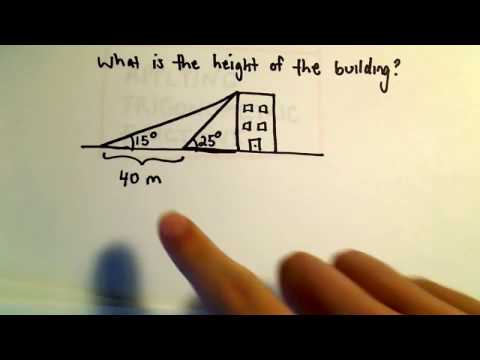
Here's a video by PatrickJMT going over an example of a trigonometric word problem.

Summary

First, you will set up the scenario. In the video, you will see the classic example of finding the angle of elevation from a point on the ground to the top of a building.

Because we also have the horizontal distance, we can use tangent.

tan⁡(θ)=heightdistance\tan(\theta) = \frac{\text{height}}{\text{distance}}

We can rearrange this to find the building's height.

height=distance×tan⁡(θ)\text{height} = \text{distance} \times \tan(\theta)

Illustrated · 2 min

Solving Word Problems Using Trigonometry

There are a lot of real-world problems that use triangles, so we know we can use trigonometry to solve these types of problems! Use all of the skills in your toolbox, including the pythagorean theorem and SOHCAHTOA.

The most common types of word problems that involve trigonometry are questions involving calculating height, based on other distances/lengths. You will often be asked to find the angle of depression or the angle of elevation. Common problems include finding the length of a ladder or shadow, finding the height, etc.

Let's walk through an example.

Example

Austin wants to calculate the height of a small tree in his yard. His dad is suggesting that he use a ladder and a tape measure, but Austin thinks he can use trigonometry to find the height of the small tree (which is a lot less work!). Austin tells his dad that if Austin can find the angle of elevation and the length of the tree's shadow, he can use trig to solve the problem. Is Austin right?

Tree with angle of elevation

Image source: by Anusha Rahman

Austin can measure the length of the base of the triangle, which would be the length of the shadow. He can measure the angle of elevation by drawing an imaginary line from the ground the top tip of the tree, as we can see in the image above.

Now that we've established that Austin can indeed find the height of the tree, let's calculate what that height actually is. At 2pm on a Tuesday, Austin finds that the length of the tree's shadow is 15m15m. Using a protractor, Austin finds that the angle of elevation of the tree is 30∘30 ^{\circ}.

Let's look back at the image we drew earlier. We can assign numerical values to the variables.

Same sketch as before, but angle labeled as theta=30 degrees, length of shadow at 15 meters.

Image source: by Anusha Rahman

We have filled in the variables that we know. We have established 1515 as the length of the shadow. We also know that the angle of elevation, θ\theta is 3030 degrees. Remember to keep track of degrees vs. radians!

Now that we've plugged in the values, we want to solve for the height, which we've established as the variable xx. Let's think about what we know - we know the angle and the adjacent side. We want to solve for the opposite side. That sounds like tangent!

tan⁡30∘=x1515⋅tan⁡30∘=x15⋅13=x153=x\begin{align} \tan{30^{\circ}} &= \frac{x}{15} \\ 15 \cdot \tan{30^{\circ}} &= x \\ 15 \cdot \frac{1}{\sqrt{3}} &= x \\ \frac{15}{\sqrt{3}} &= x \\ \end{align}

The decimal equivalent of this fraction is 8.668.66. We have calculated that the height of the small tree in Austin's yard is approximately 8.668.66 meters tall!

Illustrated · 1 min

Trigonometric Word Problems

Trig word problems are real-life problems that use sine, cosine, and tangent. They often deal with things that repeat, like waves, sounds, or seasons. You also tend to see them in geometry problems about triangles.

Trig Word Problems
understand the problem: what is being asked?
model the situation: set up a right angle
solve the equation: plug and solve
interpret the solution: make sure the answer is realistic

Image source: by Anusha Rahman

Let's walk through it.

Understand the Problem

First, read the problem carefully and figure out what is being asked. Once you've determined that, decide which trig function to use.

If the problem involves a sight angle, use SOH CAH TOA to remember the ratios. If the problem involves something that moves up and down, like a ferris wheel, you may need a sine or cosine function to model it. These are called periodic problems because the pattern repeats over time.

Model the Situation

Set up an equation that matches the situation. Plug in numbers you know and leave the unknown as a variable. Then solve the problem like a regular trig equation.

Solve the Equation

Sometimes a trig equation may have many solutions, but the world problem will usually give a time or angle range. This means you only keep answers that make sense in the real world.

Interpret the Solution

Check your answer to make sure it's realistic. Consider whether the angle is reasonable, which will help you avoid making mistakes.


Type a concept, like “slope” or “photosynthesis”.

↑ ↓ to choose · Enter to openSearch explanations and problems