Trigonometry: Double-Angle Identities

Before this, knowTrigonometry: Angle Sum and Difference Identities

Interactive · 3 questions

The double angle formulas for the trig functions can often come in handy. I will present two proofs of them: a geometric one, and a purely algebraic one.

First I will present a geometric proof.

Consider the following diagram:

Let ∠HAC=θ,AC=1,BC=b\angle HAC = \theta, AC = 1, BC = b. Note then that ∠HCA=90∘−θ\angle HCA = 90^\circ -\theta and HC=b2HC = \frac{b}{2}. So, sin⁡θ=b2  ⟹  b=2sin⁡θ\sin \theta = \frac{b}{2} \implies b = 2\sin \theta. Looking at the entire triangle, the Law of Sines tells us that sin⁡∠BACb=sin⁡∠HCA1\dfrac{\sin \angle BAC}{b} = \dfrac{\sin \angle HCA}{1}   ⟹  sin⁡2θb=sin⁡(90∘−θ)=cos⁡θ.\implies \dfrac{\sin 2\theta}{b} = \sin (90^\circ-\theta) = \cos \theta. Plugging in b=2sin⁡θb = 2\sin \theta gives sin⁡2θ2sin⁡θ=cos⁡θ  ⟹  sin⁡2θ=2sin⁡θcos⁡θ\dfrac{\sin 2\theta}{2\sin\theta} = \cos \theta \implies \sin 2\theta = 2\sin\theta\cos\theta.

Using the same diagram, we will prove formula for cos⁡2θ\cos 2\theta. Now, however, we will let ∠ACH=α\angle ACH = \alpha.

This time, try to come up with an idea of the proof on your own.

What is the first step?

Choose one answer

Worth the struggle

Twenty minutes on one hard problem can teach more than ten easy exercises. These problems are worth staying with. These are real problems from the AMC 12 and AIME, the national math competitions for middle and high school students, each with a worked solution on LIVE by Po-Shen Loh.

Read · 1 min

The double angle identities are really easy to derive. In this post, we'll show how to find formulas for sin⁡2θ\sin{2\theta}, cos⁡2θ\cos{2\theta}, and tan⁡2θ\tan{2\theta}. That means that we will find the double angle identities for sine, cosine, and tangent.

For sin⁡2θ\sin{2\theta},...actually you think about it first! Click for a hint.

2θ=θ+θ2\theta = \theta + \theta...

sin⁡2θ=sin⁡θ+θ=sin⁡θcos⁡θ+sin⁡θcos⁡θ=2sin⁡θcos⁡θ\sin{2\theta} = \sin{\theta + \theta} = \sin{\theta}\cos{\theta} + \sin{\theta}\cos{\theta} = 2\sin{\theta}\cos{\theta} sin⁡2θ=2sin⁡θcos⁡θ\boxed{\sin{2\theta} = 2\sin{\theta}\cos{\theta}}

Apply the same reasoning for cos⁡2θ\cos{2\theta}!

cos⁡2θ=cos⁡θ+θ=cos⁡θcos⁡θ+sin⁡θsin⁡θ=cos⁡2θ−sin⁡2θ\cos{2\theta} = \cos{\theta + \theta} = \cos{\theta}\cos{\theta} + \sin{\theta}\sin{\theta} = \cos^2{\theta} - \sin^2{\theta}

What's cool about this is that by the Pythagorean identity, sin⁡2θ+cos⁡2θ=1\sin^2{\theta} + \cos^2{\theta} = 1, we have cos⁡2θ=1−sin⁡2θ\cos^2{\theta} = 1 - \sin^2{\theta} and sin⁡2θ=1−cos⁡2θ\sin^2{\theta} = 1 - \cos^2{\theta}. Substitute these in:

cos⁡2θ−sin⁡2θ=(1−sin⁡2θ)−sin⁡2θ=1−2sin⁡2θcos⁡2θ−sin⁡2θ=cos⁡2θ−(1−cos⁡2θ)=2cos⁡2θ−1\cos^2{\theta} - \sin^2{\theta} = (1 - \sin^2{\theta}) - \sin^2{\theta} = 1 - 2\sin^2{\theta} \\ \cos^2{\theta} - \sin^2{\theta} = \cos^2{\theta} - (1 - \cos^2{\theta}) = 2\cos^2{\theta} - 1

Therefore we have:

cos⁡2θ=cos⁡2θ−sin⁡2θ=2cos⁡2θ−1=1−2sin⁡2θ\boxed{\cos{2\theta} = \cos^2{\theta} - \sin^2{\theta} = 2\cos^2{\theta} - 1 = 1 - 2\sin^2{\theta}}

Try doing something for tan⁡2θ\tan{2\theta}!

tan⁡2θ=tan⁡θ+θ=tan⁡θ+tan⁡θ1−(tan⁡θ)(tan⁡θ)=2tan⁡θ1−tan⁡2θ\tan{2\theta} = \tan{\theta + \theta} = \frac{\tan{\theta} + \tan{\theta}}{1 - (\tan{\theta})(\tan{\theta})} = \frac{2\tan{\theta}}{1 - \tan^2{\theta}} tan⁡2θ=2tan⁡θ1−tan⁡2θ\boxed{\tan{2\theta} = \frac{2\tan{\theta}}{1 - \tan^2{\theta}}}

Read · 1 min

The double-angle identities are identities that can be used to find the values of the trigonometric functions of double of an angle, given the values for the original angle.

The double-angle identities follow immediately from the general angle-addition identities: sin⁡(A+B)=sin⁡Acos⁡B+cos⁡Asin⁡B\sin(A+B) = \sin A\cos B + \cos A\sin B cos⁡(A+B)=cos⁡Acos⁡B−sin⁡Asin⁡B\cos(A+B) = \cos A\cos B - \sin A\sin B tan⁡(A+B)=tan⁡A+tan⁡B1−tan⁡Atan⁡B\tan(A+B) = \frac{\tan A + \tan B}{1 - \tan A\tan B} Setting B=AB = A, we get the double-angle identities: sin⁡(2A)=2sin⁡Acos⁡A\sin(2A) = 2\sin A\cos A cos⁡(2A)=cos⁡2A−sin⁡2A=2cos⁡2A−1=1−2sin⁡2A\cos(2A) = \cos^2 A - \sin^2 A = 2\cos^2 A - 1 = 1 - 2\sin^2 A tan⁡(2A)=2tan⁡A1−tan⁡2A\tan(2A) = \frac{2\tan A}{1 - \tan^2 A}

Illustrated · 1 min

Trigonometry: Double-Angle Identities

There are six negative angle identities you need to memorize!

Double Angle Identities are trig formulas that help you to find the sine, cosine, and tangent of an angle that is twice as large as another angle. Instead of working with 2x2x directly, you would rewrite the expression using only xx. Double angle identities come from the angle sum identities.

Double angle identities are shortcuts! They turn trig functions with larger angles into expressions using smaller, simpler angles. That's incredibly helpful as we navigate complex trig expressions.

Once you learn the main patterns, recognizing when to use them becomes much easier.

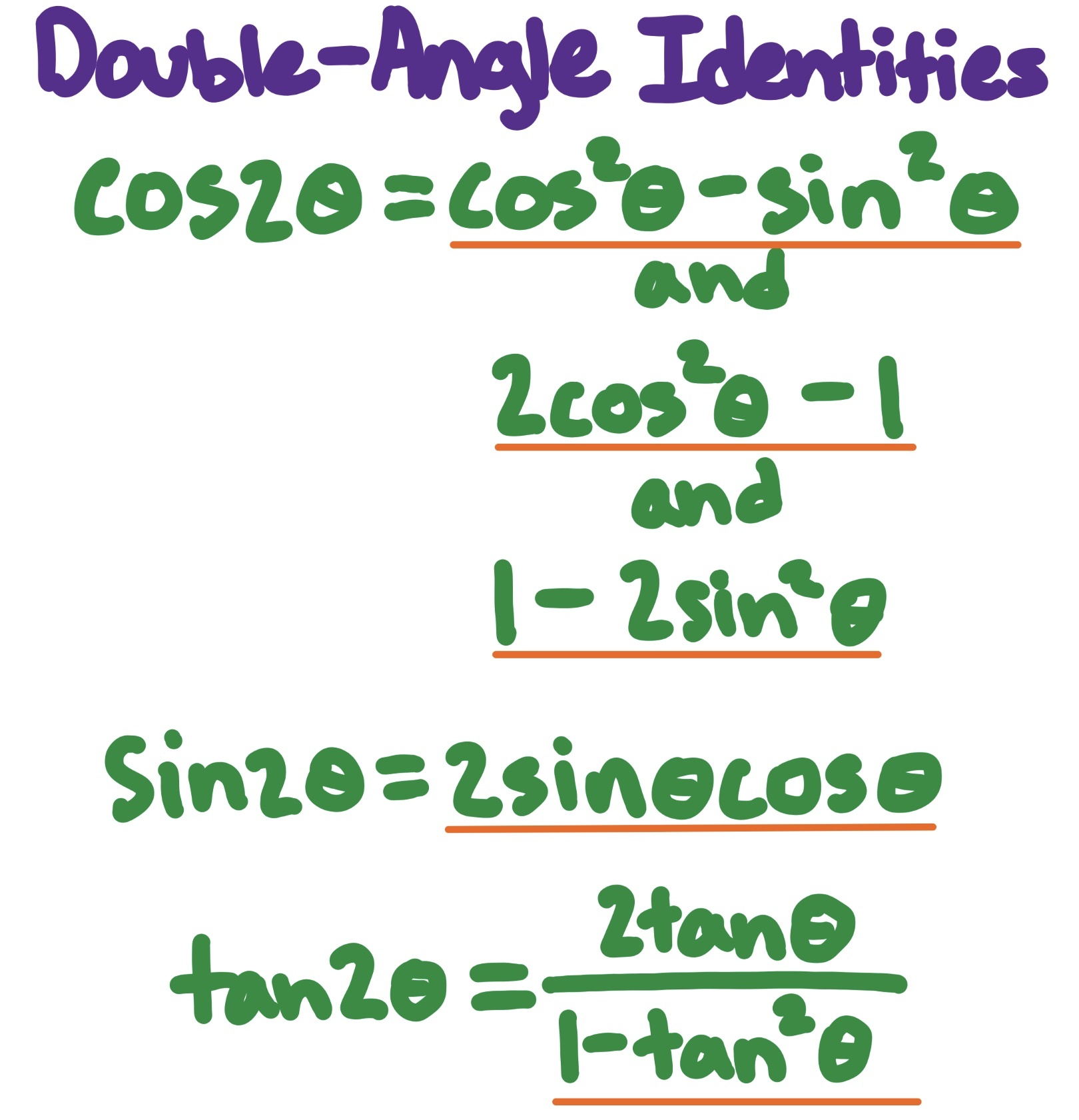
Double-Angle Identities

cos(2x) = cos^2(x) - sin^2(x) and 2cos^2(x)-1 and 1-2sin^2x)
sin(2x)=2sinxcosx
tan2x=(2tanx)/(1-tan^2x)

Image source: By Trisha

There are three very important formulas.

For sine, sin⁡(2x)=2sin⁡(x)cos⁡(x)\sin(2x)=2\sin(x)\cos(x)

For cosine, cos⁡(2x)=cos⁡2(x)−sin⁡2(x)\cos(2x)=\cos^2(x) - \sin^2(x)

For tangent, tan⁡(2x)=2tan⁡(x)1−tan⁡2(x)\tan(2x) = \frac{2\tan(x)}{1-\tan^2(x)}

Special Forms

The cosine double angle identity can also be rewritten into other useful ways.

Using sin⁡2(x)+cos⁡2(x)=1\sin^2(x) + \cos^2(x) = 1, we can say,

cos⁡(2x)=1−2sin⁡2(x)\cos(2x) = 1 - 2\sin^2(x)

, and,

cos⁡(2x)=2cos⁡2(x)−1\cos(2x) = 2\cos^2(x)-1

You can use any of these, whichever is most helpful for you to tackle an expression. Think about which one matches the information you already are working with.

Common Mistakes

A common mistake is thinking that sin⁡(2x)=2sin⁡(x)\sin(2x) = 2\sin(x).

That's not true! The cosine term is important here. Here is the correct answer:

sin⁡(2x)=2sin⁡(x)cos⁡(x)\sin(2x) = 2\sin(x)\cos(x)

Always use the full identity.

Video

(Video) Double Angle Identities

by Randy Anderson

As we continue on our journey of trigonometry, we have learned about negative angle identities, co-function identities, and angle, sum, and difference identities, but now time to learn about double angle identities!

Check out this video by Randy Andersen to learn how to derive the double angle identities.

Watch the video to see the step-by-step derivation. In summary, the double angle identities are:

sin⁡2x=2sin⁡xcos⁡x\sin{2x} = 2\sin{x}\cos{x} cos⁡2x=cos⁡2x−sin⁡2x\cos{2x} = \cos^2{x}-\sin^2{x} =2cos⁡2x−1= 2\cos^2{x}-1 =1−2sin⁡2x= 1-2\sin^2{x} tan⁡2x=2tan⁡x1−tan⁡2x\tan{2x}=\frac{2\tan{x}}{1-\tan^2{x}}

Let's work through the example problem in the video!

If given that cos⁡θ=−45\cos{\theta}=-\frac{4}{5} and sin⁡θ>0\sin{\theta}>0, we can find sin⁡2θ\sin{2\theta}.

Following along with the video...

sin⁡2θ=2sin⁡θcos⁡θ\sin{2\theta}=2\sin{\theta}\cos{\theta} =2(35)(−45)=2(\frac{3}{5})(-\frac{4}{5}) =−2425=-\frac{24}{25}

Keep watching the video to try more practice problems!

Type a concept, like “slope” or “photosynthesis”.

↑ ↓ to choose · Enter to openSearch explanations and problems