We have the following double-angle identity:
cos(2A)=cos2A−sin2A=2cos2A−1=1−2sin2A
Replacing A with 2A, we get:
cosA=cos22A−sin22A=2cos22A−1=1−2sin22A
Rearranging, we get:
sin22A=21−cosAcos22A=21+cosA
Dividing the first equation by the second gives:
tan22A=1+cosA1−cosA=(1+cosA)2sin2A
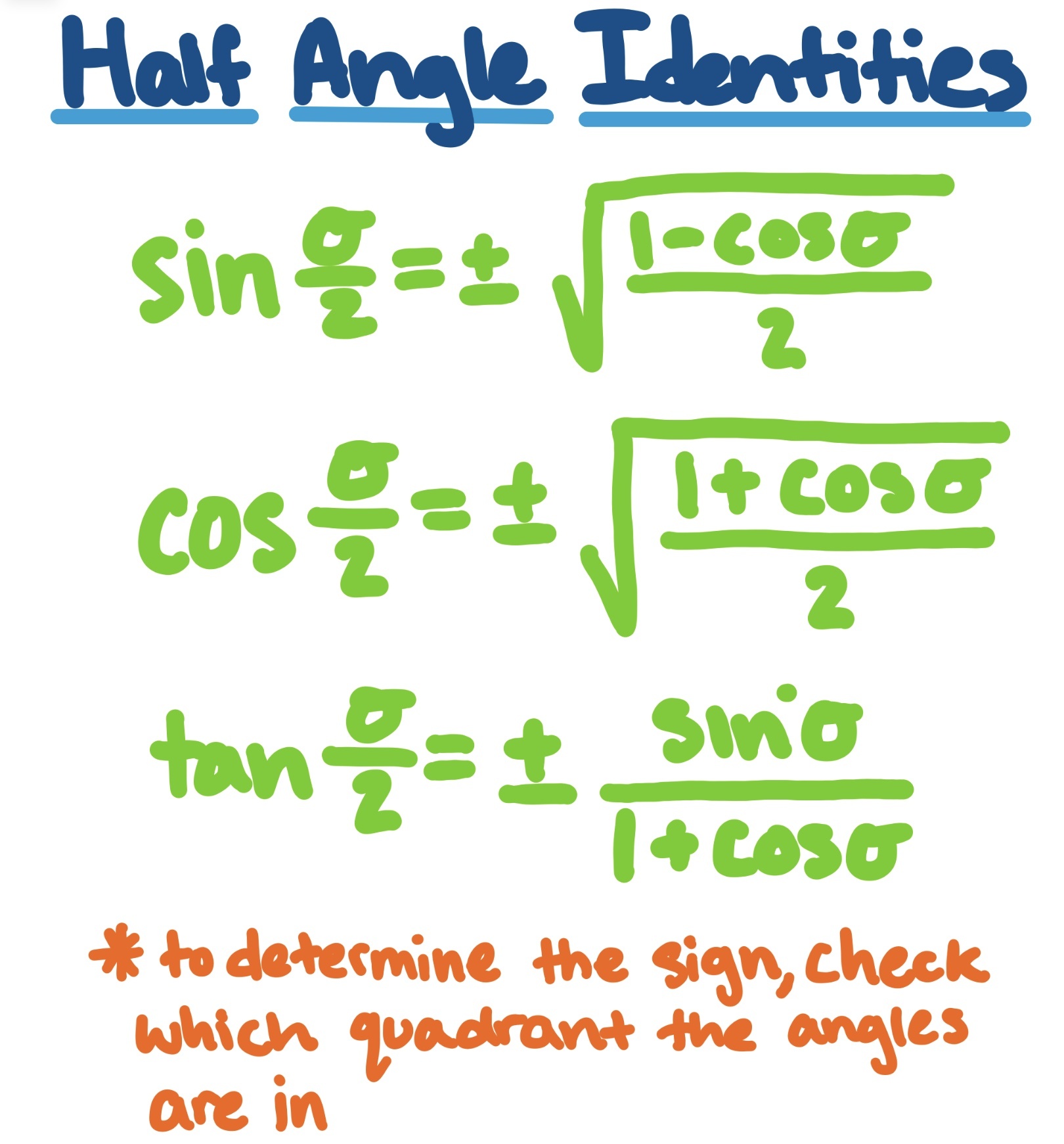
From these, we get the half-angle identities:
sin2A=±21−cosAcos2A=±21+cosAtan2A=±1+cosAsinA
To determine the sign, you will have to check which quadrant the angles A and 2A lie in.
Half angle identities are trig formulas use to find the sine, cosine, or tangent of half an angle. They are called "half angle" identities because the angle inside the trig function is divided by 2.
The half angle identities are derived from the double angle identities.
Image source: by Trisha
The sine and cosine formulas include ± because the square root alone does not tell you whether the value should be positive or negative. To choose the correct sign, you need to figure out which quadrant the angle 2x is in.
Quadrant I: sine and cosine are both positive
Quadrant II: sine is positive, cosine is negative
Quadrant III: sine and cosine are both negative
Quadrant IV: sine is negative, cosine is positive
One of the most common mistakes is forgetting the ± sign. Always check the quadrant before choosing positive or negative.