Trigonometry: Pythagorean Identity

Read · 1 min

Suppose you have the expression cos⁡2(x)+sin⁡2(x)\cos^2(x)+\sin^2(x). Let's think about how we would simplify it.

One way to represent cos⁡(x)\cos(x) and sin⁡(x)\sin(x) is the unit circle definition. Using the unit circle definition of cosine and sine. Using the unit circle definition, cos⁡(x)\cos(x) is equivalent to the x-coordinate of a point on the unit circle and sin⁡(x)\sin(x) is the y-coordinate of the same point.

To find the distance from this point to the origin, we use the distance formula: D=cos⁡2(x)+sin⁡2(x).D=\sqrt{\cos^2(x)+\sin^2(x)}. The distance from this point to the center of the circle is 1, because the radius of a unit circle is 1. Therefore we have cos⁡2(x)+sin⁡2(x)=1  ⟹  cos⁡2(x)+sin⁡2(x)=1.\sqrt{\cos^2(x)+\sin^2(x)} = 1\implies \cos^2(x)+\sin^2(x) = \boxed{1}.

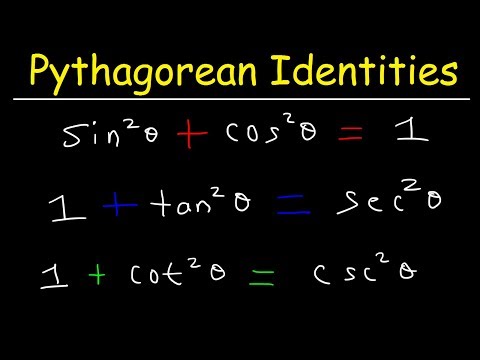
Dividing all terms by sin⁡2(x)\sin^2(x) we obtain the equivalent expression cot⁡2(x)+1=csc⁡2(x).\cot^2(x)+1=\csc^2(x). Similarly, dividing by cos⁡2(x)\cos^2(x) yields 1+tan⁡2(x)=sec⁡2(x).1+\tan^2(x)=\sec^2(x). These are all known as the Pythagorean Identities.

Read · 1 min

The Pythagorean Theorem leads to a simple proof of the Pythagorean Identity using only the basic definitions of trig functions.

The Pythagorean Theorem on a right triangle with legs a,ba,b and hypotenuse cc gives us: a2+b2=c2.a^2 +b^2 = c^2. Dividing through by c2c^2 gives: (ac)2+(bc)2=1.\left(\frac{a}{c}\right)^2 + \left(\frac{b}{c}\right)^2 = 1.

Let θ\theta be the angle opposite side a.a. Substituting in sin⁡θ=ac,cos⁡θ=bc,\sin \theta = \dfrac{a}{c}, \cos \theta = \dfrac{b}{c}, we have: (sin⁡θ)2+(cos⁡θ)2=1sin⁡2θ+cos⁡2θ=1\begin{align*} (\sin \theta)^2 + (\cos \theta)^2 &= 1 \\ \sin^2 \theta + \cos^2 \theta &= 1 \end{align*} and thus we are done. ■\blacksquare

We can also derive the two other Pythagorean Identities using a similar method.

If we had instead divided a2+b2=c2a^2+b^2=c^2 by a2,a^2, we have gotten: 1+(ba)2=(ca)21+(cot⁡θ)2=(csc⁡θ)21+cot⁡2θ=csc⁡2θ\begin{align*} &1 + \left(\frac{b}{a}\right)^2 = \left(\frac{c}{a}\right)^2 \\ &1 + (\cot \theta)^2 = (\csc \theta)^2 \\ &1 + \cot^2 \theta = \csc^2 \theta \end{align*}

Similarly, dividing by b2b^2 gives: (ab)2+1=(cb)2(tan⁡θ)2+1=(sec⁡θ)2tan⁡2θ+1=sec⁡2θ\begin{align*} &\left(\frac{a}{b}\right)^2 + 1 = \left(\frac{c}{b}\right)^2 \\ &(\tan \theta)^2 + 1 = (\sec \theta)^2 \\ &\tan^2 \theta + 1 = \sec^2 \theta \end{align*}

It's not surprising that these trigonometric relationships are known as the Pythagorean Identities!


Video

(Video) Pythagorean Identities - Examples & Practice Problems, Trigonometry

by The Organic Chemistry Tutor

Check out this video by the Organic Chemistry Tutor to learn about the Pythagorean Identities!

sin⁡2x+cos⁡2x=1\sin^2x + \cos^2x = 1 1+tan⁡2x=sec⁡2x1 + \tan^2x = \sec^2x 1+cot⁡2x=csc⁡2x1 + \cot^2x = \csc^2x

These identities can help us solve problems!

Let's use the example the Organic Chemistry Tutor uses in the video:

We know sin⁡x=45\sin{x} = \frac{4}{5} and we want to solve for what cos⁡x\cos{x} is.

We can use the trig identity: sin⁡2x+cos⁡2x=1\sin^2x + \cos^2x = 1:

(45)2+cos⁡2x=1(\frac{4}{5})^2 + \cos^2x = 1 1625+cos⁡2x=2525\frac{16}{25} + \cos^2x = \frac{25}{25} cos⁡2x=2525−1625\cos^2x = \frac{25}{25} - \frac{16}{25} cos⁡2x=925\cos^2x = \frac{9}{25} cos⁡2x=925\sqrt{\cos^2x} = \sqrt{\frac{9}{25}} cos⁡x=±35\cos{x} = \pm \frac{3}{5}

The video tells us that the angle is in the first quadrant and we know that cos⁡x\cos{x} is positive in the first quadrant, so cos⁡x=35\cos{x} = \frac{3}{5}.

Try the second example problem in the video! If cos⁡x=817\cos{x} = \frac{8}{17} and x≥3π2x\ge\frac{3\pi}{2} and x≤2πx\le{2\pi}, what is sin⁡x\sin{x}?

Choose one answer

Illustrated · 1 min

Trigonometry: Pythagorean Identity

Now that we've covered the tangent identity and reciprocal identities, we can move on.

In this lesson, we are going to learn about the Pythagorean Identities. These are special rules to help us understand how sine, cosine, and tangent work together.

Pythagorean Identities
 
$$\sin^2x + \cos^2x = 1$$
$$1 + \tan^2x = \sec^2x$$
$$1 + \cot^2x = \csc^2x$$

If $\tan{x} = \frac{1}{2}$, what is $\sec{x}$?
$$\tan^2x = {\frac{1}{2}}^2 = \frac{1}{4}$$
use the pythagorean identity!

$$1 + \tan^2x = \sec^2x$$
$$1 + \frac{1}{4} = \sec^2x$$
$$\frac{5}{4} = \sec^2x$$
$$ \pm \frac{\sqrt{5}}{2} = sec{x}$$

Image source: by Trisha

There are a few different identities. Let's start with:

sin2(θ)+cos2(θ)=1\text{sin}^2(\theta) + \text{cos}^2(\theta) =1

This identity looks similar to the pythagorean theorem with triangles, and they are derived from the same place.

Two other identities you will want to know:

1+tan2(θ)=sec2(θ)1 + \text{tan}^2(\theta) = \text{sec}^2(\theta) 1+cot2(θ)=csc2(θ)1 + \text{cot}^2(\theta) = \text{csc}^2(\theta)

These identities will be useful in solving problems and checking answers. They will always be true, no matter what the angle is. Think of them like a shortcut!

In the next lesson, we will learn how to derive identities.

Type a concept, like “slope” or “photosynthesis”.

↑ ↓ to choose · Enter to openSearch explanations and problems