
Illustrated · 1 min
By Gabi Slizewska

+1 contributors
Contributors



Image source: By Gabi Slizewska
Illustrated · 1 min
Image source: By Gabi Slizewska
Illustrated · 2 min
There are three major tropical biomes: dry forests, rain forests, and grasslands. The names stem from the fact that they exist in the tropics, the region of Earth that surrounds the equator. It covers some of South America, south Asia, and most of Africa. You can see it highlighted in red on the map below. The northernmost boundary, called the Tropic of Cancer, is located at 23.5 degrees north of the equator. The southernmost boundary, the Tropic of Capricorn, is located at 23.5 degrees south of the equator.
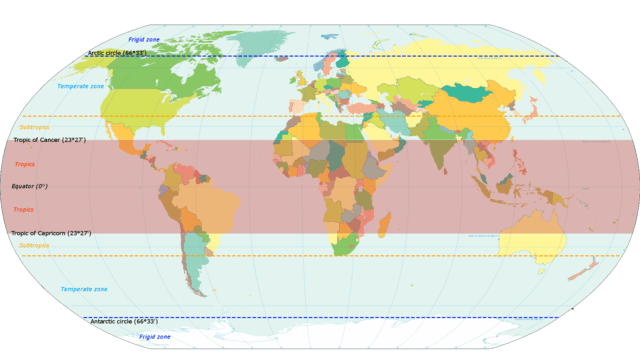
Image source: By Maulucioni CC BY-SA 4.0, via Wikimedia Commons
We'll start with tropical grasslands, which are also called savannas. Similar to the temperate grasslands, this region gets more rain than deserts, but not nearly the same amount as forests.
The seasons in this biome are different than those of temperate grasslands. There are only two: the wet and the dry season. Fires are a common issue here due to lightning.
All of these factors lead to grasses being the dominant plant life in the biome. We can sometimes find shrubs and trees, but the most common plants are grasses. The plants in the savanna have some pretty cool adaptations like losing their leaves during the dry season to conserve water.
Many animals also live in these grasslands, from elephants to cheetahs. A large part of the animal population migrates for the dry season to find water.
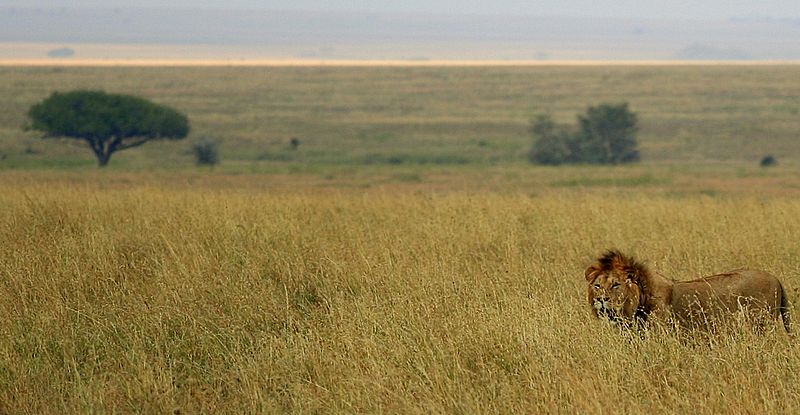
Image source: By eismcsquare CC BY 2.0, via Wikimedia Commons
Next, we'll talk about tropical dry forests. These forests have both a rainy and a dry season. The soils are rich with nutrients, and the temperature is warm.
Many plants have adaptations to survive the dry season, just like those in the savanna. For example, many trees lose their leaves during the dry season, while others have a thick, waxy coating to prevent water loss. Some of the animals in this biome are dormant (inactive) during the dry season. Other animals migrate in search of water.

Image source: By Colin Trainor CC BY-SA 3.0, via Wikimedia Commons
Now we get to discuss one of the coolest, most diverse terrestrial biomes in existence. The tropical rain forest biome contains more species than all of the other land biomes combined. The weather is hot and very wet all year long. The rain forest receives up to two meters of rain per year, more than any of the other tropical climates.
The trees here can grow so large that we divide them into three different layers: the canopy, which is the tops of the trees; the understory, which is directly beneath the canopy; and the forest floor at the bottom.
The understory plants have to compete to get any sunlight. Some have even adapted to grow on the taller trees to increase their chances of getting some light.
The animals of the rain forest are active year round and have abundant food. Many of these animals live in only one layer of the rain forest. Some of those that live in the canopy never even see the forest floor.

Image source: By Mike Thurston CC BY-SA 2.0, via flickr.com
Video
by palfrey411

In the video above, Palfrey411 discusses what grasslands look like in the tropics.
by Royal Botanic Garden Edinburgh

In the video above, the Royal Botanic Garden Edinburgh discusses dry forests.
by MooMoo Math and Science

In the video above, MooMoo Math and Science explains the rain forest.


