Read · 1 min

Two distinct lines will always intersect in at most one point. This will be true no matter how many dimensions we're in, as long as we're in a standard Euclidean geometry.

One way to see this is to consider what happens if we have two lines which intersect in more than one point. Then, there must exist at least two distinct points in common to both lines (since they intersect at least twice). Let's call these points AA and BB, and the lines l1l_1 and l2l_2. Now, we know that two distinct points determine a unique line; thus l1l_1 and l2l_2 are the same. So, we can't have two intersections unless the lines are the same, in which case they coincide and have infinitely many points in common.

There are, in fact, only four possible relationships lines can have with each other:

Intersecting lines, which lie in the same plane and intersect exactly once,

Parallel lines, which lie in the same plane and never intersect,

Skew lines, which are lines that do not lie in the same plane and thus do not intersect (because if they intersected, they would lie in the same plane), and

Coincident lines, which lie exactly on top of each other, and thus "intersect" infinitely. These lines are not distinct.

If two lines are distinct, then, they are intersecting, parallel, or skew, and therefore intersect at most one time.
Illustrated · 1 min

Say we have two lines. They are either parallel or not parallel. By definition: If they're parallel they don't intersect.

If they are not parallel they intersect once (as in the diagram above), and continue forever in their corresponding directions. The distance between the lines gradually gets smaller, until their intersection point, then which they gradually increase.

For the lines to intersect more than once, they would have to have some form of curve. Taking this to coordinate geometry, each intersection point is the solution of two linear equations:

Then, we get (x,y)=(d−ba−c,a⋅d−ba−c+b)\left( x, y \right) = \left( \frac {d-b}{a-c}, a \cdot \frac {d-b}{a-c} + b \right).

Therefore, each system of distinct linear lines has at most one intersection point.

Lastly, a disclaimer: We are assuming that we are working on a Euclidean plane. If we were on a Non-Euclidean plane, like a sphere for example, it would intersect on the two opposite points on the sphere (those two points should form the diameter).

Read · 1 min

Here's a little more to think about. If two lines intersected at more than one point, then they wouldn't be lines, right? We can't exactly have wavy lines because a line by definition is a one dimension straight (not wavy!) object made up of infinite points.

Illustrated · 1 min

Intersections of Lines

The graph of two lines will intersect if they are not parallel. They will intersect at the point that satisfies both equations. To find this point when the equations are given as functions, we can solve for an input value so that f(x)=g(x)f(x)=g(x). In other words, we can set the formulas for the lines equal, and solve for the input that satisfies the equation.

Example 13

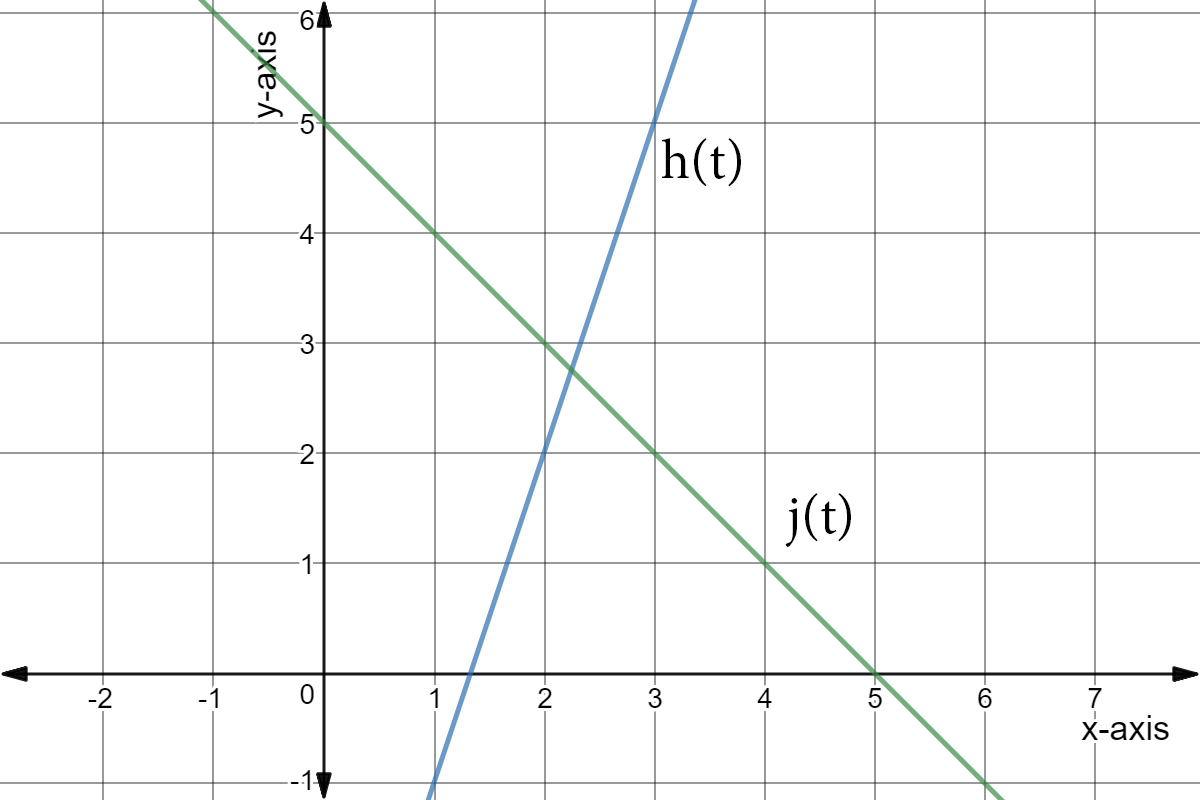
Find the intersection of the lines h(t)=3t−4h(t)=3t-4 and j(t)=5−tj(t)=5-t.

Setting h(t)=j(t)h(t)=j(t), 3t−4=5−t4t=9t=94\begin{align} 3t-4&=5-t\\ 4t&=9\\ t&=\frac94 \end{align} This tells us the lines intersect when the input is 94\frac94.

We can then find the output value of the intersection point by evaluating either function at this input j(94)=5−94=114j\left(\frac94\right)=5-\frac94=\frac{11}4

These lines intersect at the point (94,114)(\frac94,\frac{11}4). Looking at the graph, this result seems reasonable.

h(t) through (1,-1) and (2,2)
j(t) through (1,4) and (3,2)

Graph courtesy of Desmos

Two parallel lines can also intersect if they happen to be the same line. In that case, they intersect at every point on the lines. Example 14

Using the functions from the previous example, for what values of tt is h(t)>j(t)?h(t)>j(t)?

To answer this question, it is helpful first to know where the functions are equal, since that is the point where h(t)h(t) could switch from being greater or smaller than j(t)j(t) or vice-versa. From the previous example, we know the functions are equal at t=94t=\frac94.

By examining the graph, we can see that h(t)h(t), the function with positive slope, is going to be larger than the other function to the right of the intersection. So h(t)>j(t)h(t)>j(t) when t>94t>\frac94

Continue to Section 2.3→\rightarrow

From Precalculus: An Investigation of Functions by David Lippman and Melonie Rasmussen

Type a concept, like “slope” or “photosynthesis”.

↑ ↓ to choose · Enter to openSearch explanations and problems