Types of Error — Overview & Comparison

Illustrated · 2 min

Types of Error

  • Errors are common occurrences in chemistry and there are three specific types of errors that may occur during experiments.
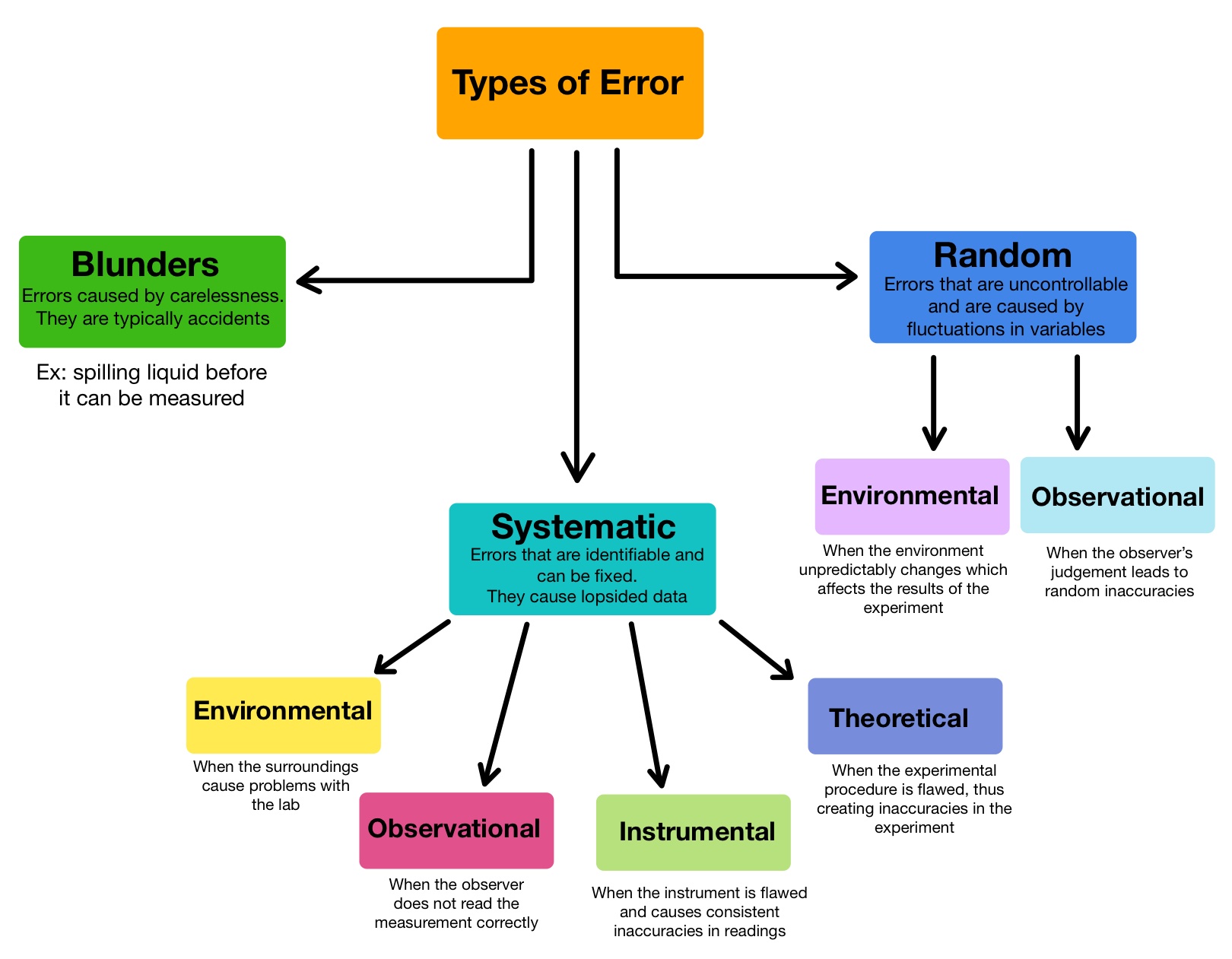
Flow chart to help distinguish the different types of error that can occur during an experiment

Image source: Caroline Monahan

Systematic Errors:

Systematic errors are errors that have a clear cause and can be eliminated for future experiments

There are four different types of systematic errors:

  1. Instrumental: When the instrument being used does not function properly causing error in the experiment (such as a scale that reads 2g more than the actual weight of the object, causing the measured values to read too high consistently)

  2. Environmental: When the surrounding environment (such as a lab) causes errors in the experiment (the scientist cell phone's RF waves cause the geiger counters to incorrectly display the radiation)

  3. Observational: When the scientist inaccurately reads a measurement wrong (such as when not standing straight-on when reading the volume of a flask causing the volume to be incorrectly measured)

  4. Theoretical: When the model system being used causes the results to be inaccurate (such as being told that humidity does not affect the results of an experiment when it actually does)
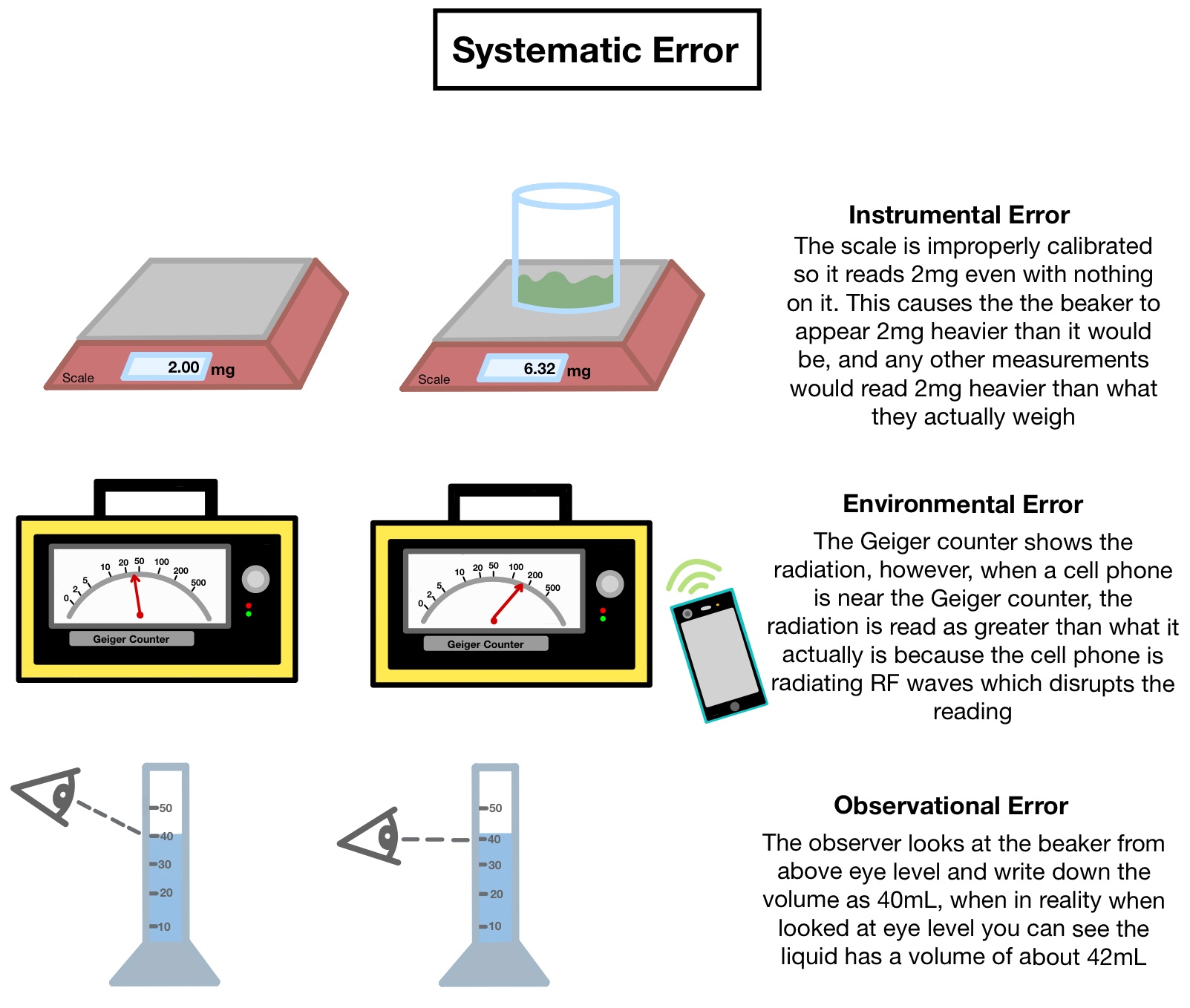
Image showing visuals of types of systemic errors (specifically observational, environmental, and instrumental)

Image source: Caroline Monahan

Random Errors:

Random errors occur randomly, and sometimes have no source/cause

There are two types of random errors

  1. Observational: When the observer makes consistent observational mistakes (such not reading the scale correctly and writing down values that are constantly too low or too high)

  2. Environmental: When unpredictable changes occur in the environment of the experiment (such as students repeatedly opening and closing the door when the pressure is being measured, causing fluctuations in the reading)
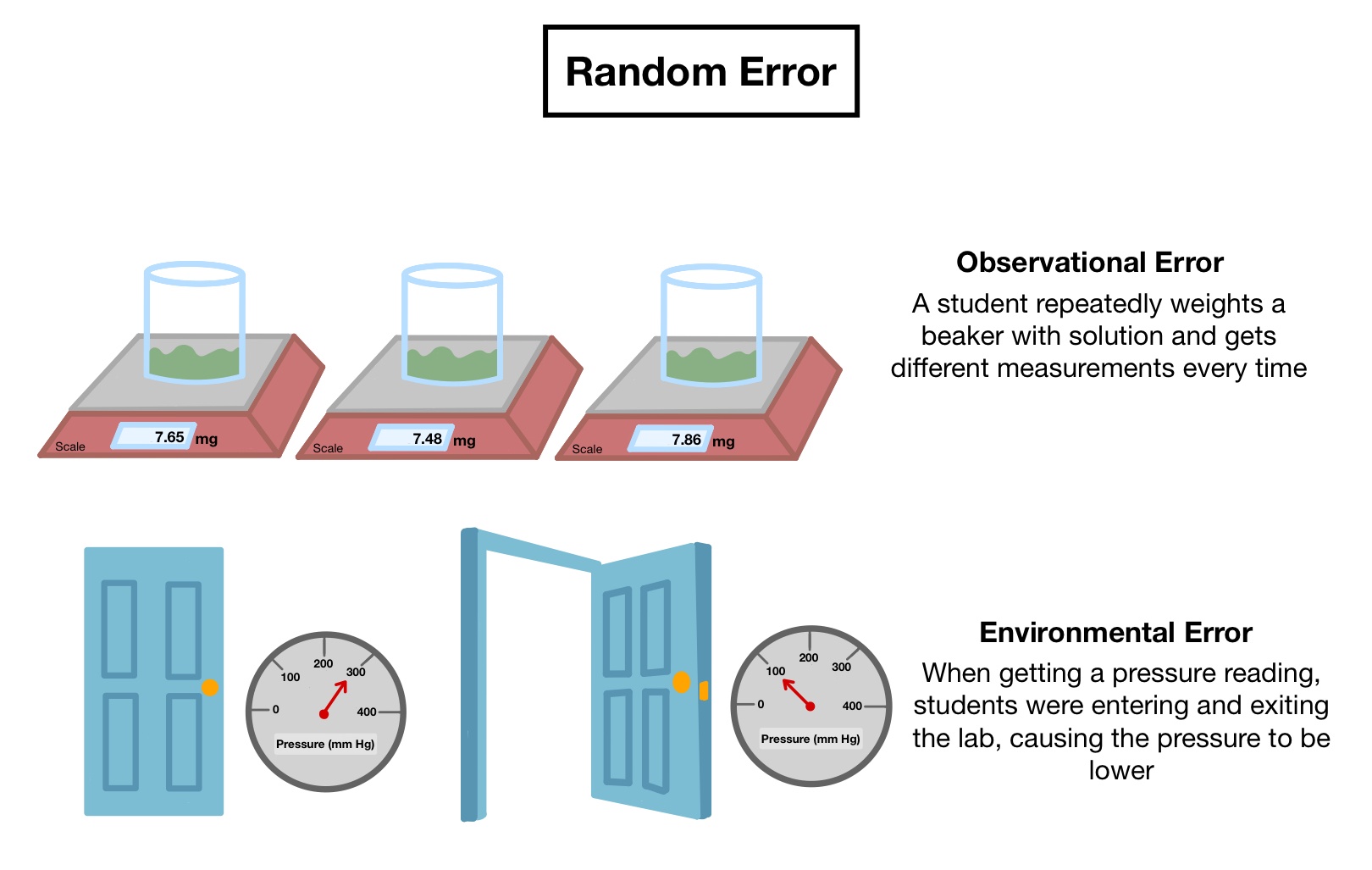
Image showing visualizations of the different types of random errors (observational, environmental)

Image source: Caroline Monahan

Systematic vs. Random Errors

  • Systematic errors and random errors are sometimes similar, so here is a way to distinguish between them:

Systematic Errors are errors that occur in the same direction consistently, meaning that if the scale was off by and extra 3lbs, then every measurement for that experiment would contain an extra 3 lbs. This error is identifiable and, once identified, they can be eliminated for future experiments

Random Errors are errors that can occur in any direction and are not consistent, thus they are hard to identify and thus the error is harder to fix for future experiments. An observer might make a mistake when measuring and record a value that's too low, but because no one else was there when it was measured, the mistake went on unnoticed.

Blunders:

Blunders are simply a clear mistake that causes an error in the experiment

Example: such as dropping a beaker with the solution before measuring the final mass
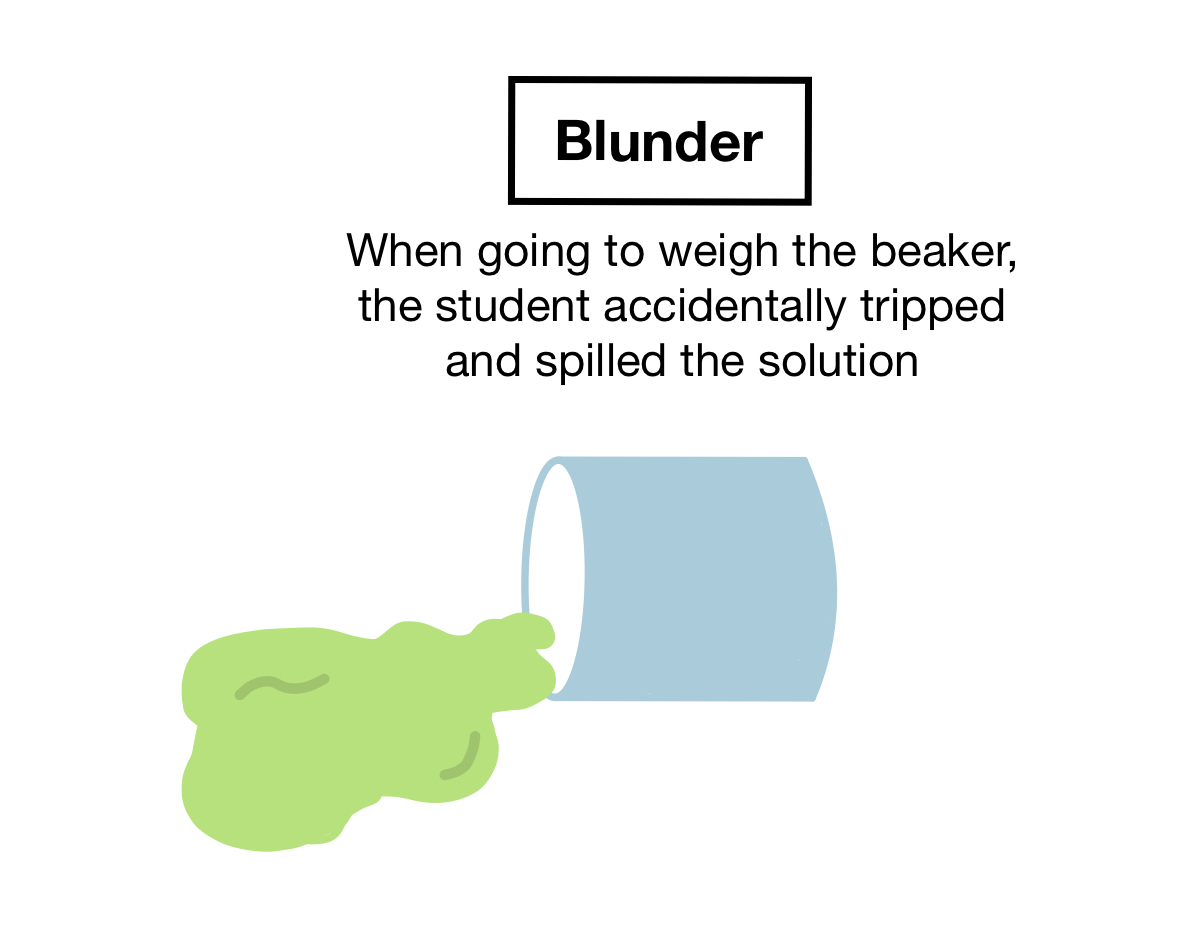
Image showing an example of a blunder (spilling liquid before weighing)

Image source: Caroline Monahan

Read · 2 min

Whenever we do an experiment, we have to consider errors in our measurements. Errors are the difference between the true measurement and what we measured. We show our error by writing our measurement with an uncertainty. There are three types of errors: systematic, random, and human error.

Systematic Error

Systematic errors come from identifiable sources. The results caused by systematic errors will always be either too high or too low. For example, an uncalibrated scale might always read the mass of an object as 0.5g too high. Because systematic errors are consistent, you can often fix them. There are four types of systematic error: observational, instrumental, environmental, and theoretical.

  • Observational errors occur when you make an incorrect observation. For example, you might misread an instrument.

  • Instrumental errors happen when an instrument gives the wrong reading. Most often, you can fix instrumental errors by recalibrating the instrument.

  • Environmental errors are a result of the laboratory environment. For example, when I was in college, our chemistry lab had one scale that was under a vent. Every time the vent was blowing the scale would read too high. We all learned to avoid that scale.

  • Theoretical errors arise because of the experimental procedure or assumptions. For example, we assume that air pressure does not affect our results but it does.

Random Error

Random errors are the result of unpredictable changes. Unlike systematic errors, random errors will cause varying results. One moment a reading might be too high and the next moment the reading is too low. You can account for random errors by repeating your measurements. Taking repeated measurements allows you to use statistics to calculate the random error. There are two types of random error: observational and environmental.

  • Random observational errors are not predictable. They fluctuate between being too high or too low. An example would be an instrument's reading fluctuating. If you were to take the mid-point of the fluctuations, you may be too high on one measurement but too low on the next.

  • Environmental errors are caused by the laboratory environment. An example might be a malfunctioning instrument. In my freshman chemistry lab, I had a pH meter that would not stay calibrated. After five minutes the pH values would fluctuate unpredictably.

Human Error

Human errors are a nice way of saying carelessness. For example, a scale might read 21g but, you write down 12g. You want to avoid human errors because they are your fault. Most teachers have no sympathy for carelessness.

Video

(Video) Type I error vs Type II error

By: 365 Data Science

When a hypothesis is tested, errors can occur called type I and type II errors. A type I hypothesis involves rejecting the true null hypothesis or gives a false positive. Type II occurs when a false null hypothesis is accepted or gives a false negative. The type II error is a less serious error since it can happen with hard to test data.

An example is given with you liking another person. The hypothesis is that that person likes you back. Type I error occurs if you do not ask out the other person and assume they don't like you. Type II error occurs when you ask out the other person, but they reject you.

A chart is used to summarize the types of error.

Type a concept, like “slope” or “photosynthesis”.

↑ ↓ to choose · Enter to openSearch explanations and problems