Read · 3 min

+1 contributors

Sample Estimates
Statistics revolves around finding trends in very large populations. For instance, you could be trying to find spending patterns for all males ages in America. This is a huge number of people that you would need to study, so it just isn't feasible to obtain all of their spending habits. We would need to break the population of year old males into smaller samples in order to estimate the true average in the population, hence the name sample estimate.
Not any sample will do. A sample taken from a population has to accurately reflect the larger population, but this doesn't just happen by chance. There are steps that can be taken to ensure a good sample.
Sampling Techniques
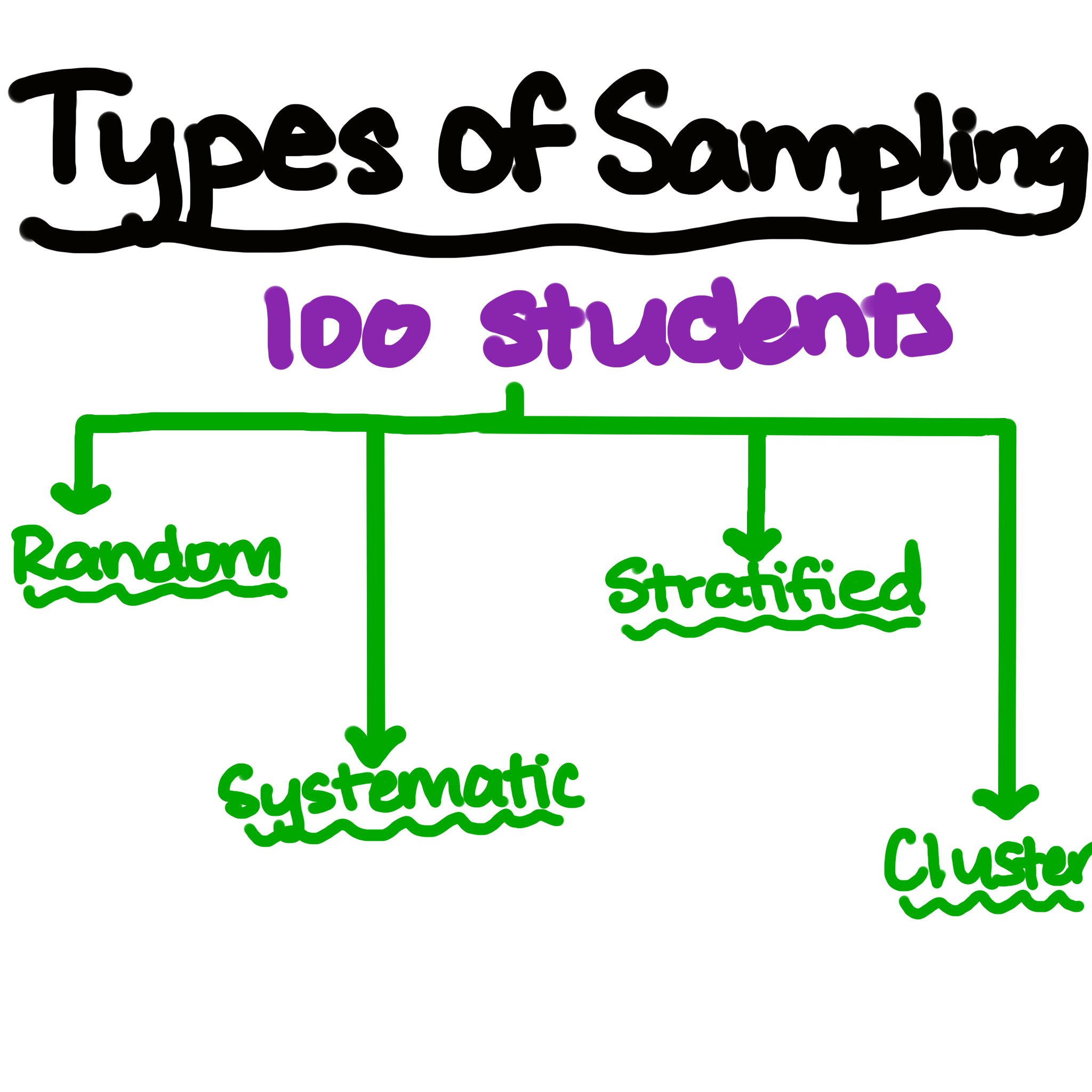
Here are the main types of sampling techniques that balance ease of giving the survey with the accuracy of the information received.
Simple random sampling is exactly what is sounds like. Every member of the population is given an equal chance of being selected to be surveyed. This is an easy way to sample if you can easily gather the entire population, but is hard with larger, more spread out groups. This can also lead to some inaccuracies due to location if you're using a group as large as the American young adult population. For instance, you could give every male an equal chance of being selected, but end up with most of your sample being from New York.
Systematic sampling is done by randomly selecting a starting point and moving an equal distance to each sample after the starting point. For instance, if you had a list of every member of your school, you could randomly select one person, then also select every th person after that. This is a little bit more efficient than simple random sampling by being less time consuming.
Stratified sampling is performed by splitting the population into different groups or strata before randomly sampling. For instance, we could break each person in an office into their departments before we randomly select from those sections.
Snowball sampling is a type of non-probabilistic sampling technique used when it's difficult to obtain a list of the entire population. Initial participants are selected, and then they refer the researcher to other potential participants, who in turn refer more participants, creating a "snowball" effect.
Purposive sampling is more commonly known as judgmental or selective sampling, where researchers select individuals to participate in the sample based on specific criteria relevant to the research objectives. Participants need to meet certain characteristics or experiences that are relevant to the study.
Other important terms
- Representative sample: a sample that accurately reflects the characteristics of the population from which it's drawn. Representative samples help with generalizing research findings from the sample to the larger population.
- Target population: the entire group of individuals that the researcher is interested in studying and to which they intend to generalize the findings of their research
- Sample size: the number of individuals selected for inclusion in a sample from a larger population
Goal of a Sample
We use these sampling techniques to give ourselves the best possible sample to work with. If we get a good, unbiased sample, we can assume that the data we get accurately reflects the larger population. Statistical tests, which you'll learn about in a future section, are designed to test the accuracy of our sample estimates against a possible parameter of the population.
We will use these sampling in clinical research or in market research. Sampling will become important as learn about different types of research studies: observational studies, surveys, and experiments.