Illustrated · 2 min

+2 contributors


Structure of Ice

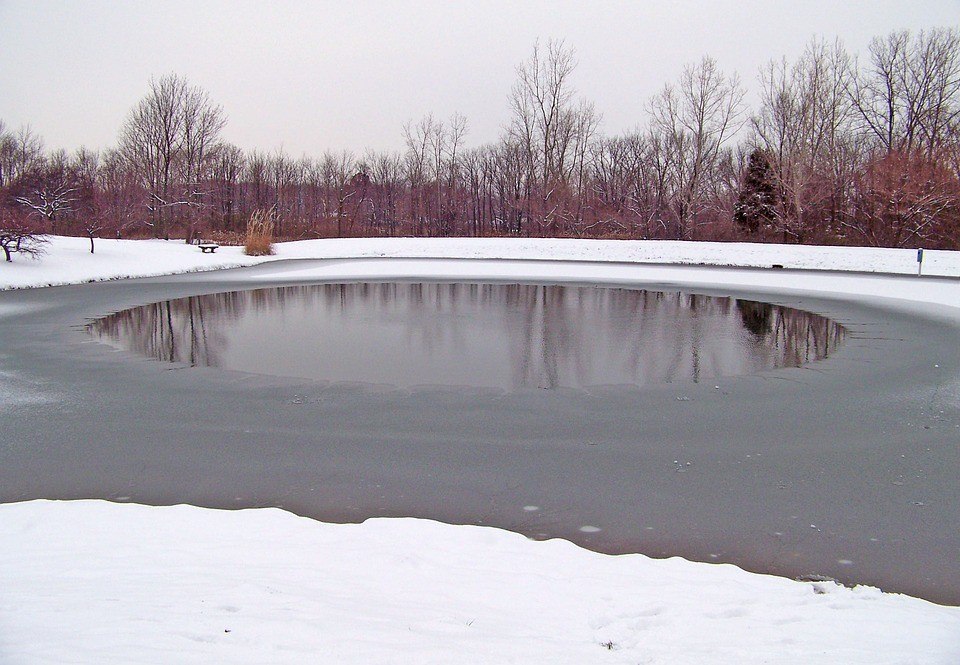
Image source: By Karrock CC BY-SA 3.0, via Wikimedia Commons
Have you ever wondered how fish and seals can stay alive underneath seemingly frozen bodies of water?
The answer lies in the unique density of ice. Density describes the mass per a certain volume of a material, and determines the ability of an object to float. As we discussed in the section on states of matter, solids are formed when strong intermolecular forces cause atoms or molecules to stick together in specific configurations, unable to move past each other or change shape.
In most cases, this involves bringing the molecules closer together than they are in the liquid form, resulting in a higher density. For example, if you put solid gold in liquid gold, the solid form sinks to the bottom.
However, because of the angular shape of water molecules, they form a unique crystal structure with a lot of space between molecules.

Liquid water (left) vs. solid water (right)
Image source: By P99am CC BY-SA 3.0, via Wikimedia Commons
This means that solid water, or ice, is actually less dense than liquid water and can float on it. Because of this, most "frozen" bodies of water are only covered by a top layer of ice, but are liquid underneath.
This unique crystal structure is also what causes snowflakes to look the way they do. Instead of simply packing together as close as physically possible, the molecules in ice have to bond at specific angles. This is because they form hydrogen bonds, or intermolecular bonds between the negative dipole on the oxygen and the positive dipole on the hydrogens. This causes each molecule in a snowflake to be set at a specific angle from the molecules it is attached to, resulting in a repeating pattern containing lots of empty space.
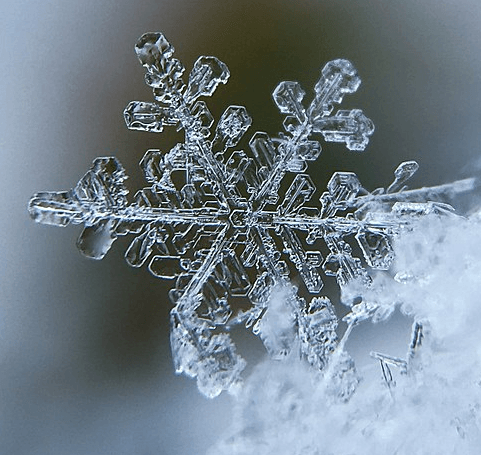
Image source: By Aaron Burden CC BY-SA 4.0, via Wikimedia Commons
As you take a walk in winter time, look closely at what you see. Everything about the ice around you, from the shape and stickiness of snowflakes to the crunchy white layers of ice on puddles that cause you to fall through and get your boots wet, can be explained by the chemical properties of water.