Unique Densities (Water) — Properties & Examples

Before this, knowWhy Does Water Support Life? — Overview & Examples

Illustrated · 2 min

Structure of Ice

A man catches a fish through a hole in a frozen lake.

Image source: By Karrock CC BY-SA 3.0, via Wikimedia Commons

Have you ever wondered how fish and seals can stay alive underneath seemingly frozen bodies of water?

The answer lies in the unique density of ice. Density describes the mass per a certain volume of a material, and determines the ability of an object to float. As we discussed in the section on states of matter, solids are formed when strong intermolecular forces cause atoms or molecules to stick together in specific configurations, unable to move past each other or change shape.

In most cases, this involves bringing the molecules closer together than they are in the liquid form, resulting in a higher density. For example, if you put solid gold in liquid gold, the solid form sinks to the bottom.

However, because of the angular shape of water molecules, they form a unique crystal structure with a lot of space between molecules.

When water is in its liquid form, the molecules are close together. In solid water, the molecules are orderly and evenly spaced.

Liquid water (left) vs. solid water (right)

Image source: By P99am CC BY-SA 3.0, via Wikimedia Commons

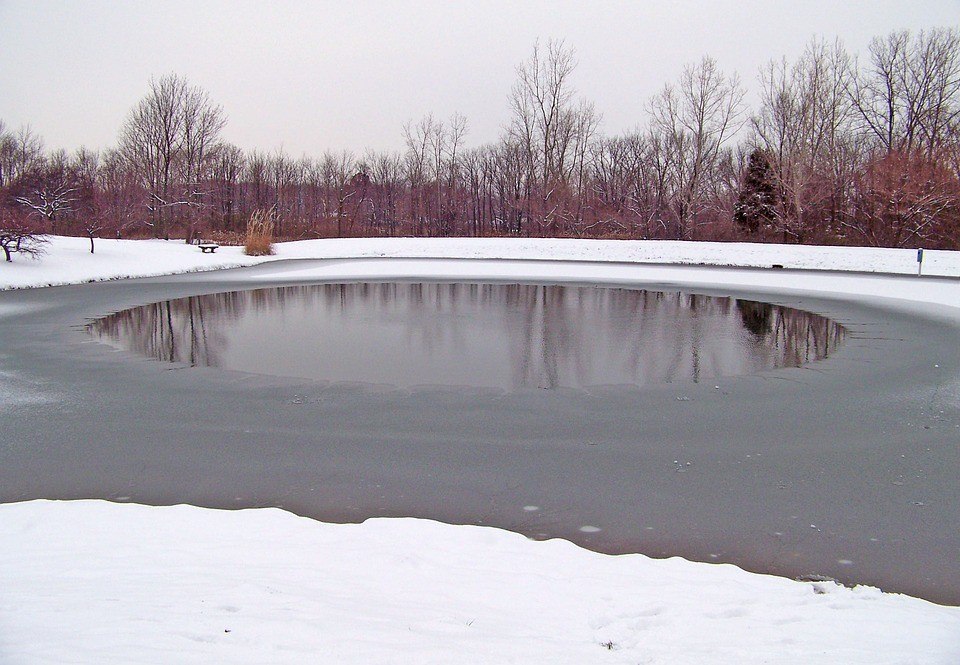
This means that solid water, or ice, is actually less dense than liquid water and can float on it. Because of this, most "frozen" bodies of water are only covered by a top layer of ice, but are liquid underneath.

This unique crystal structure is also what causes snowflakes to look the way they do. Instead of simply packing together as close as physically possible, the molecules in ice have to bond at specific angles. This is because they form hydrogen bonds, or intermolecular bonds between the negative dipole on the oxygen and the positive dipole on the hydrogens. This causes each molecule in a snowflake to be set at a specific angle from the molecules it is attached to, resulting in a repeating pattern containing lots of empty space.
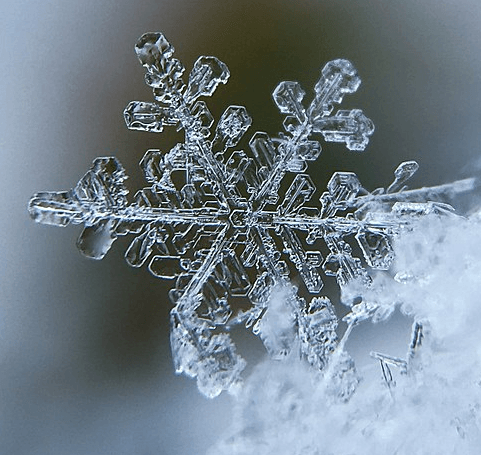
Close-up photograph of a snowflake

Image source: By Aaron Burden CC BY-SA 4.0, via Wikimedia Commons

As you take a walk in winter time, look closely at what you see. Everything about the ice around you, from the shape and stickiness of snowflakes to the crunchy white layers of ice on puddles that cause you to fall through and get your boots wet, can be explained by the chemical properties of water.

Illustrated · 1 min

Properties of water: density. Density is the mass per unit volume of a substance. The density of water changes based on the phase it's in. The density of solid water is about 0.92 grams per cubic centimeter. The molecules in ice form an ordered crystal lattice. The molecules are more spread out, 
so the density is lower than in liquid water. Liquid water has a density of about 1 gram per cubic centimeter. The molecules in liquid water constantly move past each other while forming and breaking hydrogen bonds. Water vapor has a density of about 0.0006 grams per cubic centimeter. The molecules in a gas move very fast and spread out, so the density is very low.

Image source: By Gabi Slizewska

Illustrated · 2 min

What Is Density?

Density is a measure of how closely molecules are packed together. It can be calculated by dividing a substance's mass by its volume. The unit for density is g/cm3^3, read as "grams per cubic centimeter", and pure water comes in at just under 11 g/cm3^3.

As with most substances, the density of water changes with its temperature. Density tends to increase as substances travel from their boiling point to their freezing point However, water is unusual in that it is less dense as a solid than it is as a liquid.

This means that water molecules are packed together more closely in the liquid phase than in the solid one.

Ice floats because it is less dense than liquid water.

Image source: By Scott1346 CC BY 2.0, via flickr.com

When molecules are farther apart, like they are in ice, there's more room left between them for air. So, there is more air between the water molecules in ice than there is in liquid water.

Why does all of this matter? Well, dense things sink. Because ice is less dense than liquid water, ice floats.

The ice covering a lake, for example, provides insulation for the organisms below. If ice sank, the organisms in the water would be crushed each winter. Ouch.

A partially frozen pond

Image source: By PublicDomainPictures CC0, via pixabay.com

Vocabulary Review:\color{#8925AE}{\text{Vocabulary Review:}}

Polarity\color{#8925AE}{\text{Polarity}} : Partial positive and negative charges caused by some atoms wanting electrons more than other atoms in a molecule

Hydrogen Bond\color{#8925AE}{\text{Hydrogen Bond}} : Positively charged hydrogens of one molecule are attracted to the negative charge on another molecule

Cohesion\color{#8925AE}{\text{Cohesion}} : The intermolecular (between-molecules) attraction between molecules of the same type

Adhesion\color{#8925AE}{\text{Adhesion}} : The intermolecular attraction between different types of molecules

Density\color{#8925AE}{\text{Density}} : Water's liquid state is much denser than its solid state, causing ice to float on top of water. Calculated by dividing an object's mass by its volume

Specific Heat\color{#8925AE}{\text{Specific Heat}} : The amount of heat energy needed to increase the temperature of a specific amount of a substance to a specific temperature. The lower the specific heat, the easier it is to heat a substance up

Solvent\color{#8925AE}{\text{Solvent}} : Water is a universal solvent. Polar molecules dissolve very quickly in it

Video

(Video) Water - Liquid Awesome

by CrashCourse

Water has many unique properties that allow it to sustain life. This particular clip talks about how ice is less dense than liquid water.

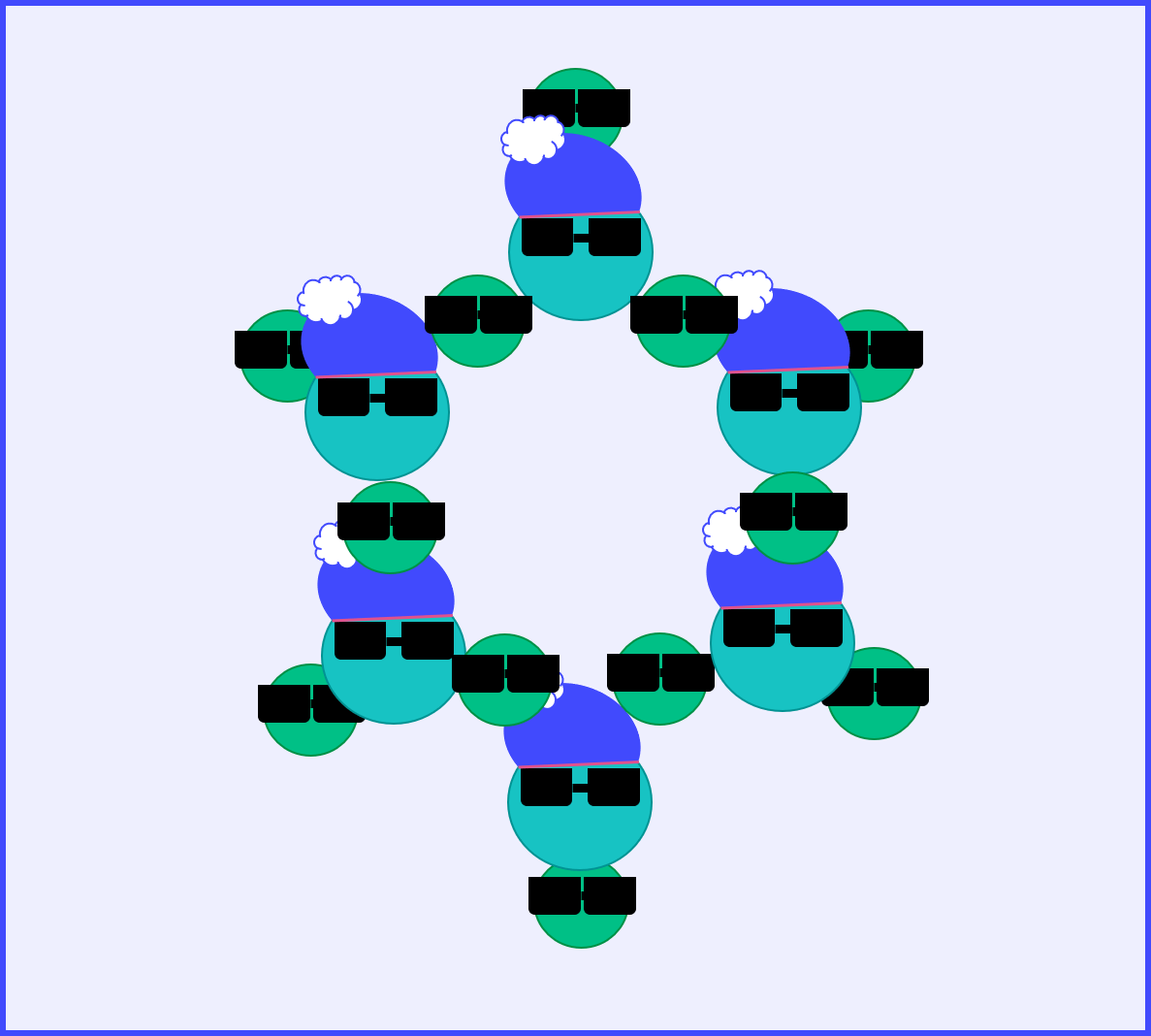
When water freezes at 0°C (read "degrees Celsius") or 32°F ("degrees Fahrenheit"), hydrogen bonds cause the molecules to spread out, creating ice crystals like in the image below.

Water molecules arranging to form a crystalline structure.

Image source: By Valeri Natole

Type a concept, like “slope” or “photosynthesis”.

↑ ↓ to choose · Enter to openSearch explanations and problems