Illustrated · 1 min
Unit Cells, Packing, And Coordination Number In Crystal Structures
In crystalline solids, molecules, atoms, and ions form crystal lattices. A lattice is made of repeating segments. An individual segment is called a unit cell. It's the simplest representation of the lattice structure.

Each component of the system has a coordination number. That's the number of neighboring atoms. The patterns in crystal structures are referred to as packing. In crystals, the packing is arranged in three dimensions with various geometries. The unit cells show the simplest geometry and symmetry within the entire crystal.
Types Of Cubic Unit Cells
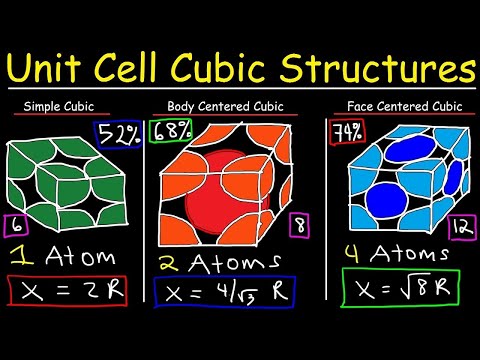
Cubic unit cells are cells with all edges equal in length and all angles of 90 degrees. There are three types of cubic unit cells:
-
Simple-cubic
-
Body-centered
-
Face-centered

There are three types of unit cells. Simple-cubic is a cube with an atom at each vertices, one eighth of each atom is inside the cube, but together each part makes one atoms. Body centered is like simple-cubic, but it has an atom in the center of the cube. One eighth of each atom plus the center atom makes two atoms in the unit cell. Face-centered is like the simple-cubic, but also has an atom on each face of the cube. There are four atoms in this type of unit cell. One comes from the atoms at each vertices and then half of six atoms gives the other three atoms.
Image source: By Cassie Gates