Unit Cell — Overview & Examples

Before this, knowCrystal Lattice — Structure & Formation

Illustrated · 1 min

Unit Cells, Packing, And Coordination Number In Crystal Structures

In crystalline solids, molecules, atoms, and ions form crystal lattices. A lattice is made of repeating segments. An individual segment is called a unit cell. It's the simplest representation of the lattice structure.

A pattern of repeating smiley faces represents the lattice structure of crystals. A single smiley face represents the unit cell or the simplest part of the repeating patterns. 
===
Image Source: By Cassie Gates

Each component of the system has a coordination number. That's the number of neighboring atoms. The patterns in crystal structures are referred to as packing. In crystals, the packing is arranged in three dimensions with various geometries. The unit cells show the simplest geometry and symmetry within the entire crystal.

Types Of Cubic Unit Cells

Cubic unit cells are cells with all edges equal in length and all angles of 90 degrees. There are three types of cubic unit cells:

  • Simple-cubic

  • Body-centered

  • Face-centered

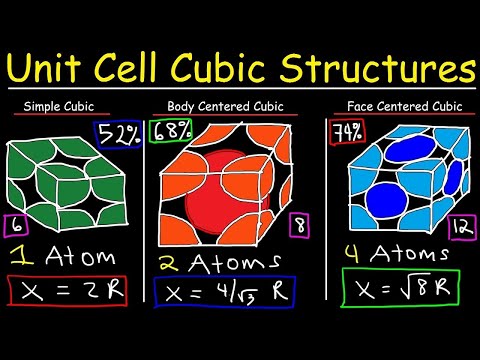
There are three types of unit cells. Simple-cubic is a cube with an atom at each vertices, one eighth of each atom is inside the cube, but together each part makes one atoms. Body centered is like simple-cubic, but it has an atom in the center of the cube. One eighth of each atom plus the center atom makes two atoms in the unit cell. Face-centered is like the simple-cubic, but also has an atom on each face of the cube. There are four atoms in this type of unit cell. One comes from the atoms at each vertices and then half of six atoms gives the other three atoms.

There are three types of unit cells. Simple-cubic is a cube with an atom at each vertices, one eighth of each atom is inside the cube, but together each part makes one atoms. Body centered is like simple-cubic, but it has an atom in the center of the cube. One eighth of each atom plus the center atom makes two atoms in the unit cell. Face-centered is like the simple-cubic, but also has an atom on each face of the cube. There are four atoms in this type of unit cell. One comes from the atoms at each vertices and then half of six atoms gives the other three atoms.

Image source: By Cassie Gates

Illustrated · 1 min

Unit Cells

A unit cell is the smallest component of a crystal that maintains the same overall shape and composition. A unit cell should be able to translate its length in 3 different directions, and perfectly overlap with the adjacent unit cell. In the example of sodium chloride (NaClNaCl), the unit cell is composed of 4 sodium ions (Na+Na^{+}) and 4 chloride ions (Cl−Cl^{-}). A depiction of the unit cell is shown below.

A depiction of the unit cell of NaCl

Image by: Jasper Brown

You may look at this and think that there are way more than 4 of each atom. We only want to count atoms that are within the cube. Since atoms on faces are half inside, and half outside the unit cell, they count as 12\frac{1}{2}

An atom split in half

Image by: Jasper Brown

Likewise, an atom on the edge is cut in half twice by two perpendicular planes, so only a 14\frac{1}{4} of it is within the unit cell.

An atom cut by 2 perpendicular planes.

Image by: Jasper Brown

Since an atom on a corner is cut by 3 mutually perpendicular planes, only 18\frac{1}{8} of the atom is within the unit cell. If we count the atoms in this way we find that there are 4 of each, resulting in an overall ratio of 1 to 1.

Every ionic compound has a unique unit cell. In every case, the unit cell has the same ratio of ions as the overall compound. For example, the unit cell of CaF2CaF_{2} has 2 fluorine atoms per calcium atom. The structure of the unit cell gives the structure of the crystal overall since the crystal is just composed of translated unit cells.

Video

(Video) Unit Cell Chemistry Simple Cubic, Body Centered Cubic, Face Centered Cubic Crystal Lattice Structure

by The Organic Chemistry tutor

In this video, The Organic Chemistry Tutor explains unit cells. He starts with an outline of the three foundational unit cells. The overview includes the number of atoms, coordination number, and percent volume. He also relates the atomic radii to the edge length. After the overview, he shows you how to calculate the percent volumes for each unit cell. If you need a better understanding of unit cells, this video can help!

Read · 1 min

A Little More Information on Unit Cells

Who cares about unit cells?

For the most part, inorganic and environmental chemists deal with unit cells. Inorganic chemistry is a broad field that studies non-carbon compounds. So, they work with a diverse array of metal and nonmetal elements. The arrangement of materials has applications for catalysis, semiconductor design, and battery construction. Environmental chemists use unit cells to study minerals and geology. The structure of compounds affects how they react in environmental systems.

What solids have unit cells?

Ionic, metallic, and atomic compounds have unit cells. Amorphous solids don't have a consistent arrangement of particles. That's also why they have more diverse chemical and physical properties. For example, they don't have a specific melting temperature. Instead, they have a melting range. Covalent networks have a traditional VSEPR geometry that repeats. So, they don't have a unit cell in the same sense as other crystalline solids.

Are there other shapes besides cubic?

There are seven different crystal geometries. Instead of geometry, inorganic chemists use the fancy term crystal systems. The cubic system is the most basic and easiest to visualize. The symmetrical systems are cubic, hexagonal, tetragonal, and orthorhombic. The asymmetrical systems are triclinic and monoclinic. If you take inorganic chemistry, you'll have to learn a whole new geometry system!

Type a concept, like “slope” or “photosynthesis”.

↑ ↓ to choose · Enter to openSearch explanations and problems