Read · 2 min

Back in Algebra 1, we learned about the quadratic formula. We used it to solve quadratic equations.
At first, we only used the formula to find real roots, which are real numbers. Now we are going to learn something new.
We will use the quadratic formula to find complex roots. These solutions go beyond real numbers and help us solve more types of equations.
The Quadratic Formula
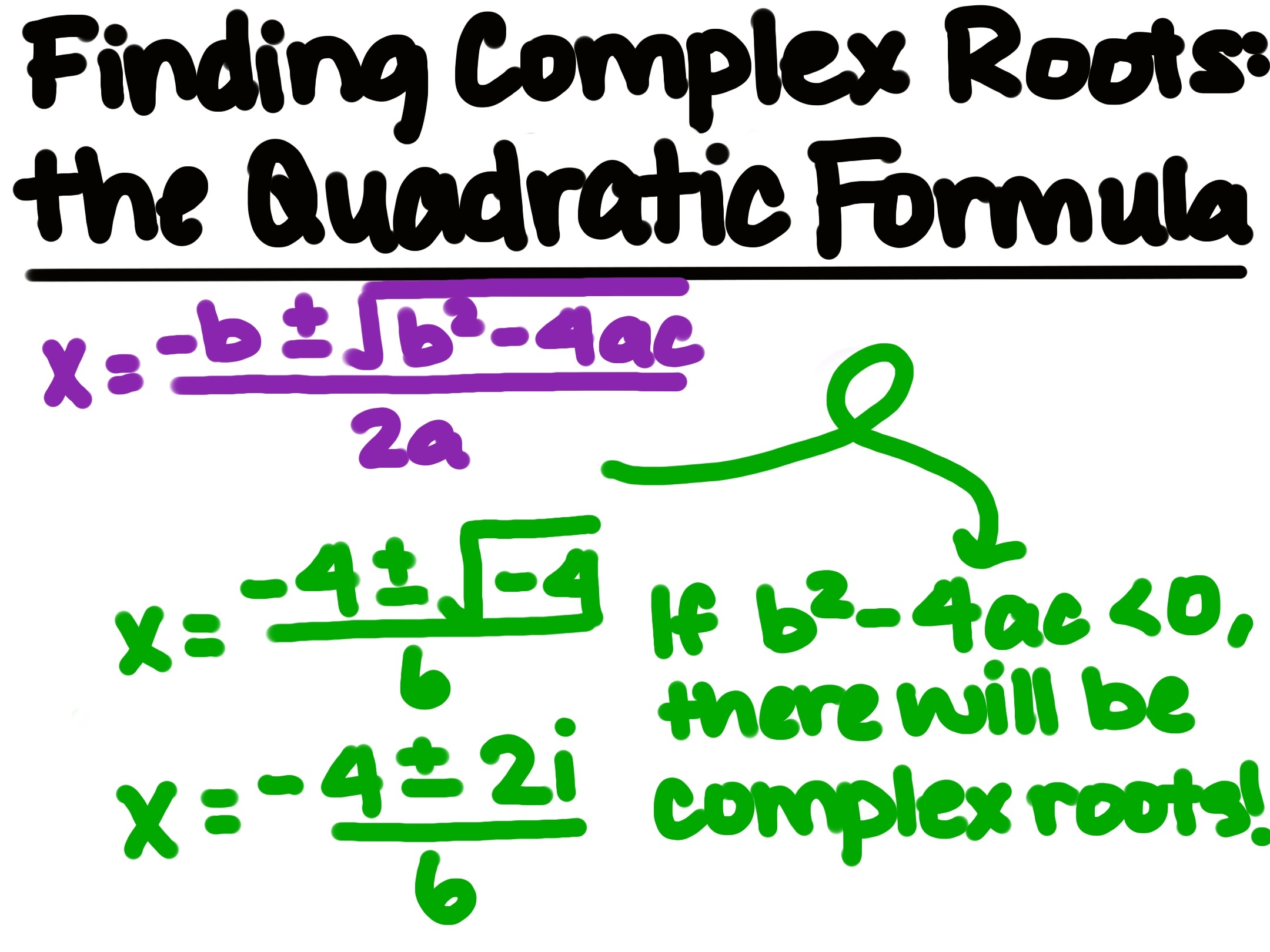
The quadratic formula is:
for quadratic equations in standard form, . When the radicand of the square root is a positive integer, this formula makes perfect sense! We get two real roots. Now, think about what happens when the radicand is a negative number. We get complex roots!
Finding Complex Roots Using the Quadratic Formula
Quadratic equations have complex roots when the graph does not cross the -axis. By looking at the graph, we can often tell whether a quadratic has real or complex roots.
In an earlier lesson, we learned how to use the discriminant to figure this out. The discriminant helps us know how many solutions a quadratic equation has.
-
If the discriminant is positive, there are two real solutions.
-
If the discriminant is zero, there is one real solution.
-
If the discriminant is negative, there are two complex (imaginary) solutions.
Using the discriminant gives us a quick way to understand the solutions, even before solving the equation.
Algebraically, we can solve the quadratic equation using the quadratic formula.
Let's look at an example.
Say we are trying to solve the quadratic equation, . We know that , , and . Let's plug in these values into the quadratic formula.
Obviously, we cannot find a real solution to , but we can find a complex solution!
Thus, our two solutions are: and .
Let's think about what we did. We used the quadratic formula to find the two complex roots to this quadratic equation!
Going Backward
As you practice more of these problems, you’ll notice a pattern. Complex roots always come in pairs called complex conjugates.
Complex conjugates look almost the same, except the sign in front of the is different. They work as a team.
When you multiply these two factors together, the terms cancel out. This brings you back to the original equation.
This is why complex roots always appear in pairs.