
Illustrated · 1 min

In the previous lesson on trigonometric functions, we used the unit circle to find sine, cosine, and tangent. In this lesson, we will use the unit circle find the reciprocal trig functions, cosecant, secant, and cotangent.
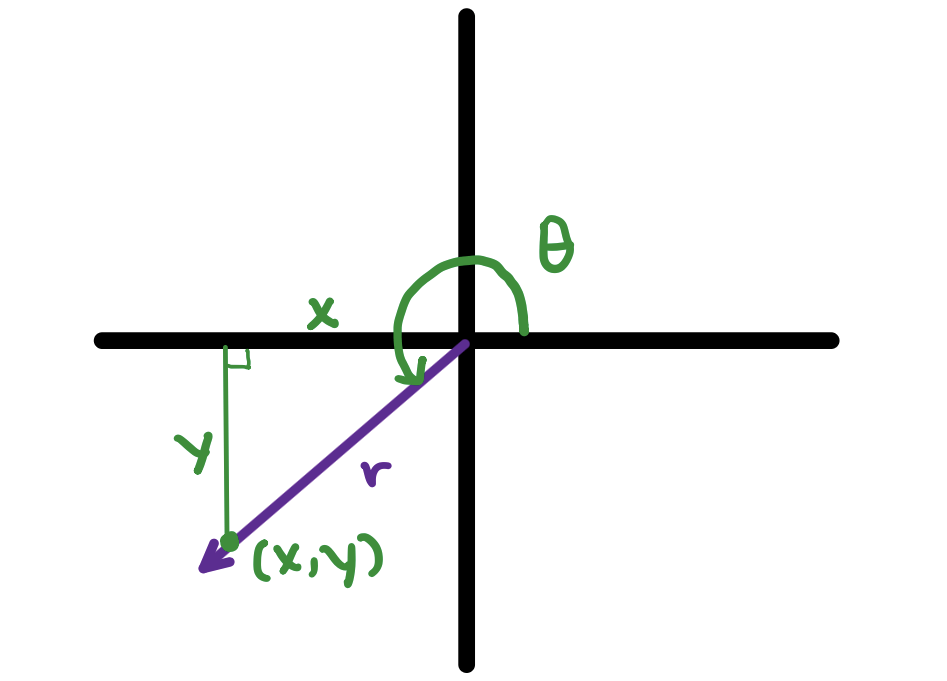
Coordinate plane, angle theta, length r

Image source: by Anusha Rahman

You may recognize the above image as being similar to one you saw when originally learning trigonometric ratios. In the above image, theta is the reference angle. (x,y)(x,y) represents the coordinate of the point. Recognize that this lesson takes place in the third quadrant! The second or fourth quadrants would not make sense (hint: 180o180^o).

From the reciprocal trig values we learned earlier, we can remember that:

sec⁡θ=rx\sec \theta = \frac{r}{x} csc⁡θ=ry\csc \theta = \frac{r}{y} cot⁡θ=xy\cot \theta = \frac{x}{y}

These are the inverse, or reciprocal, values of sine, cosine, and tangent. We've basically flipped the xx and yy values!

Video

(Video) Reciprocal Trig Functions and the Unit Circle

by James Buzzard

In this video by James Buzzard, you can see a couple of examples of the unit circle & reciprocal trig functions.

Summary

We can write the following:

csc⁡θ=1sin⁡θ=1y\csc {\theta} = \frac{1}{\sin{\theta}} = \frac{1}{y} sec⁡θ=1cos⁡θ=1x\sec {\theta} = \frac{1}{\cos{\theta}} = \frac{1}{x} cot⁡θ=1tan⁡θ=xy\cot {\theta} = \frac{1}{\tan{\theta}} = \frac{x}{y}

Using this basic foundation, you can use the unit circle to find the exact values.

Read · 1 min

Using the Unit Circle to Find Reciprocal Trig Functions

In this lesson, we will learn how to use the unit circle to find reciprocal trig functions. These functions are the flipped versions of the same trig functions you already know: sine, cosine, and tangent.

We know how to use the unit circle to find the values of sine, cosine, and tangent. The radius of the unit circle is 11 and shows the coordinates (cos θ,sin θ\text{cos }\theta, \text{sin }\theta) at different angles.

Let's say we want to find csc(30∘)\text{csc}(30^{\circ}). On the unit circle, sin(30∘)=12\text{sin}(30^{\circ}) = \frac12.

Since we know that csc(30∘)=1sin(30∘)\text{csc}(30^{\circ}) = \frac{1}{\text{sin}(30^{\circ})}, we can flip 12\frac12. That tells us that csc(30∘)=2\text{csc}(30^{\circ})=2.

We can use this same pattern for secant-cosine and cotangent-tangent.

But be careful - if sin(θ)\text{sin}(\theta) or cos(θ)\text{cos}(\theta) is 00, then the reciprocal trig function will be undefined because you can't divide by zero.

Type a concept, like “slope” or “photosynthesis”.

↑ ↓ to choose · Enter to openSearch explanations and problems