Interactive · 3 questions

+1 contributors

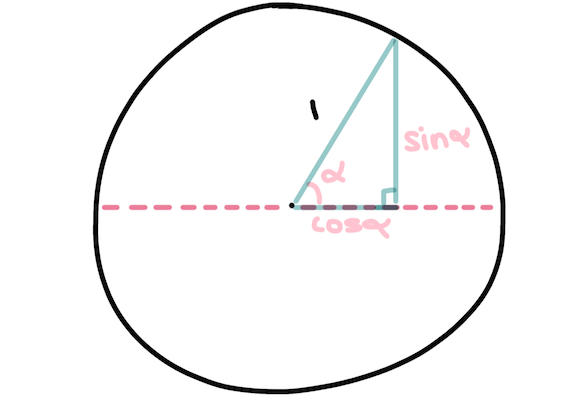
Consider the following diagram:

Image source: by Ruiran Xun
Here, we can see that having picked the point in the first quadrant of the plane, the line from the origin to forms a hypotenuse of a right triangle. This line has length .
The length of the adjacent is just the distance of the right angle from the origin, so its value is just . Similarly, the length of the opposite is .
Therefore, from our definitions of sine and cosine, and also
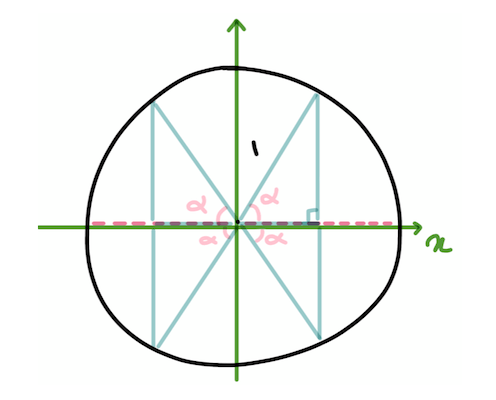
Now, consider the following diagram. In this one, .

Image source: by Ruiran Xun
It turns out that now the value of the coordinate on the circle is just !
Recall that in our first graph, and . When , and . Therefore, the coordinate is just and the coordinate .
Given any unit circle and an angle , you can just draw that angle in. At the point where the angle meets the unit circle, the values of cosine and sine can be read straight from the and coordinates!
Thinking about sines and cosines in a visual manner like this can make your life much easier, especially when you're dealing with special angles like , , , etc. This is because the only possible values for sines and cosines of these special angles are , , and .
As an example, if you picture the angle , the point on the unit circle would be further up than it is to the right, so and .
Now for a few practice questions, and we're done!
What is the value of ?
What is the value of ?
What is the value of ?