Van der Waals Forces — Overview & Role in Biology

Illustrated · 1 min

Spontaneous Forces

Van der Waals force is an intermolecular force that exists between all molecules, regardless of if they are polar or nonpolar. They are weak compared to the other intermolecular forces and act on neutral atoms and molecules. Basically, they are the attractive forces that hold molecules near each other.
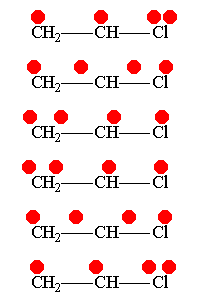
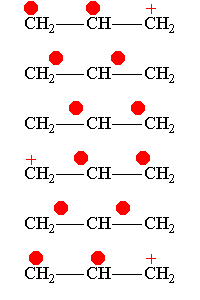
Molecules shifting closer to each other

Image sources: By Кравцов О.Н. [Public domain], via Wikimedia Commons [1] [2]

Electrons are shared between the atoms in a molecule, but sometimes they spontaneously align in such a way to create partial charges, also known as temporary dipoles, on the molecule.

Van der Waals forces are caused by polarization of molecules near each other. This means that when molecules are near each other, a small positive and negative charge will form on each molecule. In other words, it causes a dipole to appear, kind of like the dipoles in polar bonds.

The key to these forces is that they happen spontaneously. So at any moment, regardless of the types of molecules, dipoles can appear and disappear.

Closeup of a gecko's feet

Van der Waals forces help geckos stick to surfaces.

Image source: By Matteo Gabaglio CC BY-SA 3.0, via Wikimedia Commons

These forces are the glue that holds molecules near each other.

Vocabulary Review:\color{#8925AE}{\text{Vocabulary Review:}}

Polarity\color{#8925AE}{\text{Polarity}} : Partial positive and negative charges caused by some atoms wanting electrons more than other atoms in a molecule. Polar molecules have permanent dipole-dipole interactions

Covalent Bond\color{#8925AE}{\text{Covalent Bond}} : A bond formed when two atoms share an electron pair

Ionic Bond\color{#8925AE}{\text{Ionic Bond}} : A bond formed when one atom gives up one or more electrons from a different atom

Hydrogen Bond\color{#8925AE}{\text{Hydrogen Bond}} : Positively charged hydrogens of one molecule are attracted to the negative charge on another molecule

Electronegativity\color{#8925AE}{\text{Electronegativity}} : A way to measure the tendency of an atom to attract pairs of electrons

Van der Waals Forces\color{#8925AE}{\text{Van der Waals Forces}} : A relatively weak intermolecular force that holds molecules together

Video

(Video) How Do Geckos Defy Gravity?

by Eleanor Nelsen on TED-Ed

This video by Ted-Ed explains how geckos use van der Waals forces to help their toes stick to surfaces.

Illustrated · 2 min

Weak Intermolecular Forces

Van der Waals forces can be described as weak interacting forces between atoms or molecules dependent on the distance between them. These forces can quickly disappear when molecules grow too far apart. Therefore, they only play a role in molecules which are close to one another. They can happen in both polar and nonpolar molecules.

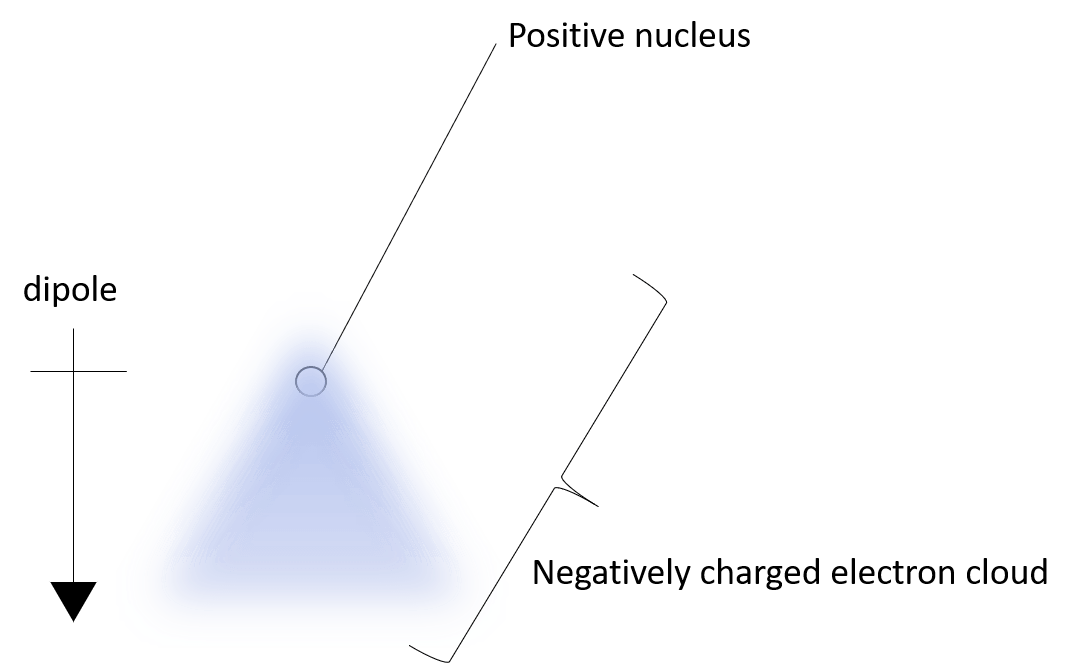
A diagram of an atom depicting the positive nucleus and negative electron cloud

Image source: By Jasper Brown

These forces can be visualized by thinking of an atom as two fluid parts. One part is the positively charged nucleus while the other is the negatively charged electrons. The electrons move around the nucleus with somewhat random movement in an area known as an electron cloud.

This random movement means that occasionally one side of the atom can suddenly become more negative than the other. This creates an instantaneous dipole. If there are any molecules or atoms nearby, this negative force has the possibility to attract the positively charged nucleus of another atom towards the negatively charged electrons. This is known as the London Dispersion Force of attraction (or London forces, named after Fritz London). The negatively charged electrons will also repel the electrons of the other molecule.

A diagram depicting a probabilistic dipole occurring in an atom

Image source: By Jasper Brown

This results in an attractive force between the two molecules. However, this interaction is only momentary. If the molecules are to suddenly move too far apart from one another, the van der Waals forces would decrease and then disappear.

This force can be observed in practically every atom and molecule because it is not based off of a molecule's or atom's chemical or electric bonds with anything else. These forces are stronger in atoms and molecules with a greater number of electrons. However, keep in mind that van der Waals forces are still the weakest of the intermolecular forces.

Review\color{#8925AE}{\text{Review}}

Intermolecular force\color{#8925AE}{\text{Intermolecular force}}: A force existing between separate molecules

Dipole\color{#8925AE}{\text{Dipole}}: A difference in electric charge between two regions

Dipole-dipole forces\color{#8925AE}{\text{Dipole-dipole forces}}: Forces that occur between molecules that are permanently polar

Transient\color{#8925AE}{\text{Transient}}: Something that is very temporary and fleeting

Van der Waals forces\color{#8925AE}{\text{Van der Waals forces}}: Weak intermolecular forces caused by transient dipoles

Type a concept, like “slope” or “photosynthesis”.

↑ ↓ to choose · Enter to openSearch explanations and problems