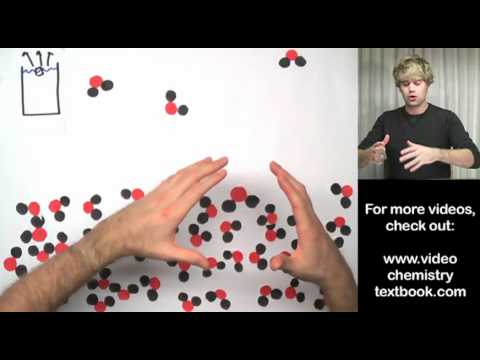
Every morning, I wake up and boil water. I'm a huge coffee snob! So, I make myself multiple pour-overs each day. But my hobby wouldn't exist without boiling water. So, our topic for this lesson is paramount to me. We're beginning to study phase changes. They occur when we move from one phase of matter to another. In our last explanation, we moved from liquid to solid. That's freezing! Today we'll talk about the phase transition from liquid to gas. It's called vaporization.
A Molecular Perspective on Vaporization
Any phase of matter is a balance between kinetic energy and Van der Waals forces. When intermolecular attraction dominates, you get a solid. The particles have a fixed arrangement. Their movement is restricted. So, they can't shift past each other. In a liquid, they balance. The intermolecular attractions keep the particles close together. But they have enough kinetic energy to slide past one another. For gases, kinetic energy dominates. The molecules completely overcome the attractive forces. So, there is empty space between particles. That's why gases fill the volume of their container and can expand or compress.
How do we transition from liquid to gas? Remember, temperature is our measurement for average kinetic energy. We need kinetic energy to overpower the intermolecular attractions. So, we need to raise the temperature. So, we add heat.
The boiling temperature depends on the strength of the intermolecular force. So, molecules that only experience dispersion forces tend to have minuscule vaporization points. A great example is carbon dioxide. We would expect the carbon-oxygen bond to be polar because of the electronegativities. But it has a linear geometry. So, the dipoles cancel. At STP, liquid carbon dioxide doesn't exist. The solid sublimes to a gas. To form liquid carbon dioxide, we pressurize it to 5.1 atmospheres! Let's compare it with water. Water experiences hydrogen bonding. Water's hydrogen bonds are more robust than carbon dioxide's dispersion forces. What's the result? Liquid water exists and vaporizes at normal atmospheric pressures and temperatures.
The Two Types of Vaporization
There are two types of vaporization: evaporation and boiling. We're familiar with both. But, each variety is a unique chemical process. So, let's explore both.
Evaporation
Evaporation only occurs on a liquid's surface. Remember, all liquids experience surface tension. The molecules on the surface get pulled down due to cohesion. But sometimes, a molecule has enough energy to escape. A subsurface molecule collides with a surface molecule. The collision disseminates energy. If enough energy gets transferred, the surface molecule overpowers the cohesive forces. The reverse can also occur. A vapor molecule collides with the surface and loses energy. What's the result? It reenters the liquid phase. That's condensation!
Evaporation transpires until we establish equilibrium. We reach equilibrium when the rates of vaporization and condensation are equal. In a closed system, it's generally a rapid process. For example, imagine you leave your half-empty water bottle outside. If you come back a couple of hours later, you'll see water droplets on the sides. Some of the water vaporized and then condensed. In an open system, we never reach equilibrium. For example, the ocean is always evaporating. The water vapor doesn't condense until it reaches the troposphere. The temperatures and pressures are much lower. So, it allows for condensation and rain.
Boiling
Boiling is a subsurface process. It occurs when vapor pressure equals or exceeds atmospheric pressure. Boiling initiates at a nucleation site. The nucleation site is typically on a surface. That's why bubbles form on the bottom of the spaghetti pot. But there can also be chemical nucleation sites. So, what happens at these nucleation sites? Within the liquid, some molecules have entered the gas phase. These molecules collect at the site and form a bubble. Eventually, the bubble rises to the surface and pops. The popped bubble releases the trapped gas. What happens if you add more heat to a boiling liquid? Vaporization is a cooling process. The highest energy molecules are leaving the liquid. So, the temperature remains constant. But the rate of boiling increases.