
Interactive · 1 question
Variable Stars
Let us start by testing your knowledge.
What are variable stars? If you've ever heard the song "Twinkle Twinkle Little Star" then you're already partially familiar with variable stars.
In case you decided not to use the hint, let me reiterate:
If you've ever heard the song "Twinkle Twinkle Little Star" then you're already partially familiar with variable stars.
The inspiration for the song is a star called Algol, found in the leg of Perseus, it was the first star ever to be classified as variable by the Egyptians about 3,000 years ago.
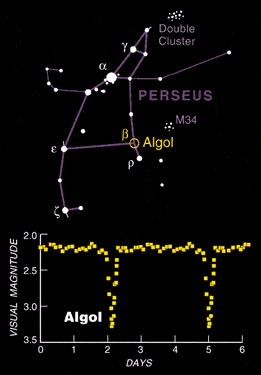
The chart above shows you Algol's dips in apparent magnitude
Types of Variable Stars
Algol is considered an extrinsic variable because it is part of a binary system of stars. These are stars that don't have changes in their luminosity, but instead in their apparent magnitude.
An intrinsic variable is a star whose luminosity is actually changing- for instance, our sun is an intrinsic variable. Its luminosity can change by around .1% over its solar cycle of 11 years, where it will transition between solar maxima and minima.
Those are the broadest classifications of variable stars, the more specific sub classifications.
One of the most notable of these is the Cepheid variables.
Cepheid Variables
Cepheid's fall under the intrinsic variable category, but if you'd like to further define them, the are pulsating variables
Why?
Because these space oddities can expand and contract, varying their radii and temperatures (the two main factors in determining a star's luminosity)
Furthermore, Cepheid variables can be considered standard Candles because there is a direct relationship between their luminosity and pulsation periods. If we recall from earlier lessons (for instance Standard Candles) then we know that by determining luminosity and apparent magnitude we can derive a stellar bodies distance from us!
Variable stars are cool to observe and helpful too!