Read · 1 min
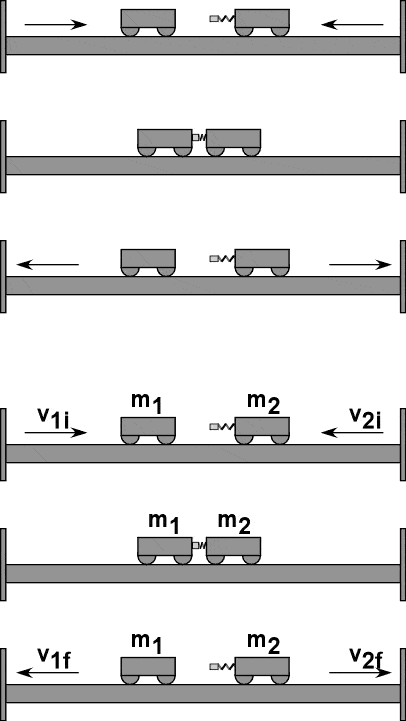
Momentum is defined as the product of an object's speed and velocity (denoted ). In an elastic collision between two (or more) objects, the total momentum of the system remains the same before and after the collision. This concept can be made more intuitive with an equation, which is written as follows:
However, if there are only two vehicles involved in the collision, this can be rewritten as
Usually either one of the velocities or the mass of one of the objects will be unknown. Henceforth problems involving collisions tend to involve some algebra.
Here is an example.
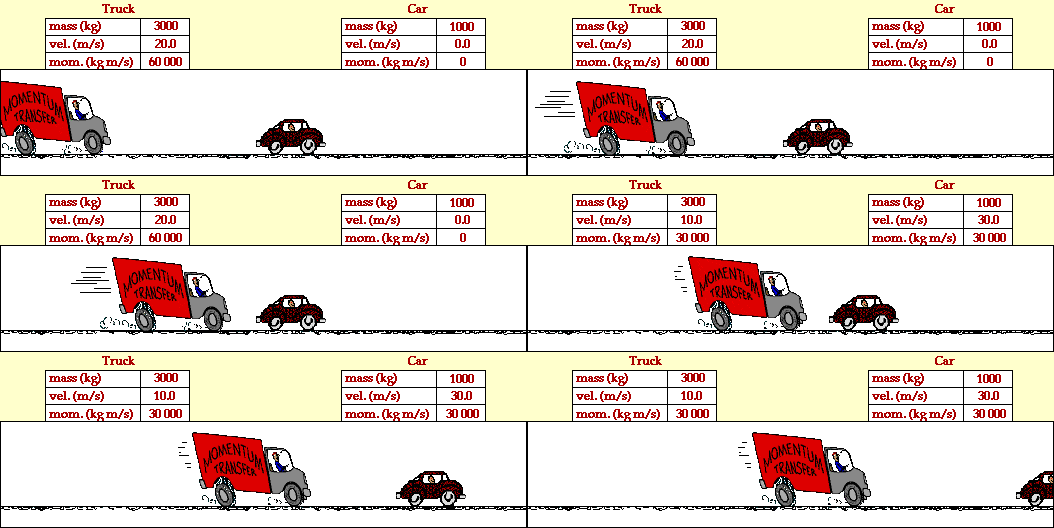
A -kg racecar initially moving south at miles per hour down a straight highway collides into a 16-wheeler truck initially at rest. After the collision, the car moves south at miles per hour while the truck is pushed south at miles per hour. What is the mass of the truck?
Solution: This is a two-vehicle collision, so the equation
will apply. Without loss of generality, let vehicle 1 be the car and let vehicle 2 be the truck. We are asked for the mass of the truck, which is denoted as . Thus we want to solve the momentum equation for .
Isolate all terms involving . This will require two steps. First, subtract from both sides of the equation:
Now subtract from both sides of the equation:
Now that all terms with are on one side of the equation, factor out from the left-hand side.
Isolate as follows:
This form of the equation allows us to plug and chug to find . All other variables have been given to us.
This is the mass of the truck, as desired.