Vertical Asymptotes of Rational Functions

Before this, knowWhat Are Asymptotes?

Interactive · 1 question

We know that a rational function is of the form r(x)=f(x)g(x)r(x) = \frac{f(x)}{g(x)}, where f(x)f(x) and g(x)g(x) are both polynomial functions. A vertical asymptote of a function is a vertical line that the function approaches but never touches. At this xx value, the function goes to ±∞\pm \infty. In the case of a rational function, if the denominator of the function is 00 at a certain xx value, then the function goes to ±∞\pm \infty at that xx value, and there is a vertical asymptote at that xx value. Now, this problem is reduced to finding the zeros of the denominator of the rational function, which can be solved with a variety of ways.

As an example, find all the vertical asymptotes of the function f(x)=3x+2x2−5x+6f(x) = \frac{3x+2}{x^2-5x+6}

Choose all correct answers

Video

(Video) Vertical Asymptotes... How? (NancyPi)

by NancyPi

Watch this video by NancyPi to learn how to find vertical asymptotes!

Nancy starts by explaining the 3 steps to finding vertical asymptotes.

  1. Factor: Make sure to factor both the numerator and denominator.
  2. Cancel: Cancel any identical terms in the numerator and denominator.
  3. Set the denominator equal to zero and solve.

Try solving the example given in the video.

Find the vertical asymptote(s) for:

f(x)=x−1x2+5x+6f(x)= \frac{x-1}{x^2+5x+6}
Choose all correct answers

Illustrated · 1 min

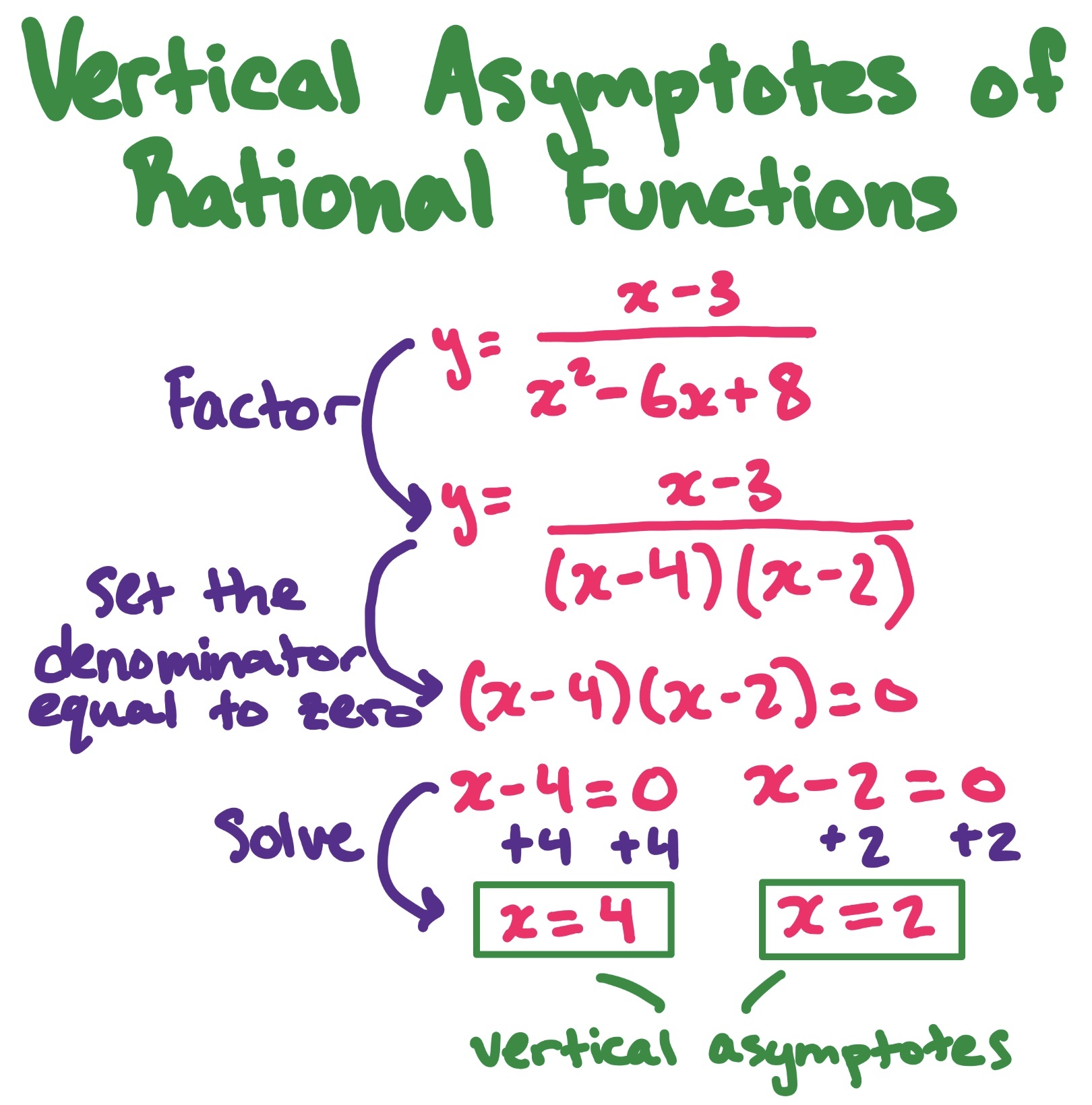
Vertical Asymptotes of Rational Functions

In this lesson, we are going to learn about vertical asymptotes. A vertical asymptote is an invisible vertical line that a graph gets really close to touching, but never does. You will see this concept in rational functions, which are functions where both the top and the bottom are polynomials.

Vertical asymptotes happen when the denominator equals zero.

Vertical Asymptotes of Rational Functions

y= fraction{x-3}/{x^2 -6x+8}
Factor: y= fraction{x-3}/{(x-4)(x-2)}
Set the denominator equal to zero: (x-4)(x-2) = 0
Solve: x-4=0 and x-2=0
x-4(+4)=0(+4) and x-2(+2) = 0(+2)
x=4 and x= 2 (vertical asymptotes)

Image source: by Trisha

Be careful! If the denominator is zero, the numerator cannot also be zero - then, it might be a hole instead of an asymptote. For example, in the function f(x)=1x−3f(x) = \frac{1}{x-3}, the graph has a vertical asymptote at x=3x=3 because the bottom becomes zero at that point. The graph shoots up or down near x=3x=3, but never crosses that line.

Not all discontinuities are asymptotes; some are removable points.

The find vertical asymptotes, set the denominator equal to zero and solve. Always check if the factor cancels with top. If it doesn't, you've got a vertical asymptote! Values that make the denominator zero are excluded from the domain.

In the next lessons, you will learn about horizontal and oblique asymptotes.

Type a concept, like “slope” or “photosynthesis”.

↑ ↓ to choose · Enter to openSearch explanations and problems