Water Cycle — Definition & Diagrams

Illustrated · 1 min

What's the Water Cycle?

Water is constantly moving through Earth and its atmosphere. It is constantly changing phases. Sometimes we drink it. Sometimes we see it as snow, and other times we see it as steam.

The water cycle describes the different processes that move water between the land, oceans, and the atmosphere. It is also called the hydrologic cycle.

A diagram of the water cycle

Image source: By AIRS (Atmospheric Infrared Sounder) CC BY-SA 2.0, via flickr.com

Precipitation

Water makes its way from the atmosphere to Earth through precipitation. This falling water comes in many forms such as rain, snow, sleet, and hail.

Precipitation gets absorbed into the ground and becomes groundwater. It can become a part of an underground reservoir if it reaches deep enough. Water that doesn't get absorbed will travel down the land surface until it reaches a river or another body of water. This is called surface runoff.

Groundwater can be released at the surface, forming streams and other bodies of water. It can also be absorbed through the roots of plants.

Evaporation

Water at Earth's surface can re-enter the atmosphere when it evaporates. Evaporation is the process through which water turns into a gas. Another form of this is called transpiration. This is when water evaporates from the leaves of plants as a byproduct of photosynthesis. When water evaporates, it is called water vapor.

Condensation

Once in the atmosphere, the water molecules cool off and condense into droplets. This is called condensation, which is the process of changing a gas into a liquid. Once the droplets become big enough, they can travel back down to the land through precipitation.

And the cycle goes on.

Illustrated · 2 min

Water

Every puddle, stream, pond, and lake you've ever seen is a part of the global water cycle. The water they contain is the same water that life first evolved in. It's been around for a long time. The water has been moved all around the world; it's been a part of a cloud, part of the ocean—it's probably even been used by a tree.

How Does Water Move Around?

The water cycle is how water moves through the environment, from glacier to stream, and from ocean to atmosphere. It's a cycle, meaning it repeats over and over. It also means that the amount of water throughout Earth remains more or less the same, whether we can see it or not.

Parts of the Water Cycle

There are three key processes:

  • Evaporation is the process of liquid water becoming gaseous water.

  • Transpiration is basically evaporation from the leaves of plants. The water enters the plant from the roots and is carried up into the leaves. It then passes through the stomata and evaporates.

  • Precipitation is water vapor condensing into either liquid water or solid water (ice). You might think of it as just water falling from the sky, but it takes many forms like rain, sleet, hail, ice, and snow. Water from precipitation can be absorbed into the ground, becoming ground water. Or it could travel along the surface of the earth as runoff until it reaches rivers and lakes.

The water cycle illustrated. It starts with evaporation from oceans, lakes, and streams and transpiration from plants. Next is condensation in the atmosphere, and then precipitation. The precipitation enters the groundwater and reenters the oceans, lakes, and streams.

Image source: By AIRS (Atmospheric Infrared Sounder) CC BY-SA 2.0, via flickr.com

What Does an Example Look Like?

Because this is a cycle, we can begin at any part. Let's start at evaporation. Water evaporates from plants and bodies of water. The evaporated droplets mix and grow larger. They form clouds in the atmosphere, which are pushed by the wind to other areas.

When there is a large amount of condensed water in the atmosphere, it will form droplets and begin to fall to Earth as precipitation. It enters streams, lakes, and the ground, and begins its flow back to the ocean. Some of it is picked up by the roots of trees and transpirated again through the leaves.

The cycle continues.

Vocabulary Review:\color{#8925ae}{\text{Vocabulary Review:}}

Water Cycle\color{#8925ae}{\text{Water Cycle}} : How water is moved and recycled through the environment

Evaporation\color{#8925ae}{\text{Evaporation}} : The process of liquid water becoming gaseous water

Transpiration\color{#8925ae}{\text{Transpiration}} : Evaporation from the leaves of plants

Precipitation\color{#8925ae}{\text{Precipitation}} : Water vapor condensing into either liquid water or solid water

Video

(Video) The Water Cycle

by National Science Foundation

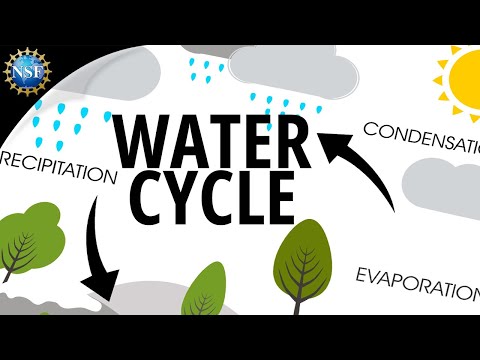
In this video, the National Science Foundation explains how water changes from one state to another in the environment.

Type a concept, like “slope” or “photosynthesis”.

↑ ↓ to choose · Enter to openSearch explanations and problems