Interactive · 1 question

+3 contributors



Physical Properties of Water

Image source: By Darekk2 CC BY-SA 4.0, via Wikimedia Commons
Water has a few features that make it one of the most versatile and interesting molecules on Earth. Water's unique physical and chemical properties are the result of its molecular structure and bonding.
Water Structure
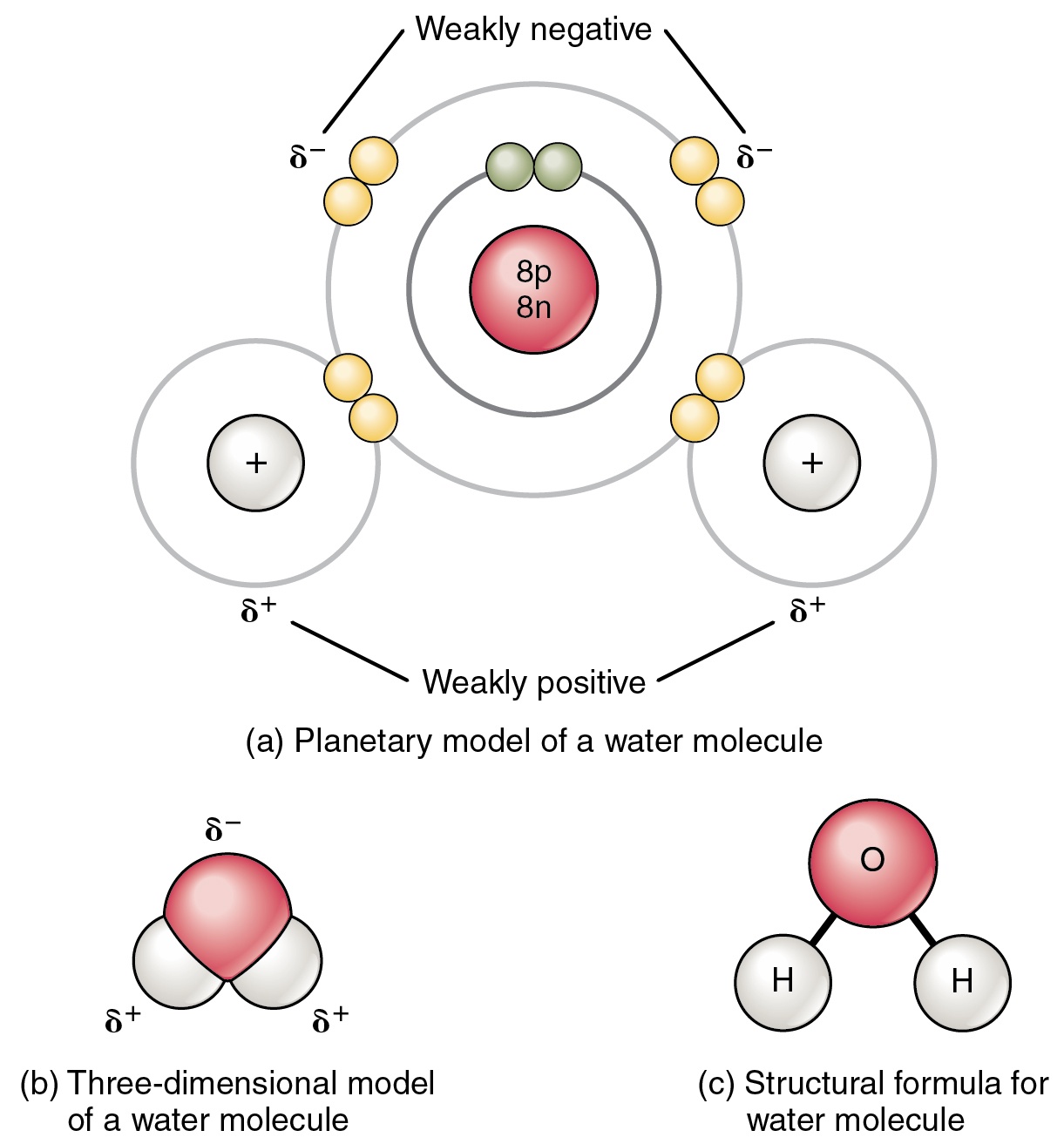
A water molecule is made of one oxygen atom and two hydrogen atoms. The oxygen atom has six electrons, but it really wants to have eight. Both hydrogen atoms have one electron, but each of them wants to have two.

The oxygen's electrons are shown as circles and the hydrogen's electrons are shown as x's. The overlap areas that have an x and a circle are the bonds. Image source: By Benjah-bmm27 [Public domain], via Wikimedia Commons
The oxygen shares one pair of electrons with the hydrogen atoms so that the oxygen has eight electrons and both hydrogens have two. By sharing electrons with each other, the oxygen and hydrogen atoms bond. This specific type of interaction is known as a covalent bond.

A water molecule looks kind of like a boomerang.
Image source: By Thebiologyprimer CC0, via Wikimedia Commons
The oxygen atom still has two extra sets of electrons that nothing is bonded to (these are called lone pairs. Those poor electrons). These lone pairs push away the bonded electrons, which cause the water molecule's structure to look like a boomerang.
Which atoms in a water molecule have lone pairs.
The Covalent and Hydrogen Bonding of Water
When atoms are joined together in a molecule and one of the atoms is really greedy for electrons, it will draw the electrons closer to itself. This is known as a polar covalent bond. Polarity is when one or more bonded atoms are bad at sharing their electrons. This causes an uneven distribution of negatively charged electrons across the molecule.
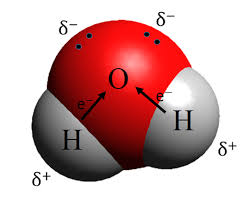
Look at where the partial charges are on this water molecule.
Image source: By Drago Karlo CC BY-SA 4.0, via Wikimedia Commons
Water is a polar molecule, which means that it has a partial positive charge (+) on the hydrogen atoms and a partial negative charge on the oxygen (-). The partial charges on a water molecule are similar to a bar magnet, where oppositely charged poles repel each other but opposite poles attract.
Because of the uneven charge distribution, the partially positive hydrogen atoms can form a weak bond with other oxygen atoms. This is called a hydrogen bond.
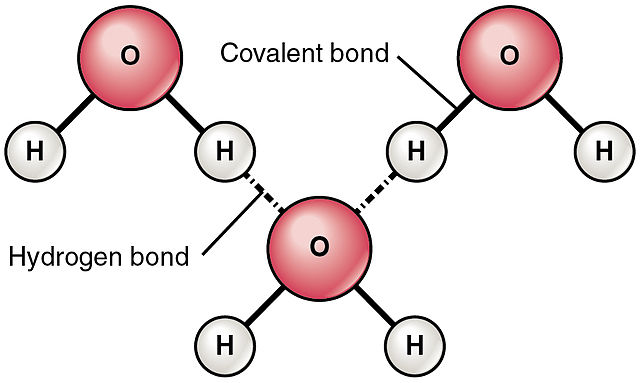
Hydrogen bonding between water molecules.
Image source: By OpenStax College CC BY 3.0, via Wikimedia Commons
: Partial positive and negative charges caused by some atoms wanting electrons more than other atoms in a molecule
: Positively charged hydrogens of one molecule are attracted to the negative charge on another molecule