What Are Asymptotes?

Read · 1 min

An asymptote is a straight line that does not touch a curve. For example, if I have a hyperbola, the asymptote would be either a vertical, horizontal, or other line that does not intersect the hyperbola. In the graph of tan(θ)tan(\theta), the asymptotes of the function are vertical lines.

The use of asymptotes are everywhere. When graphing a hyperbola or tangent curve, you can graph the asymptotes and then construct the hyperbola. There can be both horizontal and vertical asymptotes.

Read · 1 min

Rational functions are generalizations of polynomials. Specifically, they are of the form R(x)=P(x)Q(x)=anxn+⋯+a0bmxm+⋯+b0,R(x)=\frac{P(x)}{Q(x)}=\frac{a_nx^n+\cdots+a_0}{b_mx^m+\cdots+b_0}, for polynomials P(x)P(x) and Q(x)Q(x), where Q(x)Q(x) is not the zero polynomial. (Q(x)≠0Q(x)\ne 0.)

For example, any polynomial is simply a rational function with its denominator being the polynomial Q(x)=1Q(x)=1. Other examples include: 2x2+13x+5,1x,17x17+πex2.\frac{2x^2+1}{3x+5}, \frac{1}{x}, \frac{17x^{17}+\pi}{ex^2}.

Rational functions also may have vertical and horizontal asymptotes. If rr is a root of Q(x)Q(x) but not of P(x)P(x), we say that R(x)R(x) has a vertical asymptote at x=rx=r. Around this point the value of the function explodes to plus or minus infinity. If the degree of PP is less than the degree of QQ, then RR has a horizontal asymptote of y=0y=0. If R=c+SR=c+S for some constant cc, and SS has the property that its numerator has a smaller degree than its denominator, SS has a horizontal asymptote of y=0y=0 and RR of y=cy=c.

Read · 1 min

Rational functions are functions that are fractions with polynomial numerators and denominators. More specifically, they are functions of the form R(x)=P(x)Q(x)R(x)=\dfrac{P(x)}{Q(x)} where P(x)P(x) and Q(x)Q(x) are polynomials, and Q(x)Q(x) is a nonzero polynomial. Furthermore, all polynomials are rational functions with Q(x)=1Q(x)=1.

As a result, they behave differently from normal functions. They may have vertical, horizontal, or oblique asymptotes and/or removable discontinuities.

Vertical asymptotes are roots rr of Q(x)Q(x) which are not roots of P(x)P(x). This is because as the function approaches rr, the denominator tends to 00, so the function diverges off to positive or negative infinity.

If a root rr of Q(x)Q(x) is also a root of P(x)P(x), we call rr a removable discontinuity because the rational function behaves normally until it reaches rr, in which it becomes undefined because the value becomes 00\frac{0}{0}. rr thus appears as a hole on the graph.

Horizontal asymptotes are only defined when the degree of P(x)P(x) is less than or equal to that of Q(x)Q(x). If the degree of the numerator is less than that of the denominator, the horizontal asymptote is y=0y=0. If it is equal, then the horizontal asymptote is the leading coefficient of P(x)P(x) divided by the leading coefficient of Q(x)Q(x).

Oblique Asymptotes are tricker. Again, we want to analyze what happens to the function as it approaches infinity, so we perform polynomial division and get R(x)=q(x)+r(x)Q(x)R(x)=q(x)+\dfrac{r(x)}{Q(x)} in which q(x)q(x) is the quotient of P(x)Q(x)\frac{P(x)}{Q(x)} and r(x)r(x) is the remainder of that division. As xx approaches infinity, the fraction will tend to 00 because, by definition the degree of r(x)r(x) is less than that of Q(x)Q(x), so the oblique asymptote is y=q(x)y=q(x).

Illustrated · 1 min

As we've covered reciprocal functions, we were introduced to asymptotes of reciprocal functions. They've helped us to understand the domain and range of rational functions. We will now learn more about them in the context of rational functions.

Asymptotes

An asymptote is a line that a graph gets closer and closer to, but never actually touches. We've learned this before, and it's the same concept. You can think of it like an invisible boundary that the graph approaches forever.

There are three main types of asymptotes: vertical, horizontal, and slant (or oblique). In this lesson, we will cover vertical and horizontal asymptotes.

Asymptotes
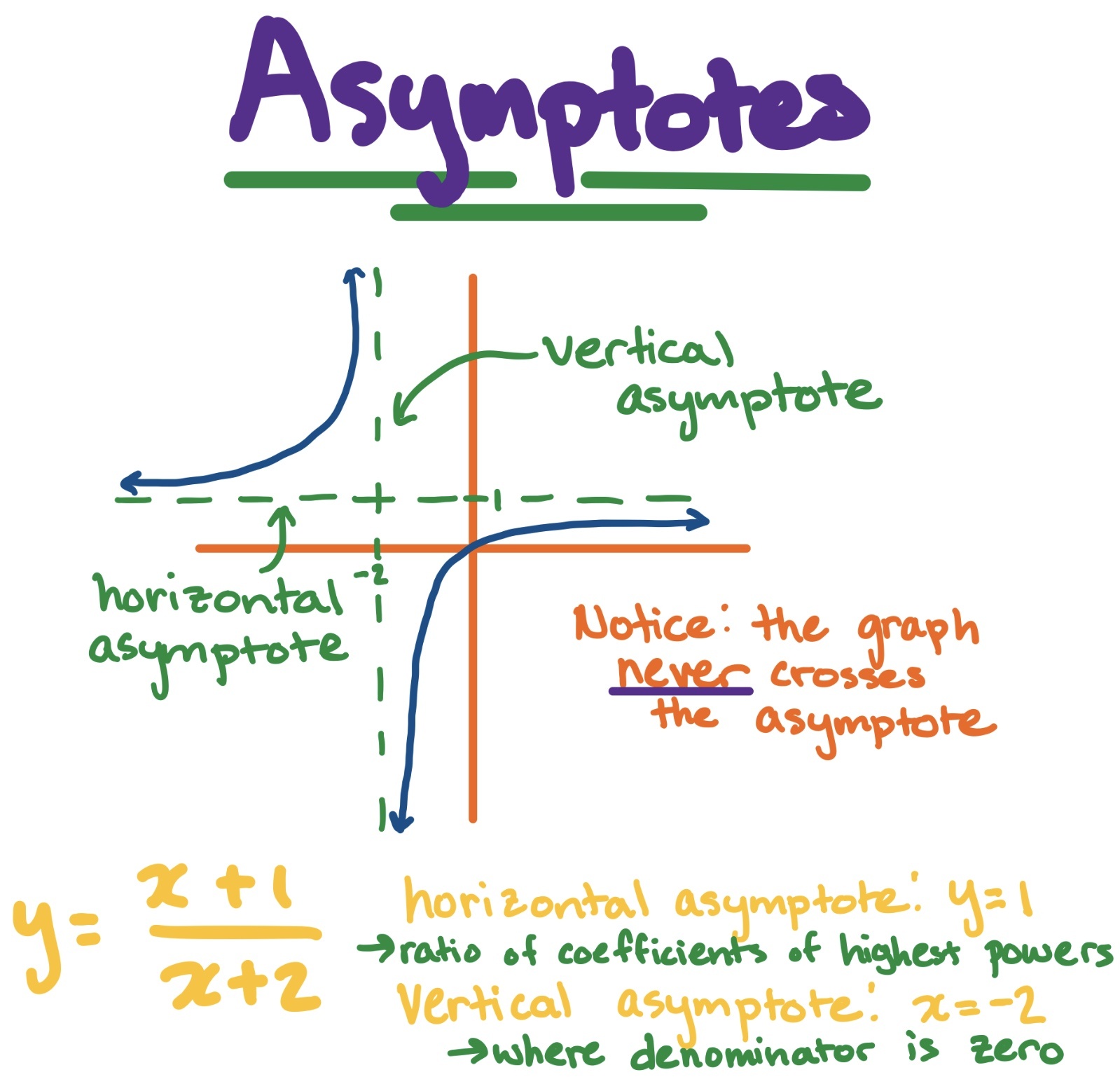
(Graph of y=(x+1)/(x+2) with vertical and horizontal asymptotes identified)
Notice: the graph never crosses the asymptote

Horizontal asymptote: y=1
--> ratio of coefficients of highest powers
Vertical asymptote: x=-2
--> where denominator is zero

Image source: by Trisha

We can use the above technique to find the vertical asymptote and to find the horizontal asymptote. The range and domain of the function do not include the values of the asymptote(s).

A vertical asymptote happens when a function grows really fast up or down near a certain xx-value, like when a number is being divided by zero. For example, in the function:

y=1xy = \frac{1}{x}

, there's a vertical asymptote at x=0x=0 because the function shoots up or down near the value.

A horizontal asymptote shows what happens as the graph goes really far left or right. It’s the yy-value that the graph levels out toward. For example, in:

y=1xy=\frac{1}{x}

, the horizontal asymptote is y=0y=0 because the curve gets closer and closer to the xx-axis.

Some graphs, like rational functions, can also have a slant asymptote, which is a diagonal line the graph approaches. Asymptotes are helpful because they tell you how the graph behaves at the edges or near undefined values.

Knowing about asymptotes helps you sketch graphs more accurately and understand limits in algebra and calculus.

Illustrated · 1 min

###Finding asymptotes graphically

Asymptotes

An asymptote is a line that a curved function approaches. There are three types of asymptotes: vertical, horizontal, and oblique.

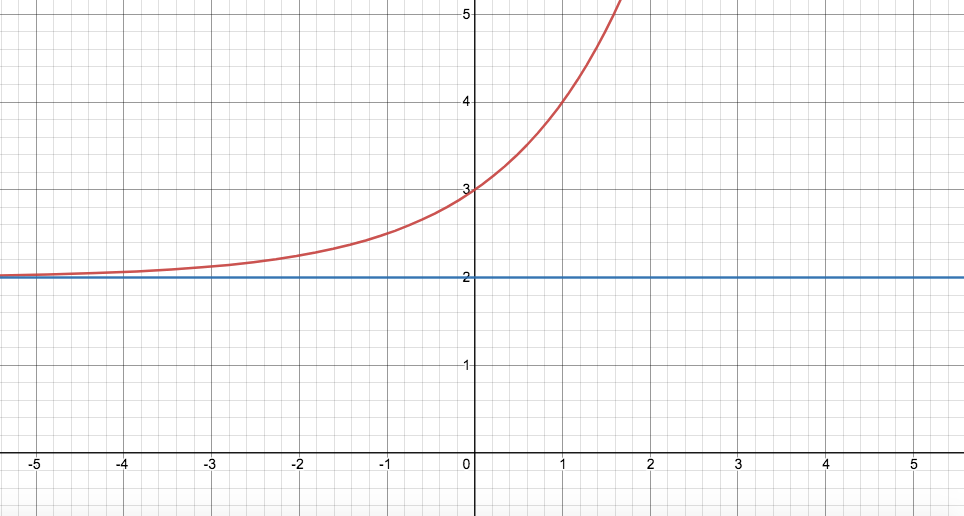
Let's look at the graph of y=2x+2y=2^x + 2 and its asymptote.

Graph of y=2^x + 2 and y=2

Made using Desmos

Looking at the graph, we can see that the curve of y=2x+2y=2^x + 2 (in red) approaches a certain value. In blue, y=2y=2 is graphed, which is the asymptote. We can see just by looking at the curve in red how it approaches the value of y=2y=2.

There are many ways to solve for the asymptote algebraically, but looking at the graph, we can find the asymptote(s) by looking at the value the curve approaches.

Video

(Video) Asymptotes

by The Organic Chemistry Tutor

In this video by The Organic Chemistry Tutor, you will learn about asymptotes, rational functions, and domain & range.

Type a concept, like “slope” or “photosynthesis”.

↑ ↓ to choose · Enter to openSearch explanations and problems