What Are Enzymes? — Definition & Overview

Illustrated · 2 min

What Are Enzymes?

Enzymes are sites of catalytic activity, speeding up almost every single chemical reaction that happens in our cells. A catalyst is something that increases the rate of a reaction without getting used up or changed in the process. Catalysts help reactions go from reactants (the starting materials) to products much faster than without having a catalyst. If they weren't around to help speed things up, most biochemical processes would happen too slowly for life to exist.

The vast majority of these helper molecules are made of protein monomers called amino acids, but there are also some made of RNA called ribozymes.

The image is a cartoon illustration. The image depicts a purple blob with arms, representing the enzyme lactase, and a pink molecule representing lactose, which is lactase's substrate. The hands of the cartoon enzyme represent the enzyme's active sites where it binds to its substrate.

Notice how the substrates can fit into the active sites perfectly.

Image source: By Sylvia Freeman

Enzymatic proteins are highly specific, which means that typically one type can catalyze just one reaction. Why are they so particular? Well, the tertiary (and sometimes quaternary) structure of a protein determines a protein's shape. A protein's shape is vital to its function. If an enzyme loses its structure due to mutation or extreme conditions, it often stops working or works with a greatly reduced ability.

The active site is the location where the substrates bind. The shape of the active site matches the shape of its substrate so that the substrate fits just right. Otherwise, the enzyme wouldn't be very good at its job.

Think of substrate molecules and active sites like the story of Goldilocks and the Three Bears:

The top of the image says "Goldie substrate and the three enzymes", making a reference to Goldilocks and the Three Bears. The image depicts three cartoon bear enzymes and a golden substrate molecule. Each of them has a hole in their stomach, which is the active site. The substrate fits perfectly in the active site of one of the bear enzymes. The other enzymes have active sites that don't fit the substrate.

Image source: By Sylvia Freeman

As you can see, the left bear enzyme's active site is a different shape from the substrate, while the right bear's active site is too big. In both of these cases the substrate can't bind to the active site, so the reaction won't happen. Only the smallest bear's active site fits the substrate just right, so that's where Goldi-substrate will bind and react.

The fit is extremely specific. This fit is often referred to as a lock and key model. The correct key (substrate) has to fit into the correct lock (active site) for the reaction to work.

This lock-and-key business is how enzymes work their magic. Enzymes bring substrates close enough together for the reaction to occur quickly. When a substrate binds to it, the active site might change shape slightly to better fit the substrate. This is known as induced fit. This helps the reactions go even faster.

Here's an example of our enzyme in action:

The image is a cartoon illustration. The image depicts a purple blob with arms, representing the enzyme lactase, and a pink molecule representing lactose, which is lactase's substrate.

This is just a generic example, but the reaction shown also shows how lactase (purple) breaks down lactose (the double pink molecule) into glucose (one single ball) and galactose (the other ball). \\ Image source: By Sylvia Freeman

Fun fact: Many enzymes are named after the substrate they act on by replacing the end of the word with the suffix –ase. For example, lactose is the main sugar found in milk. Lactase breaks down lactose into its two component sugars—glucose and galactose.

The image is a cartoon illustration. The image depicts a purple blob with arms, representing the enzyme lactase, and a pink molecule representing lactose, which is lactase's substrate. In this image, the lactose molecule has bonded to lactase's active site.
The image is a cartoon illustration. The image depicts a purple blob with arms, representing the enzyme lactase, and a pink molecule representing lactose, which is lactase's substrate. In this image, lactase has started to break apart the lactose molecule.
The image is a cartoon illustration. The image depicts a purple blob with arms, representing the enzyme lactase, and a pink molecule representing lactose, which is lactase's substrate. In this image, lactase has broken lactose apart into its two single sugar monomers, glucose and galactose.
The image is a cartoon illustration. The image depicts a purple blob with arms, representing the enzyme lactase, and a pink molecule representing lactose, which is lactase's substrate. In this image, lactose has been broken up into its two component sugars but is still bound to lactase.
The image is a cartoon illustration. The image depicts a purple blob with arms, representing the enzyme lactase, and a pink molecule representing lactose, which is lactase's substrate. In this image, glucose and galactose have separated from lactase and are floating freely. The reaction is complete and lactase is free to catalyze the breakdown of more lactose molecules.

Image source: By Sylvia Freeman

Illustrated · 2 min

How Do Enzymes Speed Up Reactions?

An enzyme is an organic molecule and a type of protein. Enzymes are a type of catalyst, meaning they speed up chemical reactions without being a part of the reaction themselves. At the end of a reaction, they can be reused.

They are typically made of amino acids, and each type has a specific molecule or molecules that it can bind to. Its role is to speed up the rate of a reaction. It does this by lowering the reaction's activation energy: the amount of energy needed to start the reaction.

A diagram showing the difference in activation energy between a reaction without an enzyme and with an enzyme. The activation energy is significantly lower for the reaction with an enzyme.

Image source: By Gabi Slizewska

This is very important because without catalysts most chemical reactions would take way too long to be efficient. Living organisms would not survive without them.

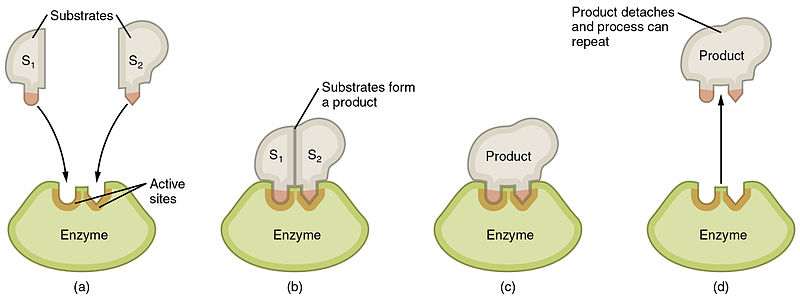
For a reaction to happen, reactants have to run into one another in the right orientation and with enough force. In order to lower the activation energy, an enzyme first has to bind the reactants at a location called the active site. By doing this, it brings the reactants closer together and orients them in a way that makes it easier for them to react.

A diagram of a generic reaction. Reactant A and reactant B bind the enzyme to form intermediate AB. Then the reaction produces product C.

Image source: By Gabi Slizewska

Pretty cool.

It's important to remember, though, that each enzyme can only bind to a specific reactant or reactants. Also, reactions do not need catalysts to occur. They'll just happen very slowly.

Proteins Work Best In Optimal Conditions

Enzyme molecules are found all throughout our bodies, but each type works best in different conditions. Some, like the ones in our stomachs, work best at low pH. However, if an enzyme that operates at a high pH were put into our stomach, it wouldn't be able to function properly.

Other factors, like temperature, also affect catalytic function. Proteins, including catalytic proteins, have an optimal condition at which they function best. If the temperature of the environment is too high, the protein's bonds can denature and it will no longer work.

What Is an Example?

A common enzyme in the human body is amylase. Amylase is in your saliva and is able to break complex starches down into simple sugars. The active site can latch onto starch chains and break them apart. While some enzymes bring substrates together in their reaction, ones like amylase can take in a substrate and then break it into smaller pieces.

Vocabulary Review:\color{#8925AE}{\text{Vocabulary Review:}}

Enzyme\color{#8925AE}{\text{Enzyme}} : A protein that acts like a catalyst. It speeds up biological reactions but is not used up during the reaction

Activation Energy\color{#8925AE}{\text{Activation Energy}} : Minimum amount of energy needed to begin a chemical reaction

Catalyst\color{#8925AE}{\text{Catalyst}} : A substance that speeds up reactions but is not used up during the reaction

Substrate\color{#8925AE}{\text{Substrate}} : Molecules that a specific enzyme binds to and recognizes. It is transformed during the reaction

Interactive · 2 questions

How Do Enzymes Work?

Enzymes are proteins that speed up chemical reactions in cells without being used up. In fancy scientific terms, they are specialized, catalytic protein macromolecules. Catalysts are materials used to speed up chemical reactions. They can be used over and over without breaking down.

Enzymes are made of a protein scaffolding that supports the active site.

Image source: By OpenStax College CC BY 3.0, via Wikimedia Commons

Catalysts are like the hammer used to pound in a nail. You can use the hammer to pound in a thousand nails, but it doesn't fall apart. It just makes the process of pounding the nail in much faster and easier.

What are enzymes?

Choose one answer

Illustrated · 2 min

The Perfect Fit

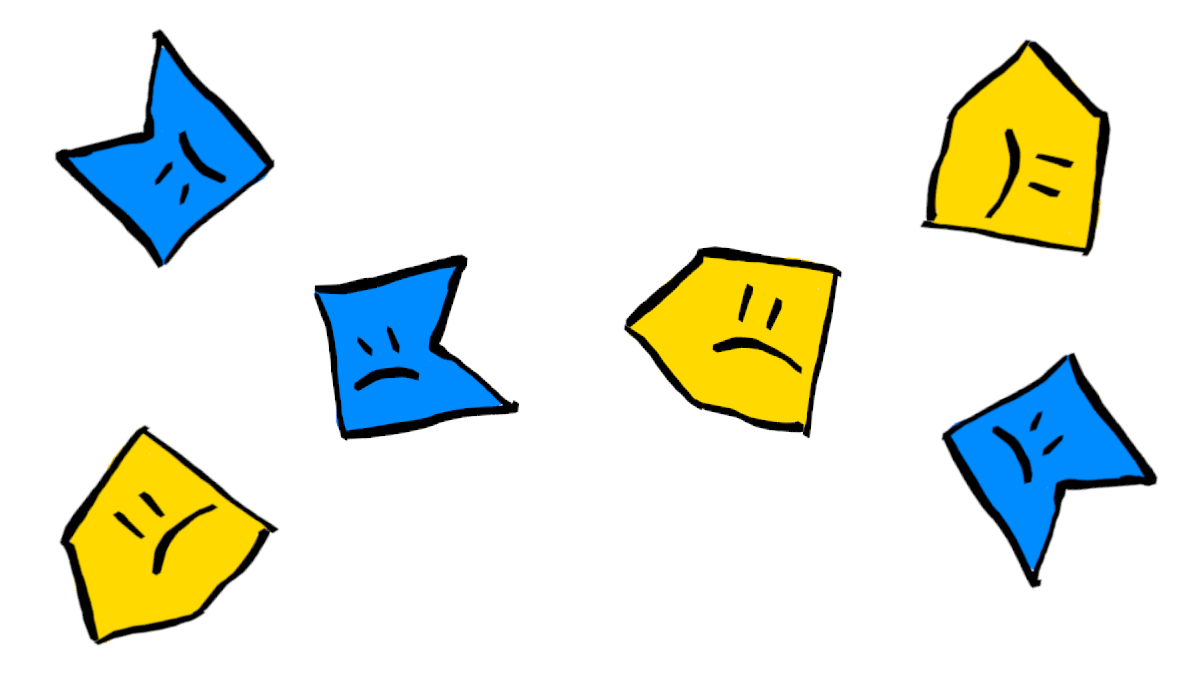
The image shows blue and yellow reactants frowning as they float around.

Image source: By Sarah Morgan

What Is a Catalyst?

Without enzyme molecules, reactants float around in a cell hoping that they will bump into each other in just the right way to cause a reaction. This takes a lot of time and energy, and the reactions are rare.

The image shows blue and yellow reactants. Two of them are close to each other and have surprised faces.

Will these two reactants finally bump into each other?

Image source: By Sarah Morgan

With enzymes, the reactions are helped out by a protein that can bring the reactants together. Because they take part in a chemical reaction without being changed or used up by it, they are also known as catalysts.

The image shows a cartoon cat catalyst bringing together a purple and a green reactant.

Catalysts bring reactants together and make the reaction process easier.

Image source: By Sarah Morgan

When reactants are taken in by the enzyme, they are called substrates. The substrate molecules are then put into binding sites. Binding sites place the substrates against each other in order to promote a reaction.

An orange enzyme is holding a blue and yellow substrate.

The enzyme uses its binding site to make sure the substrates are properly placed.

Image source: By Sarah Morgan

The catalytic site, which is usually between the substrates, lowers the activation energy of the reaction.

What Is Activation Energy?

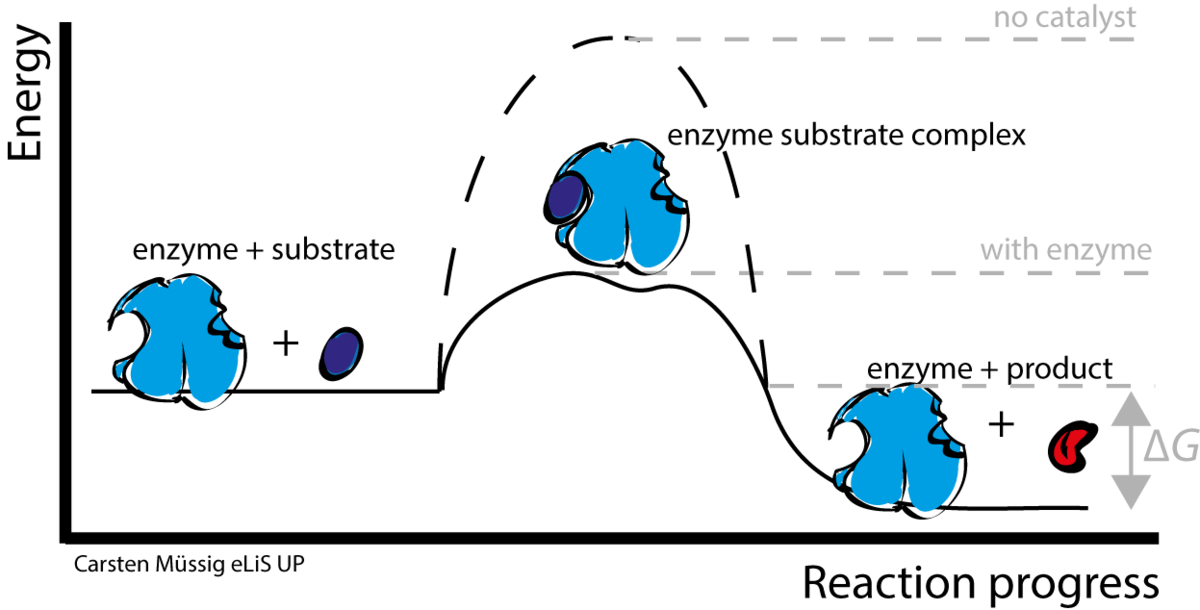
The activation energy of a reaction is the amount of energy required to get the substrates to undergo a reaction. Normally, the activation energy of the reaction is quite high. Enzymes are able to lower the energy required.

Imagine that you are pushing a heavy cart up a hill. It takes a lot of energy to push the cart to the top of the hill. If you had an enzyme helping you, it would be like having a bulldozer that makes the hill smaller for you.

The image shows how an enzyme can lower the energy required for two substrates to undergo a reaction.

Image source: By Muessig CC BY-SA 3.0, via Wikimedia Commons

Enzymes are usually specific to their reactants. The active site shape will usually only bind to one type of substrate. However, they can be activated and deactivated by things like changes in pH, temperature, or the presence of coenzymes and cofactors that can also bind to the enzyme. Vitamins are often cofactors and can help speed up reactions.

What Is an Example?

A common enzyme in the human body is amylase. Amylase is in your spit and is able to break complex starches down into simple sugars. The active site can latch onto starch chains and break them apart. While some enzymes bring substrates together in their reaction, ones like amylase can take in a substrate and then break it into smaller pieces.

Video

(Video) Enzymes

by Amoeba Sisters

Chemical reactions abound in our bodies and enzymes help them happen. This video breaks down—pun intended—what enzymes are, what they do, and how they work.

Type a concept, like “slope” or “photosynthesis”.

↑ ↓ to choose · Enter to openSearch explanations and problems