What Are Infinite Series?

Interactive · 1 question

At its core, a series is a sum of terms denoted something like this: S=∑i=1naiS = \sum\limits_{i=1}^{n}a_i This notation means that we are allowing the variable ii to iterate through all values from 11 to nn, resulting in ∑i=1nai=a1+a2+a3+a4+....+an−1+an\sum\limits_{i=1}^{n}a_i = a_1 + a_2 + a_3 + a_ 4 + .... + a_{n-1} + a_{n} so we can essentially think of a series as a sum SS of terms in a sequence {ai}i=1n\{a_i\}_{i=1}^{n}.

Let's look at a concrete example. Consider the series ∑n=1∞1n=11+12+13+14+15+⋯\sum\limits_{n=1}^{\infty}\frac{1}{n} = \frac{1}{1} + \frac{1}{2} + \frac{1}{3} + \frac{1}{4} + \frac{1}{5} + \cdots This is the sum of the terms in the sequence 11,12,13,14,15,⋯ ,\frac{1}{1}, \frac{1}{2}, \frac{1}{3}, \frac{1}{4}, \frac{1}{5}, \cdots, so we're just taking things to the next level here.

Series are some really cool things to investigate, and looking at the behavior of series comprises a large part of higher math. The reason is because we can consider how they behave as we add more and more terms of the series.

Let's look at a sequence of partial sums. True to their name, they are the sums obtained when you only add together part of a series. s1=a1s2=a1+a2s3=a1+a2+a3s4=a1+a2+a3+a4⋯sn=a1+a2+a3+a4+⋯+an\begin{align} s_1 &= a_1 \\ s_2 &= a_1 + a_2 \\ s_3 &= a_1 + a_2 + a_3 \\ s_4 &= a_1 + a_2 + a_3 + a_4 \\ &\cdots \\ s_n &= a_1 + a_2 + a_3 + a_4 + \cdots + a_n \end{align} For example, consider the series ∑n=1∞12n=12+14+18+116+⋯\sum\limits_{n=1}^{\infty}\frac{1}{2^n} = \frac{1}{2} + \frac{1}{4} + \frac{1}{8} + \frac{1}{16} + \cdots In order, the partial sums are 12,34,78,1516,⋯\frac{1}{2}, \frac{3}{4}, \frac{7}{8}, \frac{15}{16}, \cdots As we continue writing out these terms, it turns out that they get infinitely close to 22. Since they are approaching a specific number — 22 — we would call this series convergent (convergent series).

If a series does not end up approaching a specific number, we would call it divergent (divergent series).

Let's consider again the series ∑n=1∞1n\sum\limits_{n=1}^{\infty}\frac{1}{n}. Is it convergent or divergent?

Choose one answer

Read · 1 min

If we have a sequence such as 12+14+18+116+…\frac{1}{2} + \frac{1}{4} + \frac{1}{8} + \frac{1}{16} + \dots, which never stops, our sequence is called an infinite sequence. Now let's think about what we need in order to find the sum of the terms of our infinite sequence. It is impossible to add up all the terms; there are infinity of them. So we have to use this algorithm. First, let's call the sum of our terms SS. We have:

S=12+14+18+116+…S = \frac{1}{2} + \frac{1}{4} + \frac{1}{8} + \frac{1}{16} + \dots

Then notice that if we divide each side of the equation by 22, we find: S2=14+18+116+132+…\frac{S}{2} = \frac{1}{4} + \frac{1}{8} + \frac{1}{16} + \frac{1}{32} + \dots

The 12\frac{1}{2} term just disappeared! So S=S2+12S = \frac{S}{2} + \frac{1}{2} !

Therefore, 2S=S+12S = S + 1, so S=1S = 1.

From here we can conclude that SS, the sum of the terms in our sequence, is equal to 11!

We solved our infinite series.

Video

(Video) Infinite Series

by Numberphile

In this video by Numberphile, you will learn about infinite series.

Illustrated · 2 min

Infinite Series

Now that we've finished learning about finite series, we'll dive into infinite series!

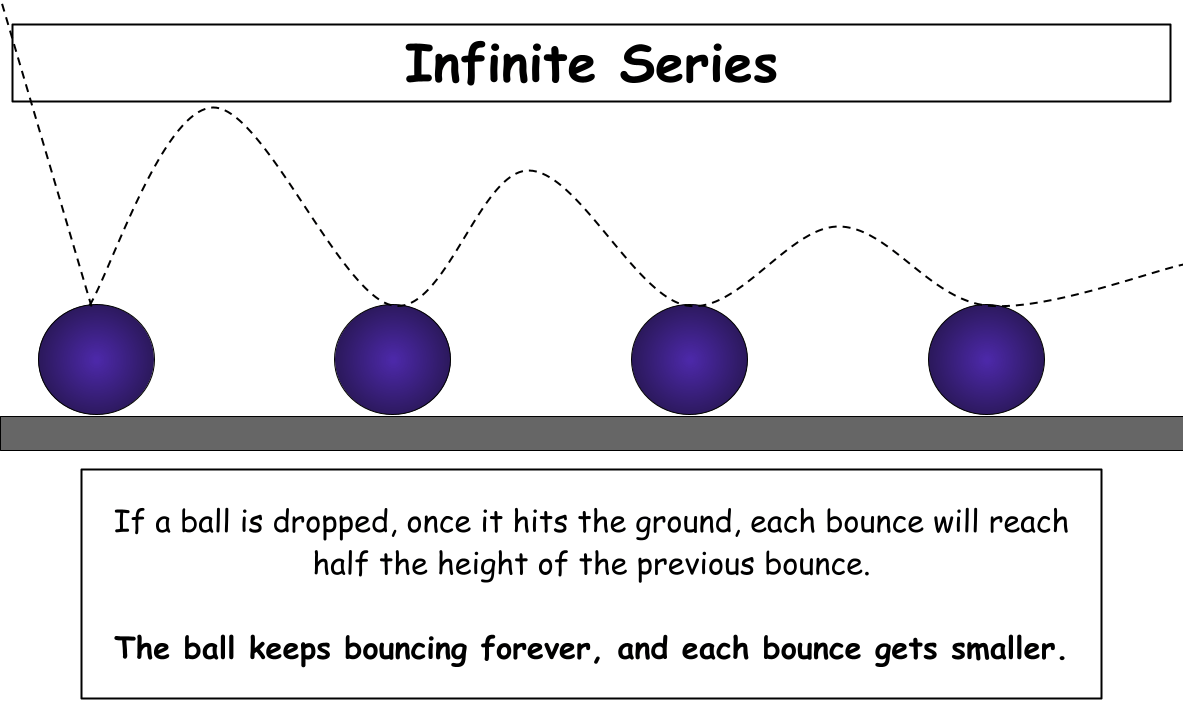
Imagine dropping a ball from a certain height. Each time it bounces, it reaches only half the height of the previous bounce. If you add the height of every bounce together, you create a series. Unlike a finite series, this series never ends. The ball continues to bounce forever, even though the bounces become smaller and smaller.

A bouncing ball
If a ball is dropped, once it hits the ground, each bounce will reach half the height of the previous bounce. 

The ball keeps bouncing forever, and each bounce gets smaller.

Image source: by Anusha Rahman

A series with infinitely many terms is called an infinite series. The dots at the end of the series, called an ellipse (...), show that the pattern continues without stopping. Even though there are infinitely many bounces, each new bounce adds less to the total than the one before it. Eventually, the added heights become so small that they have very little effect on the total.

####Diving Deeper into Infinite Series In Further Lessons

Some infinite series have a sum that approaches a fixed number. These are called convergent series. Other infinite series continue to grow without approaching a single value. These are called divergent series, and you'll see more examples of convergent and divergent series as you continue studying this topic.

The bouncing ball is an example of an infinite geometric series because each bounce is multiplied by the same ratio. In a later lesson, you'll learn how the Infinite Geometric Series and the Geometric Series Test can determine whether a series has a finite sum.

Not every infinite series converges. One useful tool for recognizing divergence is the Nth Term Test for Divergence of Series, which checks whether the terms become small enough as the series continues.

You'll also discover that some Infinite Geometric Series can be written as Rational Functions, providing another way to represent their sums. Finally, you'll explore Finite Telescoping Sums and Products, where many terms cancel, making surprisingly complicated sums much easier to evaluate. Together, these ideas will help you understand how mathematicians work with series that continue forever.

Type a concept, like “slope” or “photosynthesis”.

↑ ↓ to choose · Enter to openSearch explanations and problems