What Are Organelles? — Definition & Overview

Illustrated · 1 min

What Is an Organelle?

The human body is made up of multiple organ systems that work together to serve the whole body. Organs are collections of specialized tissues that have a specific function in an organism.

This is a cartoon illustration of the organs in a human body. The organs are smiling and cute.

Image source: By Sylvia Freeman

Just like there are organs in your body, there are organelles inside of your cells. They serve specialized functions. As you can probably tell, they were named after organs; -elle is a suffix meaning "little". So the name literally means "little organs".

Where Are They Found?

Organelles are membrane-bound compartments found inside of eukaryotic cells in the cytoplasm. They are separated from the rest of the cell by a lipid bilayer. This lets them independently carry out different functions that might interfere with each other if they weren't separated by membranes.

What Is an Example?

For example, lysosomes are responsible for breaking down cellular waste. Lysosomes can use strong degradative enzymes to break down waste without destroying the rest of the cell because they are enclosed within lipid membranes.

Some organelles even have a double membrane. Examples include mitochondria, chloroplasts, and the nucleus with its nuclear envelope.

Do All Cells Have Them?

Only eukaryotic cells have these structures. In fact, having membrane-bound organelles is one of the major things that separates eukaryotes from prokaryotes. Some prokaryotic cells technically do have little microcompartments, but these are not considered real organelles because these structures aren't separated by membranes.
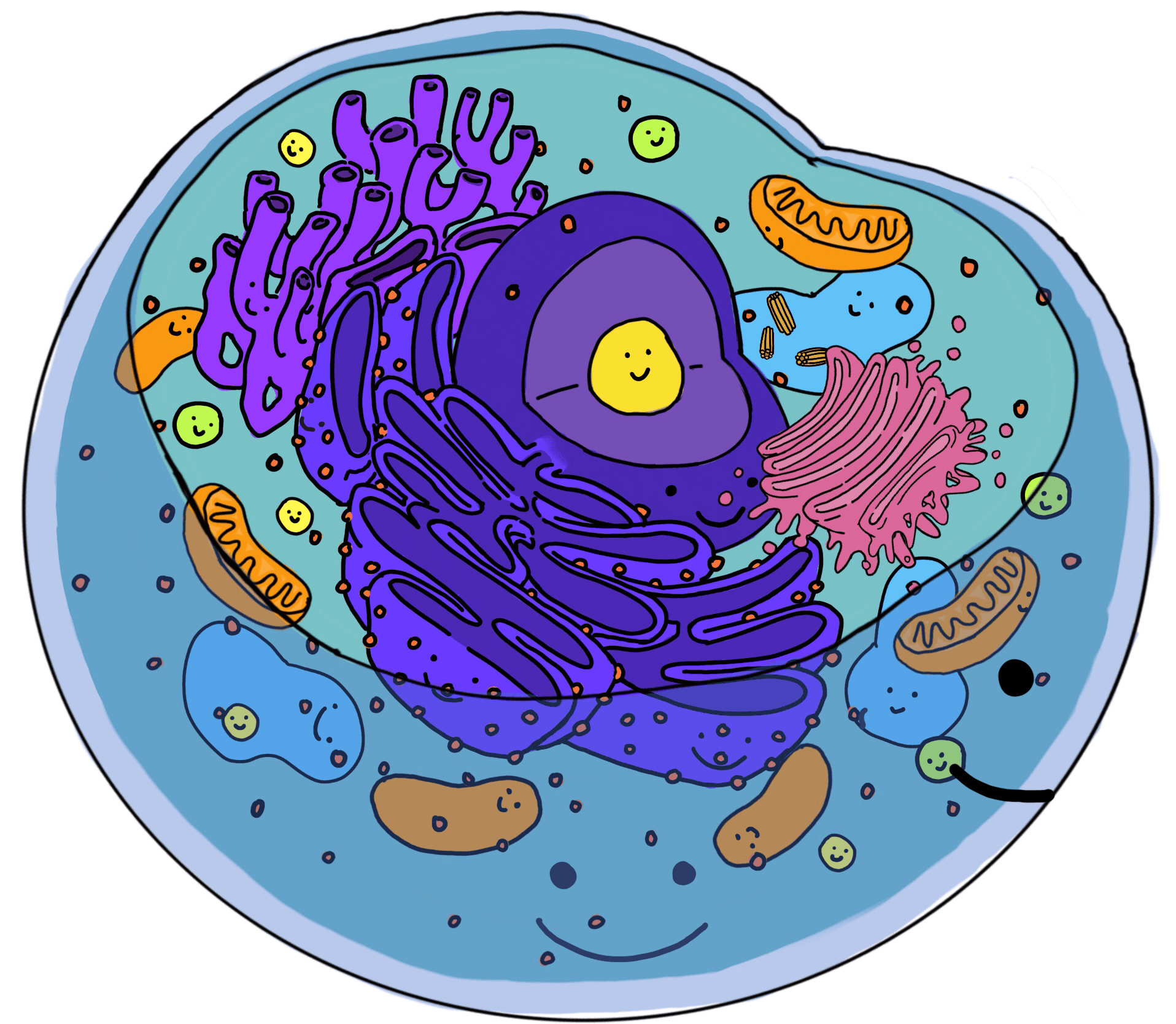
This is a cartoon illustration of all the organelles in a eukaryotic cell. The organelles are smiling and cute.

Image source: By Sylvia Freeman

There are many different types of organelles which all perform different functions. Most are found in all eukaryotic cells, but some kinds are only found in either plant or animal cells.

Interactive · 2 questions

All About Organelles

The image shows a man with a close-up of his heart, which has a close-up of its tissues, which has a close-up of its cells, which then has a close-up of an organelle.

Image source: By Sarah Morgan

What Are They?

Just like how a body has organs, individual cells have organelles. They are specialized structures within a cell, just like how organs have specific tasks in a body.

What Are Some Examples?

The nucleus is the part of the cell that contains DNA (a nucleic acid). It is kind of like the brain of a cell because it controls the activity of other organelles. The endoplasmic reticulum and Golgi apparatus are like hands that throw and catch packages that travel to and from cells. Mitochondria generate energy so that the cell can stay active and alive, similar to how the heart keeps blood circulating for the body.

Cells can also have more specialized organelles, like vacuoles that store fat or chloroplasts that photosynthesize in plants.

What Are Cells Made Of?

These little structures are made primarily of lipids. Specialized phospholipids make large sheets that fold and connect into the structure of the organelle.

Phospholipid bilayers have phosphates on the outside and lipids on the inside.

Phospholipid bilayers have phosphates on the outside and lipids on the inside.

Image source: By Sarah Morgan

Organelles can also have proteins placed inside their lipid membranes. These proteins can perform many functions, like generating ATP in mitochondria or attaching labels to molecules in the Golgi apparatus. The rough endoplasmic reticulum (rough ER) can have large groups of proteins called ribosomes. The ribosomes assemble amino acids into long protein chains.

Why Use Them? Why Not Have Everything Floating Loose in the Cell?

A cell seems tiny to us, but proteins are even smaller. To a protein, a cell contains a lot of empty space. If something like DNA polymerase had to look through the whole cell to find DNA, it would take a long time. By containing things within organelles, it makes it far more likely that a protein will run into its substrate. If both DNA and DNA polymerase are kept inside the nucleus, they are more likely to run into each other and start performing DNA replication.

Some organelles also depend on very sensitive pH levels to work correctly. If the environment in the cell became too acidic or too basic, the cell would stop working. Without organelles, the pH of the cell would be uniformly neutral. However, inside specific ones, the pH can be kept at specific levels. This often happens in mitochondria. The mitochondria harvest energy by moving electrons across a gradient that requires areas with slightly different pH levels.

Other organelles like peroxisomes, which can generate hydrogen peroxide to kill invading bacteria, need lipid membranes because the cell would be hurt by their contents.

Organs are to bodies as...

Choose one answer

Illustrated · 1 min

What Are Organelles?

They are like teeny-tiny organs inside each cell.

You know how the organs of your body (your heart, liver, kidneys, stomach, etc.) each perform a job that keeps you alive? Well, organelles do the same thing for a cell. Each one performs a specific job that keeps the cell alive.

This is an animal cell that's been cut along its equator. Each of the numbered objects in the picture is an organelle.

Image source: By Kelvinsong CC0, via Wikimedia Commons

Let's take a look at some of the most important organelles, their functions (jobs), and the types of cells they are found in.

List of organelles in prokaryotic and eukaryotic cells

Image source: By Hannah Bonville

Let's take a quick look at a plant cell so we can see what a chloroplast and enlarged vacuole look like.

An image showing a chloroplast and a vacuole in a plant cell

Image source: By LadyofHats [Public domain], via Wikimedia Commons

The Cell Membrane and Cell Wall

There are some external structures that are important to include here, too.

An animal cell and plant cell are shown. The animal cell is round. It has a cell membrane but no cell wall. The plant cell is square. It has both a cell membrane and a cell wall.

Image source: By Fran Barreto CC0, via pixabay.com \\ Image source: By LadyofHats [Public domain], via Wikimedia Commons

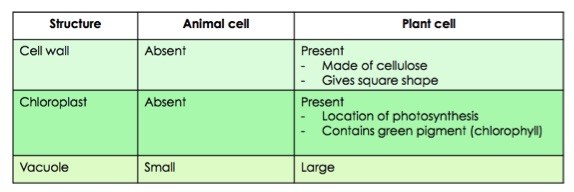
There's one more table that might be helpful since this topic seems to come up a lot on standardized tests. There are some major structural and organelle differences between animal and plant cells. Let's take a look at them.

Plant cells have some unique structures: cell walls, chloroplasts, and large vacuoles.

Image source: By Hannah Bonville

Key Vocabulary:

  1. Organelle
  2. Nucleus
  3. Ribosome
  4. Endoplasmic reticulum
  5. Golgi body (apparatus)
  6. Lysosome
  7. Vacuole
  8. Chloroplast
  9. Mitochondria
  10. Cell wall

Video

(Video) Introduction to Cells: The Grand Cell Tour

by Amoeba Sisters

This video will give you a brief introduction to the many organelles found in plant and animal cells. Some examples include the nucleus, endoplasmic reticulum (ER), Golgi body, mitochondria, chloroplasts, and vacuoles.

There are also some important structures that protect the cell like the plasma membrane and the cell wall, which is found in plants. These outermost parts of the cell control what goes in and out, helping the cell remain in a state of balance.

Type a concept, like “slope” or “photosynthesis”.

↑ ↓ to choose · Enter to openSearch explanations and problems