Read · 2 min

+1 contributors

###
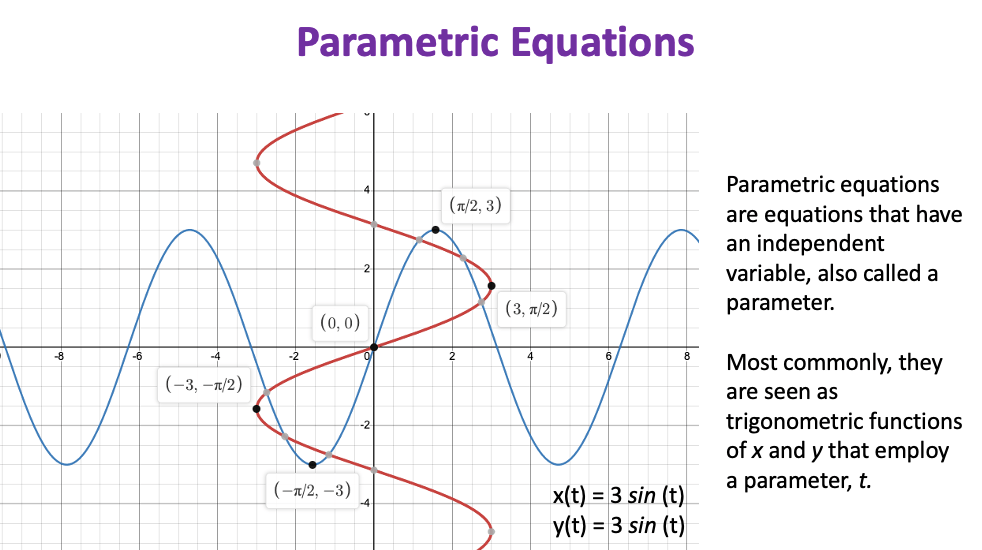
are equations that depend on another independent variable, conventially . Parametric equations are used to define parametric functions. To get a better understanding of what parametric functions entail, let us first discuss the features of a non-parametric equation. Parametric equations often describe motion using vectors that can be written and visualized.
###
First and foremost, a function is essentially an equation that relates a dependent variable, , to an independent variable, .
An independent variable is a variable that depend on the value of any other variable, while a dependent variable depend on an another variable.
For instance, take the function, The variable in this case could be any value, it does not depend on any other value in order to define it's value. The value of the variable, however, does depend on another variable, which is . will always be equal to . If , then , If , then , and so on and so forth. Given this, is the independent variable and is the dependent variable.
###
Given what we now know about how non-parametric functions are defined, we can now be able to pinpoint the crucial way in which parametric functions from non-parametric functions. As stated earlier, parametric equations are equations that depend on another independent variable, .
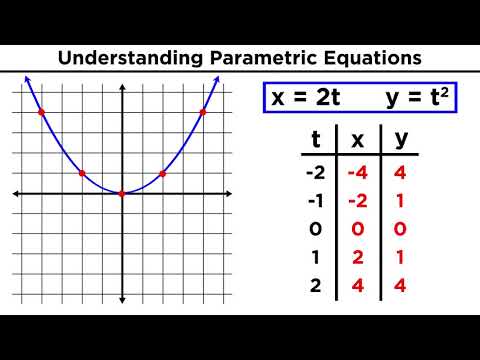
Say we have the functions, The output of both of these functions depends of the value of , the independent variable; it itself does not depend on another value. When we set the value of the parametric function equal to and the value equal to , we get these two relationships: These parametric equations are what define a parametric function.
Though, the independent variable is present in both equations representing and , parametric functions are typically written using two equations, because of the fact that the and variables each depend on the value of functions of .
In other words, the value of our value now depends on the value of the function , a function that itself depends on the independent variable , and the value of our variable now depends on the value of the function , which again itself depends of the value of .