What are Parametric Equations?

Read · 2 min

###What are Parametric Equations?‾\underline{\textbf{What are Parametric Equations?}}

Parametric Equations\textbf{Parametric Equations} are equations that depend on another independent variable, conventially tt. Parametric equations are used to define parametric functions. To get a better understanding of what parametric functions entail, let us first discuss the features of a non-parametric equation. Parametric equations often describe motion using vectors that can be written and visualized.

###How are Non-Parametric Functions Defined?‾\underline{\textbf{How are Non-Parametric Functions Defined?}}

First and foremost, a non-parametric\textbf{non-parametric} function is essentially an equation that relates a dependent variable, yy, to an independent variable, xx.

An independent variable is a variable that does not\textit{does not} depend on the value of any other variable, while a dependent variable does\textit{does} depend on an another variable.

For instance, take the function, y=x2y = x^{2} The variable xx in this case could be any value, it does not depend on any other value in order to define it's value. The value of the yy variable, however, does depend on another variable, which is xx. yy will always be equal to x2x^{2}. If x=2x = 2, then y=4y = 4, If x=5x = 5, then y=25y = 25, and so on and so forth. Given this, xx is the independent variable and yy is the dependent variable.

###How are Parametric Functions Defined?‾\underline{\textbf{How are Parametric Functions Defined?}}

Given what we now know about how non-parametric functions are defined, we can now be able to pinpoint the crucial way in which parametric functions differ\textit{differ} from non-parametric functions. As stated earlier, parametric equations are equations that depend on another independent variable, tt.

Say we have the functions, g(t)=t2+2t+4g(t) = t^2 + 2t + 4 h(t)=t3h(t) = t^3 The output of both of these functions depends of the value of tt, the independent variable; it itself does not depend on another value. When we set the xx value of the parametric function equal to h(t)h(t) and the yy value equal to g(t)g(t), we get these two relationships: y=t2+2t+4y = t^2 + 2t + 4 x=t3x = t^3 These parametric equations are what define a parametric function.

Though, the independent tt variable is present in both equations representing xx and yy, parametric functions are typically written using two separate\textit{separate} equations, because of the fact that the xx and yy variables each depend on the value of different\textit{different} functions of tt.

In other words, the value of our xx value now depends on the value of the function g(t)g(t), a function that itself depends on the independent variable tt, and the value of our yy variable now depends on the value of the function h(t)h(t), which again itself depends of the value of tt.

Video · + 1 min read

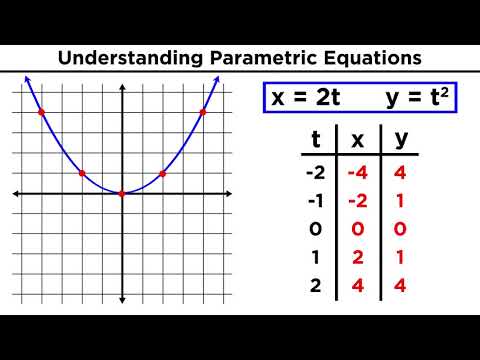
(Video) Parametric Equations

by Professor Dave Explains

This video by explains what parametric equations are and when you would use them.

Summary

So far, we've learned a lot about different types of equations where yy relates to xx. You may also be familiar with polar equations, where rr relates to θ\theta. This lesson covers parametric equations, where xx and yy depend on another variable.

xx and yy are calculated in separate equations, and each is dependent on some other variable. We see this concept a lot with two-dimensional motion of objects, such as projectile motion. Consider when you throw a ball into the air. The xx and yy motion are independent of each other (how high the ball goes is independent of how far the ball goes). This concept is more complicated, as there is both horizontal and vertical velocity, but you get gist of it. In these types of equations, it makes sense to have an equation that models the xx coordinate as a function of time and a separate equation that models the yy coordinate as a function of time.

x=f(t)x=f(t) y=g(t)y=g(t)

These are two separate functions that depend on the same variable, tt.

In terms of graphing, we can either graph these equations parametrically or normally. If we want to graph these types of equations in parametric form, we solve for xx and yy based on set values of tt, and then we graph the corresponding xx and yy points. If we want to graph normally (i.e., in rectangular form), we can use substitution to get rid of the third variable, tt.

Illustrated · 1 min

Parametric Equations

In this next section, we are going to learn about parametric equations.

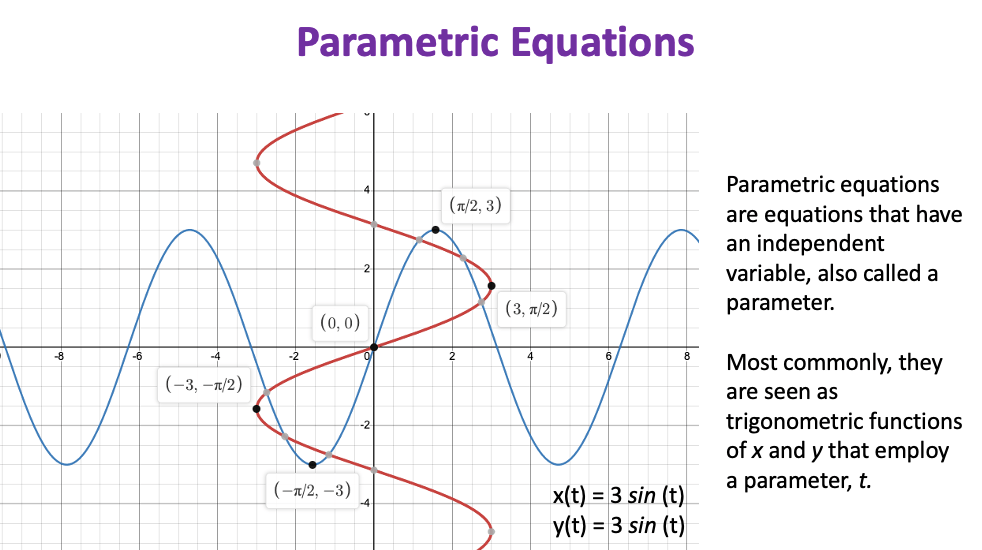
Parametric Equations

Parametric equations are equations that have an independent variable, also called a parameter.

Most commonly, they are seen as trigonometric functions of x and y that employ a parameter, t. 

Graph of: 
x(t) = 3 sin (t)
y(t) = 3 sin (t)

Image source: by Anusha Rahman & Made using Desmos

Parametric Equations

Parametric equations are continuous functions that have an independent variable, also called a parameter. We most commonly use parametric equations when dealing with trigonometric functions of xx and yy that employ a parameter, tt. You will see parametric equations with many common physics problems.

The above image is a graph of the set of parametric equations, x(t)=3sin(t)x(t) = 3 sin (t) and y(t)=3sin(t)y(t) = 3sin(t). These two equations are centered at the origin. Important points on the curve are labelled.

Once parametric equations are introduced, the next step is parametrizing a curve. To compare parametric equations with standard forms, you can convert them by finding rectangular equations from parametric equations.

Type a concept, like “slope” or “photosynthesis”.

↑ ↓ to choose · Enter to openSearch explanations and problems