What Are Periodic Functions?

Interactive · 1 question

Periodic Functions\text{Periodic Functions}

Here are some important definitions you'll need to know about periodic functions. \\ Periodic function: A function with a graph that repeats identically from left to right. It can be represented by f(x)=f(x+p)f(x)=f(x+p). \\ Period: The horizontal distance required for a complete cycle of the graph.\\ Frequency: 1period\frac{1}{\text{period}}\\ Phase shift: A horizontal shift of a periodic function. \\ Vertical shift: A shift up or down of a periodic function.\\ Amplitude: One half of the distance between the minimum and maximum yy values. This is always positive. \\

Now, we will discuss an example of a periodic function. f(x)=sin⁡(x)f(x)=\sin(x). Look at the graph below.

Graph of y=sin(x)

made using Desmos

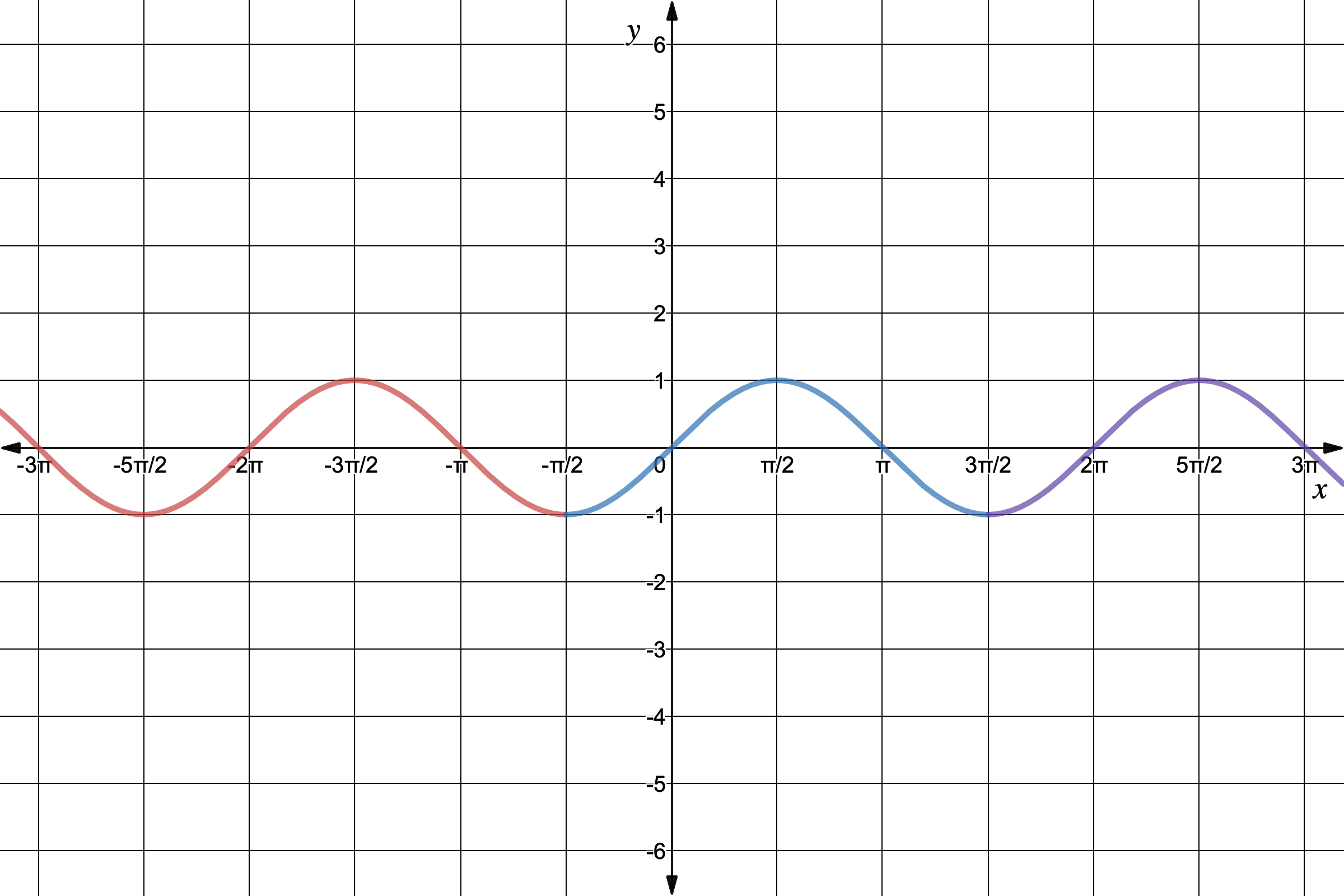
This function is periodic because it repeats identically. We can see that the graph on the interval (−3π2,π2)\left(-\frac{3\pi}{2}, \frac{\pi}{2}\right) is identical in the interval (π2,5π2)\left(\frac{\pi}{2}, \frac{5\pi}{2}\right). This means that f(x)=f(x+p)f(x)=f(x+p). We can see that below. The graph of sin⁡x\color{Red}\sin{x} is in red, the graph of sin⁡(x+2π)\color{Blue}\sin(x+2\pi) is in blue and the graph of sin⁡(x+4π)\color{purple}\sin(x+4\pi) in in purple. The blue and purple graphs both of a shift of pp and are still periodic.

Graph of y=sin(x), y=sin(x+2pi), y=sin(x+4pi)

made using Desmos

The period of this graph (sin⁡x)(\sin{x}) is 2π2\pi because that is the distance it takes for the curve to complete one cycle. \\ The frequency of this graph is 12π\frac{1}{2\pi}.\\ The amplitude is 11.

If you click on the continue button, we will look at a phase shift and a vertical shift of a periodic function y=cos⁡(x)y=\cos(x).

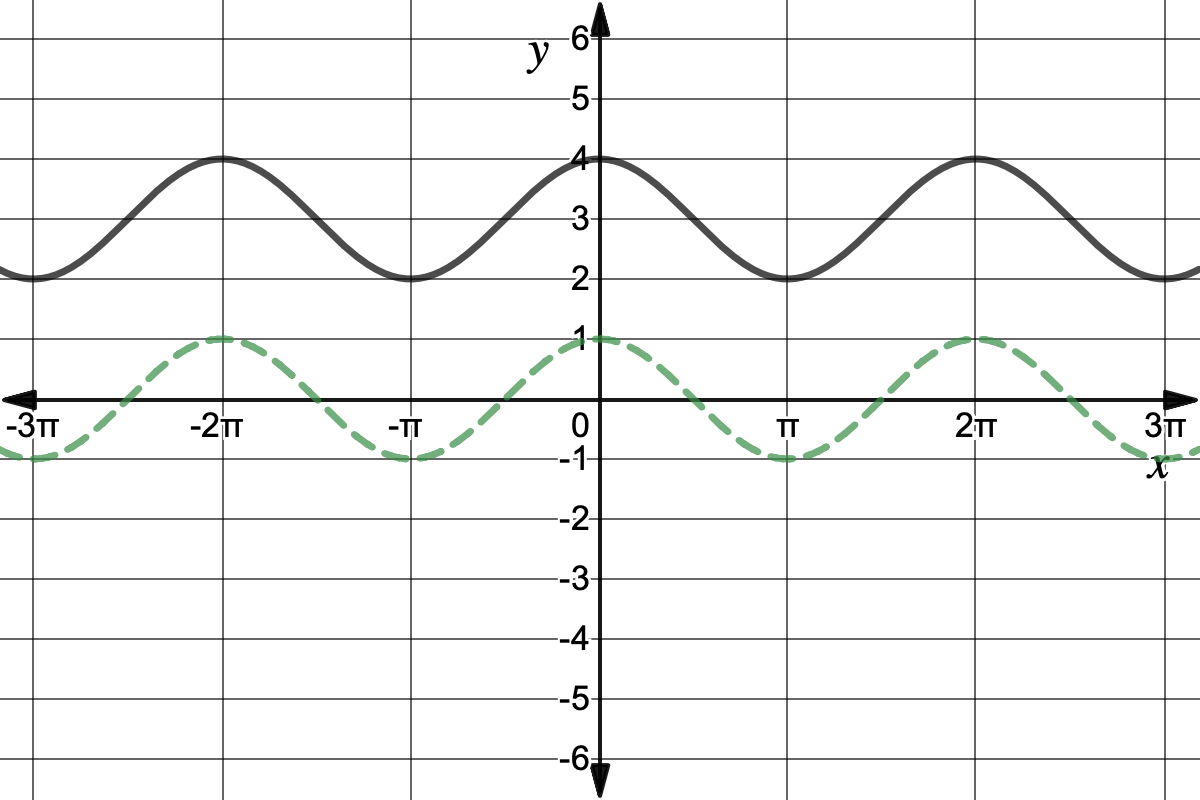
The graph below shows a phase shift right 22 units. The green dashed graph is y=cos⁡(x)\color{green}y=\cos(x).

Graph of y=cos(x) and y=cos (x-2)

made using Desmos

The black graph is a phase shift of the function y=cos⁡(x)y=\cos(x). It is the function y=cos⁡(x−2)\color{black}y=\cos{(x-2)}. It still has a period of 2π2\pi, a frequency of 12π\frac{1}{2\pi}, and an amplitude of 11. Now, we'll look at a vertical shift. The green dashed graph is y=cos⁡(x)\color{green}y=\cos(x).

Graph of y=cos(x) and y=cos(x)+3

made using Desmos

The black graph above is the function y=cos⁡(x)+3y=\cos(x)+3. It still has a period of 2π,2\pi, a frequency of 12π\frac{1}{2\pi}, and an amplitude of 11.

Now let's do a practice problem.

Which of the following are periodic functions?

Choose all correct answers

Illustrated · 1 min

Periodic Functions

When we have dealt with trigonometric functions, we were dealing with periodic functions, so we have seen these before!

Periodic function: functions that repeat themselves over an interval

Image source: by Anusha Rahman

A periodic function is a function that repeats itself over a regular interval. The sine and cosine functions are two very common periodic functions.

The period is the interval over which a periodic function repeats. The fundamental period is the smallest possible period of a particular function.

Common math questions may ask you to find the period, graph the periodic function given the period, or write an equation based on the graph of a periodic function. We've done these types of problems before with sine and cosine functions!

Video · + 1 min read

Intro to Periodic Functions

by Dina Yagodich

In this video by Dina Yagodich, you will learn about what periodic functions are and major characteristics.

Summary

A periodic function is a function whose graph repeats itself identically from left to right. Mathematically, this looks like:

f(x)=f(x+p) for all x f(x) = f(x+p) \text{ for all x }

The sine and cosine functions are examples of periodic functions.

The period of a function is the horizontal distance required for a complete cycle. On a standard function, the period goes from 00 to 2π2\pi in radians, or 0∘0^{\circ} to 360∘360^{\circ}. This won't be the case for all periodic functions, but they will be fairly standard for basic trigonometric (sine or cosine) functions.

The frequency of a function is the reciprocal of the period. Mathematically, that looks like:

frequency =1period\text{frequency }= \frac{1}{\text{period}}

A phase shift of a function is the horizontal shift of a periodic function. We can also think of this as a horizontal translation.

The amplitude of a function is half the distance between the maximum and the minimum values of a periodic function, or the distance to the midline. We can also think of this as the radius of a periodic function. Amplitudes will always be positive.

The vertical shift of a function is the vertical shift of a periodic function along the yy-axis. We can also think of this as a vertical translation.

Type a concept, like “slope” or “photosynthesis”.

↑ ↓ to choose · Enter to openSearch explanations and problems