
Interactive · 1 question
Here are some important definitions you'll need to know about periodic functions. Periodic function: A function with a graph that repeats identically from left to right. It can be represented by . Period: The horizontal distance required for a complete cycle of the graph. Frequency: Phase shift: A horizontal shift of a periodic function. Vertical shift: A shift up or down of a periodic function. Amplitude: One half of the distance between the minimum and maximum values. This is always positive.
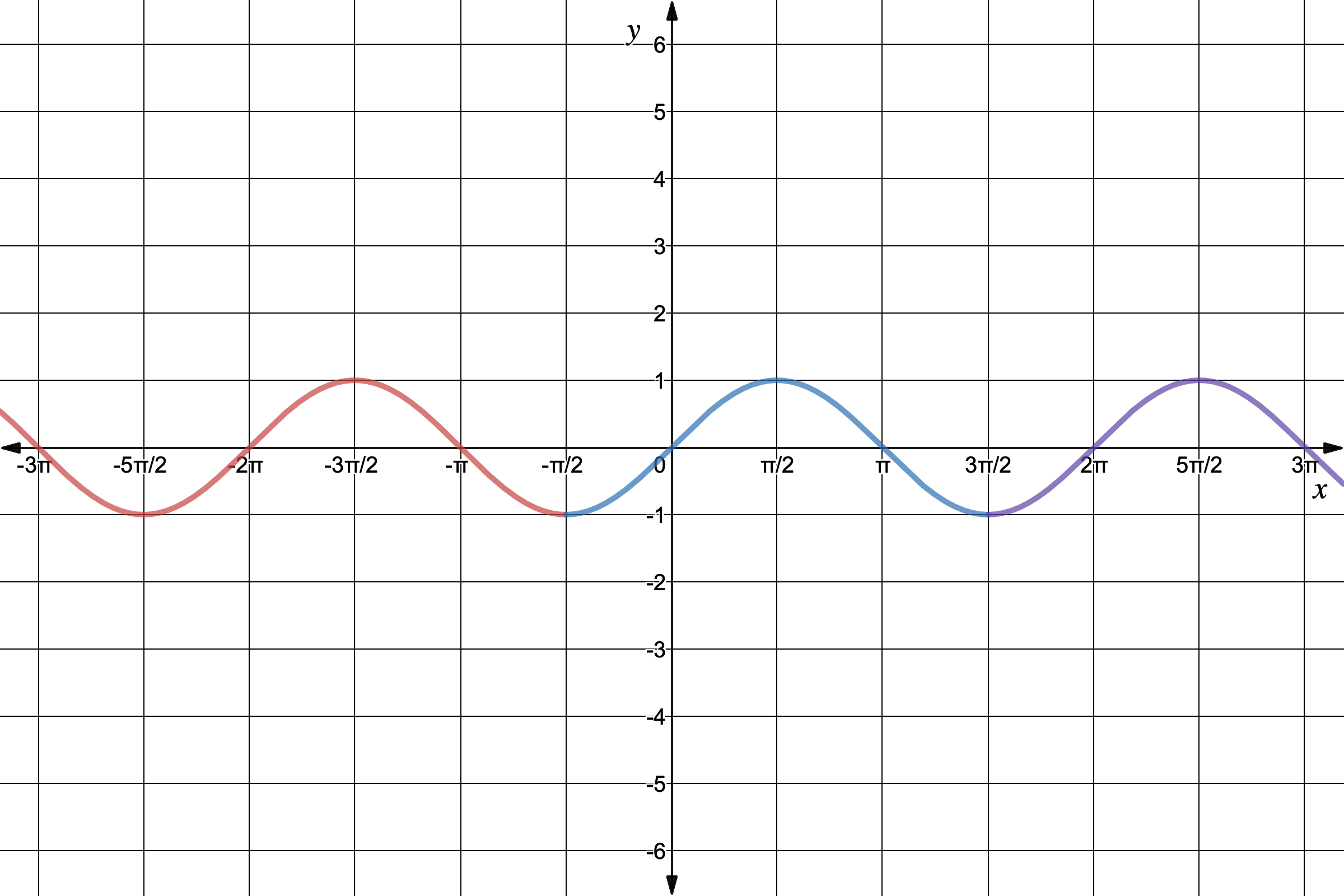
Now, we will discuss an example of a periodic function. . Look at the graph below.

made using Desmos
This function is periodic because it repeats identically. We can see that the graph on the interval is identical in the interval . This means that . We can see that below. The graph of is in red, the graph of is in blue and the graph of in in purple. The blue and purple graphs both of a shift of and are still periodic.
made using Desmos
The period of this graph is because that is the distance it takes for the curve to complete one cycle. The frequency of this graph is . The amplitude is .
If you click on the continue button, we will look at a phase shift and a vertical shift of a periodic function .
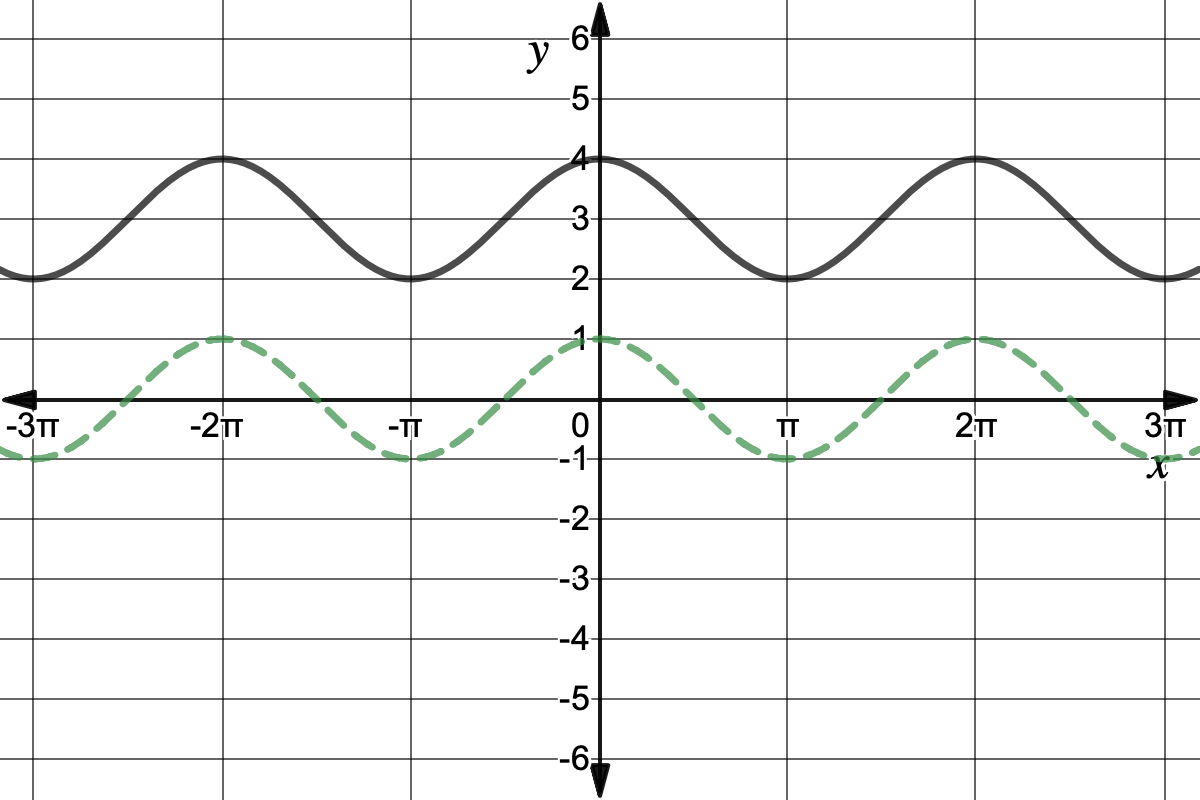
The graph below shows a phase shift right units. The green dashed graph is .

made using Desmos
The black graph is a phase shift of the function . It is the function . It still has a period of , a frequency of , and an amplitude of . Now, we'll look at a vertical shift. The green dashed graph is .
made using Desmos
The black graph above is the function . It still has a period of a frequency of , and an amplitude of .
Now let's do a practice problem.
Which of the following are periodic functions?
Now you know some more about periodic functions! Click the practice button to get more practice with these functions!


