What Are Proteins? — Structure & Function

Video

(Video) What Is a Protein?

by RCSBProteinDataBank

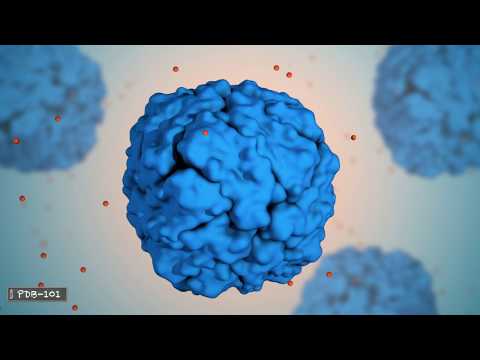
What happens once amino acids come together to form a protein? In this video, you can take a glimpse into the world of proteins. You'll learn about how they are made, their functions, their shapes, and specific examples like hemoglobin and collagen.

You'll also see how primary, secondary, tertiary, and quaternary structures are formed.

The image shows a stick figure with a muscular arm, flexing. The person is saying, "Protein is life, bro. Even if you don't lift."

Image source: By Valeri Natole

Illustrated · 2 min

What Are Proteins?

Proteins are polymers formed from monomers called amino acids joined together by peptide bonds. A chain of amino acids can also be called a polypeptide. (Anything with "pep" in it probably refers to a protein.)

The primary structure of a protein is the sequence of its amino acid chain.

Proteins are pretty much just long (sometimes incredibly long) chains of amino acids. In the picture above, the amino acids are represented by circles. Each amino acid is joined to its neighbor by a peptide bond.

Image source: By National Human Genome Research Institute [Public domain], via Wikimedia Commons

There are 20 amino acids from which all protein molecules are made. Some proteins contain just a few amino acids in a chain. Other proteins are chains of thousands of amino acids. The largest known protein is titin. It's made of a chain of 33,000 amino acids.

Here are the 20 amino acids. Note that many (though not all) have names ending in -ine. All amino acids contain nitrogen.

Each of the amino acids can be identified by looking at their R group. The R group can be polar, nonpolar, aromatic, positively charged, or negatively charged.

Image source: By CNX OpenStax CC BY 4.0, via Wikimedia Commons

All amino acids have four identical parts: An amino group, a carboxyl group, a central carbon, and a hydrogen. They only differ in their fifth part, which has many names. It can be called a functional group, R group, side chain, or amino acid residue. Let's go with functional group.

In the table above, the functional groups are highlighted in blue. Note how every other part of the amino acids is always the same.

What Do Proteins Do?

Proteins are the most diverse of the four biomolecules. In fact, they perform the majority of a cell's functions. For example, proteins can catalyze (speed up) reactions as enzymes, act as signaling proteins, transport molecules, replicate DNA, respond to stimuli, and form structures within cells.

Peripheral proteins are found on the outside of the phospholipid bilayer. Channel proteins and integral proteins, however, go the entire way through the membrane.

Image source: By Boumphreyfr (modified by expii) CC BY-SA 3.0, via Wikimedia Commons

Proteins are an important part of the cell membrane (also called the phospholipid bilayer or the plasma membrane). They are shown in blue above, nestled in amongst the phospholipids.

There are two types of membrane proteins you should know about:

Integral proteins go all the way through the membrane. Peripheral proteins don't go all the way through the membrane. They sit on one side or the other.

Image source: By Hannah Bonville

Here's how I remember the difference:

  • Integral proteins are well-integrated into the cell membrane
  • Peripheral proteins are like your peripheral vision—just on the side

As you can see in the picture, integral proteins can act like channels. They allow things to pass through the cell membrane more easily.

Proteins do not store energy; they are the workers of a cell.

This is so important that it's worth repeating: proteins are not energy storage molecules. Eating lots of protein will not give you a burst of energy.

Proteins do things. They perform and carry out the functions that enable a cell to move, use energy, respond to stimuli, and everything else that keeps a cell alive.

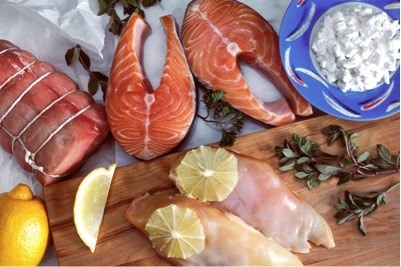
The image shows different forms of protein like meat, fish, and cottage cheese.

Muscles are made almost exclusively of proteins. So, when we eat meat products, we are eating animal muscle. This means that meat is high in protein. Dairy and nuts are also protein-rich foods.

Image source: By Unknown photographer [Public domain], via Wikimedia Commons

Vocabulary Review:\color{#8925AE}{\text{Vocabulary Review:}}

Monomer\color{#8925AE}{\text{Monomer}} : Any molecule that can react with other molecules of the same or different makeup to form a chain, or polymer

Polymer\color{#8925AE}{\text{Polymer}} : A chain of monomers made of a specific type of compound

Macromolecule\color{#8925AE}{\text{Macromolecule}} : A polymer that has a large (macro) molecular mass. There are four main types in organisms: carbohydrates, proteins, lipids, and nucleic acids

Amino Acids\color{#8925AE}{\text{Amino Acids}} : Molecules with a carboxyl group (−COOH)(-COOH) and an amino group (−NH2)(-NH_{2}). The building blocks of proteins

Polypeptide\color{#8925AE}{\text{Polypeptide}} : A molecule made up of peptide bonds, or covalent bonds, that hold amino acids together

Protein\color{#8925AE}{\text{Protein}} : Complex polymer made of carbon, hydrogen, nitrogen, and oxygen. They are made of amino acids

Illustrated · 2 min

Levels of Protein Structure

A protein's shape determines its function. This shape is determined by how the protein's amino acids are folded. The shape has four levels of complexity:

  1. Primary: The primary level of a protein is the sequence of its amino acids. These chains form through dehydration synthesis by ribosomes in the cytoplasm of a cell. The ribosomes bring in the amino acids that correspond to the RNA sequence and join them together with peptide bonds.

A peptide bond is a covalent bond formed between the amino group of one amino acid and the carboxyl group of a different amino acid. The arrangement of amino acids in a polypeptide chain is dictated by DNA.

Proteins are made of a specific sequence of amino acids.

The primary structure of proteins is just a chain of amino acids.

Image source: By National Human Genome Research Institute (NHGRI) [Public domain], via Wikimedia Commons

  1. Secondary: Proteins can have unique secondary structures depending on the functional groups on each amino acid. Secondary structure refers to how these functional groups form hydrogen bonds and interact with each other based on their specific properties like polarity and charge. This produces two different shapes: the α helix (alpha helix) and β sheet (beta sheet). There will be many of these shapes varying in size per protein.
The secondary protein structure forms when amino acids form hydrogen bonds and become alpha helices and beta pleated sheets.

The hydrogen atoms in proteins align themselves into these shapes. There will be many of these per protein.

Image source: By CNX OpenStax CC BY 4.0, via Wikimedia Commons

  1. Tertiary: The tertiary structure forms when different secondary structures align and fold into a final shape. This level uses many different kinds of bonds.
Primary protein structure is a sequence of amino acids. The secondary protein structure occurs when the amino acids are linked by hydrogen bonds. The tertiary protein structure occurs when certain attractions are present between alpha helices and beta-pleated sheets. The quaternary structure is a protein consisting of more than one amino acid chain.

Image source: By NHGRI [Public domain], via Wikimedia Commons

  1. Quaternary: The quaternary structure is when different protein sub-units come together to make a protein complex. Not all proteins are protein complexes.
A fully assembled protein. Two distinct sections are visible: one with red helices and one with blue helices.

Image source: By Zephyris at the English language Wikipedia CC BY-SA 3.0, via Wikimedia Commons

An Example of Protein Formation

Okay, so let's say we want to make the protein hemoglobin (pictured above), which carries oxygen in red blood cells.

  1. First, the cell takes the segment of DNA (a nucleic acid) that codes for the protein and transcribes it into an mRNA molecule.
  2. This mRNA molecule is transported out of the nucleus and into the cytoplasm. There, ribosomes read the mRNA and create a sequence of amino acids.
  3. This sequence of amino acids then arranges itself into alpha helices and beta-pleated sheets.
  4. These two shapes then twist and arrange themselves into the best possible form using a bunch of different bonds.
  5. Then, two separate segments (red and blue in the picture above) arrange themselves into the final protein complex called hemoglobin.

Type a concept, like “slope” or “photosynthesis”.

↑ ↓ to choose · Enter to openSearch explanations and problems