
Illustrated · 3 min

+2 contributors

Simply put, rigid motions are transformations that preserve the side lengths and angles in a shape. You can see any of these transformations by moving an object you may have around you right now. Grab your notebook or phone and slide it across the desk you're working on. Now turn it so it's facing sideways. Now flip it over on one of its edges so you're looking at the back side of it. All of these motions are rigid motions.
Let's get into some more formal definitions with some wonderfully drawn MS Paint pictures.

Translation
A translation is a transformation that pushes or slides an object. On the picture above, the triangle has just moved to the right a little bit, while keeping its shape. The slide could be in any direction on the plane as long as it keeps its shape, and stays facing the same way.

Rotation
A rotation is exactly what it sounds like. When the shape turns, you have a rotation. In the picture above, the triangle is turning clockwise. You can rotate a shape clockwise or counter clockwise, and for any number of degrees. Once again, the shape is preserved, but now it has a different corner on the bottom, and is facing a different direction. Think of turning a doorknob, when you turn it to one direction, the doorknob still remains the same shape.

Reflection
A reflection is when a shape flips. In this case, the triangle has flipped to the right over an imaginary line in the center. You can flip a shape in any direction and over any part of itself, but this can be a little harder to visualize on your own, so here is a picture showing some other types of flips.

Multiple reflections
As you can see, horizontal reflections result in the same shape, and vertical reflections result in the same shape. What has changed between them is what point is being flipped on. For the upwards reflection, the shape is being flipped on the top corner of the triangle, while the downwards reflection is being flipped on the bottom side. The same goes for the horizontal reflections. The right reflection is being flipped on the right most point, and the left reflection is being flipped on the left side.
Let's think about these rigid transformations in a way that is a little big more familiar by using a screen shot from a level in Super Mario Maker.
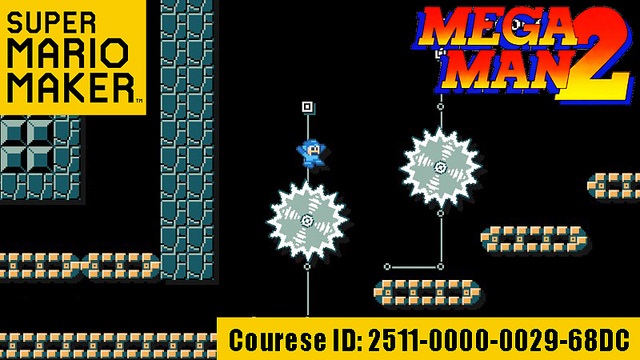
Image by AntMan3001 via Flickr
While this screenshot doesn't have many objects in it, they can demonstrate every rigid transformation.
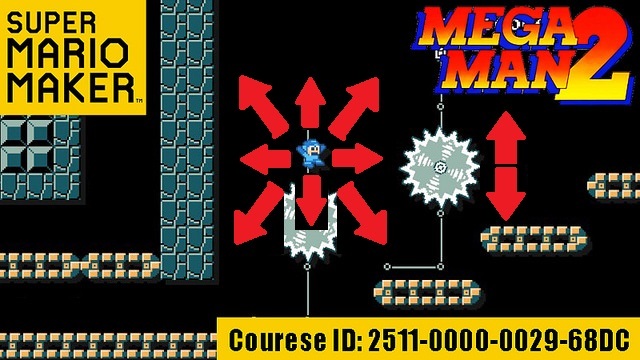
Image by AntMan3001 via Flickr
The arrows here show the translations within the stage. The saws can move up and down on their tracks, while your character can move in any direction that you want them to. While they move, they retain their shape, otherwise the game wouldn't work as intended. The only slight difference here is that your character may have a slightly different sprite while jumping, but that can be ignored for the sake of visualizing the translations.

Image by AntMan3001 via Flickr
The rotations are shown in this level by the saws. While the saws move up and down on their tracks, they rotate along their center, showing the player that they will in fact cut you up if you land on them.

Image by AntMan3001 via Flickr
Each time your character moves right or left, they will always face the direction they are moving. In the above picture, let's say you notice that you're going to hit the saw, so you choose to start moving back towards the platform that you jumped from. Your character flips horizontally so they are facing the direction they are moving, while still staying the same exact size and the same position they were in before moving.
To review, the rigid motions are translations (slides), rotations (spins/turns), and reflections (flips). All of these types of motions occur without changing the shape of the object or figure being moved.

