Interactive · 1 question

Finding the nnth roots of unity

What is a nnth root of unity?

Choose one answer

No recipe to follow

These problems have no steps to copy. You have to understand the idea well enough to bend it to a new purpose. These are real problems from the AMC 12 and AIME, the national math competitions for middle and high school students, each with a worked solution on LIVE by Po-Shen Loh.

Read · 1 min

Roots of Unity

Here, we focus on the roots of a specific form of a polynomial, namely xn−1=0x^n-1=0. The roots of this polynomial form are called the Roots of Unity. Many interesting things can be found out about the roots of unity, and we will find a generalization for them in terms of n as well.

Let's begin with x3−1=0.x^3-1=0. We can quickly factor this with common factoring techniques to achieve x3−1=(x−1)(x2+x+1)=0.x^3-1=(x-1)(x^2+x+1)=0. Thence, the three roots are:

1,−1+i32,−1−i32.1, \frac{-1 + i\sqrt{3}}{2}, \frac{-1 - i\sqrt{3}}{2}. In exponential notation, they are e0e^0, e2πi/3e^{2\pi i/3}, and e4πi/3e^{4\pi i/3}

We now plot them on the unit circle.

You get an equilateral triangle.

Interesting! Let's continue onto x4−1=0x^4-1=0. We can quickly factor and notice that x4−1=(x2−1)(x2+1)=0x^4-1=(x^2-1)(x^2+1)=0. So, the four roots are:

1,i,-1,-i. In exponential notation, they are e0,eπ/2,eπi,e3πi/2e^0, e^{\pi/2}, e^{\pi i}, e^{3\pi i/2}

Again, we plot them on the unit circle.

You get a square.

They can be proved, but now we list our generalizations.

For any given polynomial of the form xn−1=0x^n-1=0, The complex number e0,e2πi/n,e4πi/n,e6πi/n,...,e2(n−1)πi/ne^0, e^{2\pi i/n}, e^{4\pi i/n}, e^{6\pi i/n}, ... , e^{2(n-1)\pi i/n}.

When graphed on the unit circle, these roots of unity will always, when connected, form a regular n-gon.

Lastly we explore primitive roots of unity.

An nthnth root of unity, zz, is called a primitive nth root of unity if zn=1z^n=1 and zkz^k does not equal 11 for k=1,2,3,...n−1.k=1,2,3,...n-1. As expected, we can make a generalization for these special roots of unity.

If gcd(k,n)=1gcd(k,n)=1, then ω=e2πik/n\omega=e^{2\pi ik/n} is a primitive nth root of unity, and 1,ω,ω2,...ωn−11, \omega, \omega^2,...\omega^{n-1} are all nthnth roots of unity.

Interactive · 4 questions

Roots of unity are interesting because they are both algebraic and trigonometric: they have a nice representation as the roots of a polynomial (xn−1x^n-1) and as complex numbers (cis2πkn\text{cis} \frac{2\pi k}{n}). We can often combine these to prove some surprising results; the following problem is an example of one.

Show that

cos⁡(0)+cos⁡(π/11)+cos⁡(2π/11)+…+cos⁡(21π/11)=0.\cos(0) + \cos(\pi/11) + \cos(2\pi/11) + \ldots + \cos(21\pi/11) = 0.

The key idea is to bring in complex numbers. This might seem odd - but as we'll see, this simplifies the problem greatly.

How can we use complex numbers to modify this equation a little?

Choose one answer

Video

(Video) Example of Roots of Unity

by PatrickJMT

In this video by PatrickJMT, you will learn about an example of the Roots of Unity.

Illustrated · 1 min

Roots of Unity

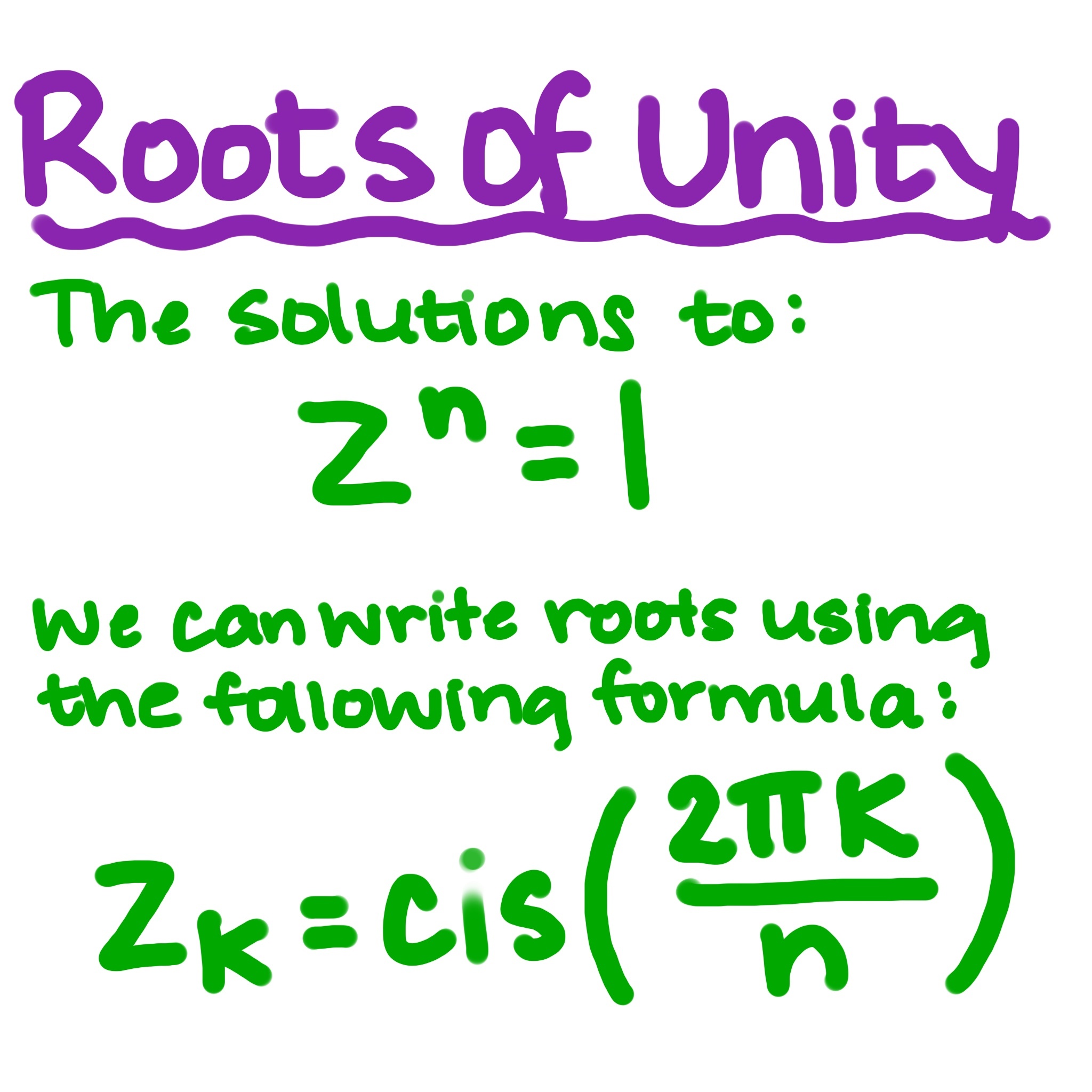
The roots of unity are special complex numbers that, when raised to a certain power, equal 11.

Roots of Unity

Image source: by Anusha Rahman

For example, the square roots of unity are the numbers that satisfy z2=1z^2=1. These are just 11 and −1-1 because both numbers squared give 11.

In general, the n^{th} roots of unity are the solutions to the equation: zn=1z^n = 1

This means that we are looking for nn complex numbers that, when multiplied by themselves nn times, give 11.

One of these roots is always z=1z=1, but the rest of the complex numbers that form a regular polygon on the unit circle in the complex plane. That's because all roots of unity have a magnitude, rr, of 11 and are evenly spaced around the circle.

We can write them using polar form: zk=cis(2πkn)z_k = \text{cis}(\frac{2\pi k}{n})

, where k=0,1,2,...,n−1k=0,1,2,...,n-1

These are called the "n-th roots of unity" because each one is a "unity" (i.e., has a magnitude of 11), and together, they complete a full circle.

Type a concept, like “slope” or “photosynthesis”.

↑ ↓ to choose · Enter to openSearch explanations and problems