
Interactive · 2 questions

+3 contributors



Sets and Roster Form
A set is a collection of distinct objects, and these objects are called elements of the set. These elements can be anything: numbers, shapes, symbols, animals, colors, even other sets. In later lessons, you will learn how to do cool things with sets, like find unions and intersections!
Here is an example of a set of shapes. Notice that each element is distinct, which means there are no repeats.

Image source: by Caroline Kulczycky
We can also have sets of numbers. Consider the set of even numbers between and inclusive. We can represent this set with a picture (like the above picture of a set of shapes), but we can also represent it in a different way: roster form.
To write a set in roster form, all you have to do is list each element of the set, separated by commas, within a pair of curly braces! Let's look at the example above of the set of even numbers between and inclusive. Let's call this set In roster form, we represent in the following way: Each element of is included within the curly braces!
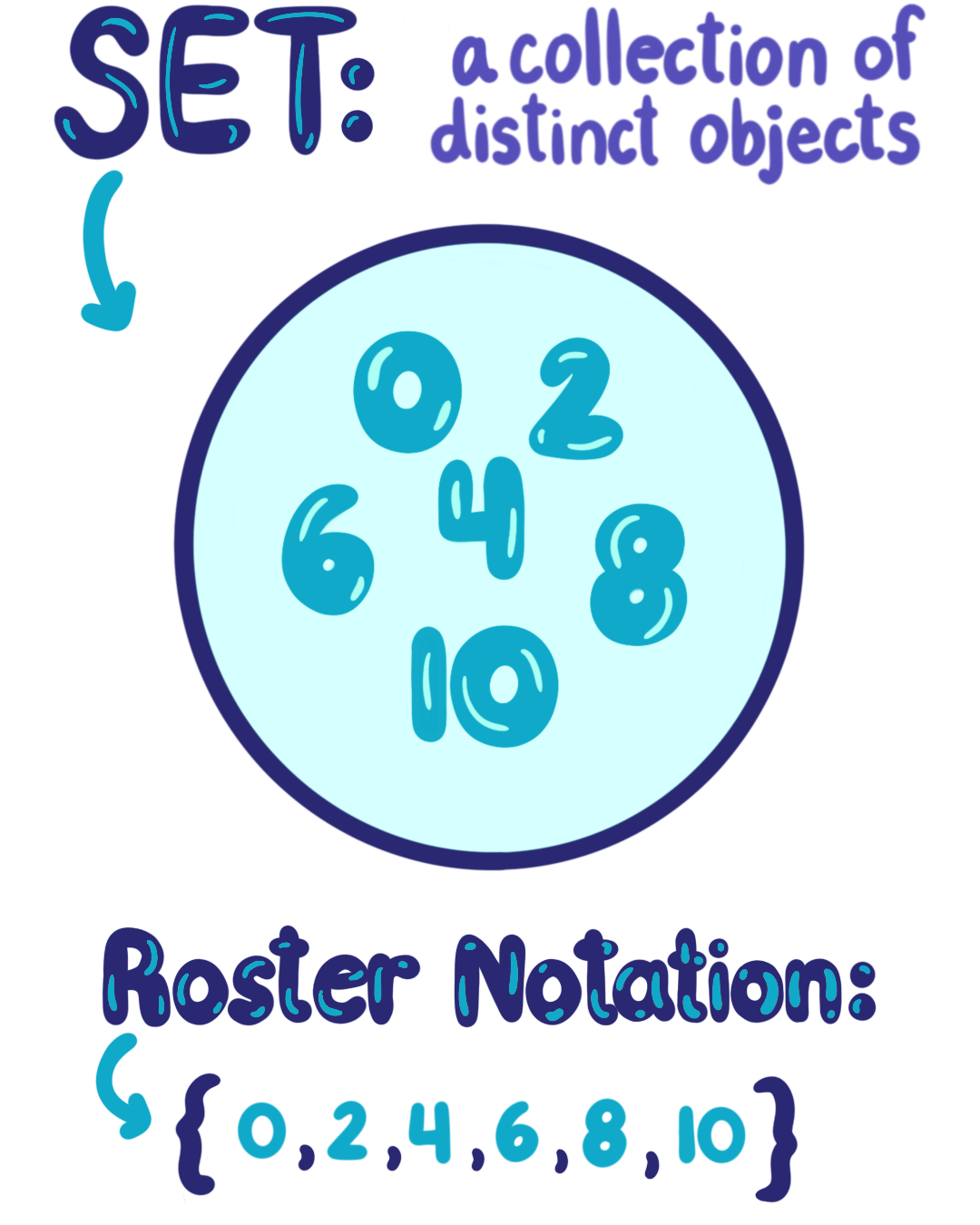
Image source: by Caroline Kulczycky
Note: Sets are unordered, which means that you can write their elements in any order in roster form. Thus, we could have also written: or or any other way of ordering the elements of the set. All of these ways of writing in roster form are the same! However, when working with numbers, we usually just write the elements of the set in numerical order.
Here are some important sets in roster form:
In roster form, the ellipses mean that the set is infinite. For example, in the roster form of the set of natural numbers, we use ellipses to show that the natural numbers keep going and going after
Let's do some examples to practice what you've learned about roster form!
Which of these sets is in roster form? Check all that apply.
Remember, roster form means that we list each element of the set within curly braces.
- doesn't list elements within curly braces, so it isn't in roster form.
- is in the correct roster form.
- does not list each distinct element separately, so it isn't in roster form. This is another kind of notation called "set-builder notation."
- does not list each distinct element separately, so it isn't in roster form.
Let's do one more!
Olivia has seven pens: one red, one orange, one yellow, one green, one blue, one purple, and one pink. Her favorites are the pink pen and the purple pen. How can you describe the set of Olivia's favorite pens in roster form?
- does not describe Olivia's set of favorite pens, which are pink and purple. This set is in roster form, but it is not the set we are looking for.
- doesn't list Olivia's favorite pens, pink and purple, separately. Thus, it isn't in roster form.
- doesn't use curly braces, so it isn't in roster form.
- and are both in roster form, because they list each of Olivia's favorite pens within curly braces. Remember, we can write these pens in any order, and the set will still be the same!
