Video
Overview of Cell Cycle Control

At various points in the cell cycle, there are checkpoints. The cell cycle control system is a set of molecules that either trigger or stop events in the cell cycle at various checkpoints.
References
 In development
Video
Overview of Cell Cycle Control
At various points in the cell cycle, there are checkpoints. The cell cycle control system is a set of molecules that either trigger or stop events in the cell cycle at various checkpoints.
References
Interactive · 1 question
As a reminder, mitosis is the process by which a cell creates an identical copy of itself. Mitosis is different from meiosis, in which a gamete is formed. It is important to remember that mitosis creates genetically identical cells.
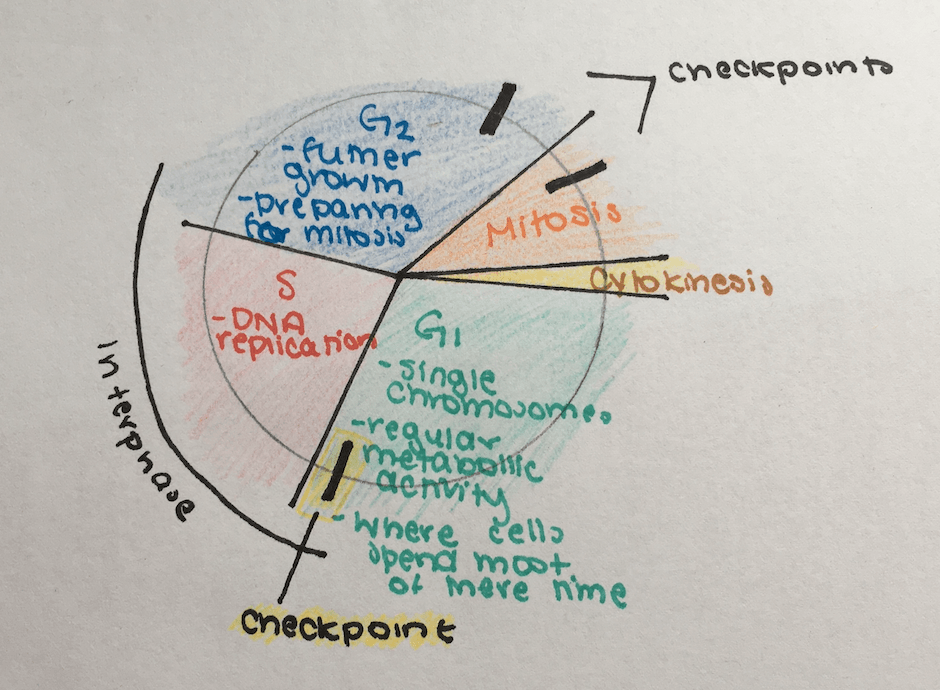
The cell cycle can be split into different sections based on the cells actions: **G1: **The cell is metabolically active and is growing. Chromosomes are single and replicated. **S: **DNA replication occurs **G2: **More growth in preparation for mitosis **M: **Mitosis
*G1, S, and G2 all constitute interphase
During many of these phases, there is a checkpoint to ensures that everything that happened in the last step went correctly, and also promotes the cell into the next stage of the cell cycle. These checkpoints correlate to specific internal signals, and the reception of these signals is what allows the cell to go from one phase to the next. This prevents the body from making a copy of a cell with a mutation or other abnormality and also prevents uninhibited/unregulated cell growth.
Below is a diagram that quickly reviews the cell cycle and the areas where different check points occur:
Don’t understand the cell cycle? Don’t worry! Check out the bottom of this page for links to better your understanding.
The checkpoint highlighted in the yellow box is the checkpoint we will be focusing in on. This checkpoint is particularly important because it is what allows the cell to get ready to duplicate its DNA in the S phase. DNA duplication is energy costly for the cell, so there are certain molecules always active in the cell that prevent DNA duplication. If the cell does not go through this checkpoint, it will not be able to start duplicating its DNA.
This checkpoint is so important for the cell that it is sometimes referred to as the** restriction point. **
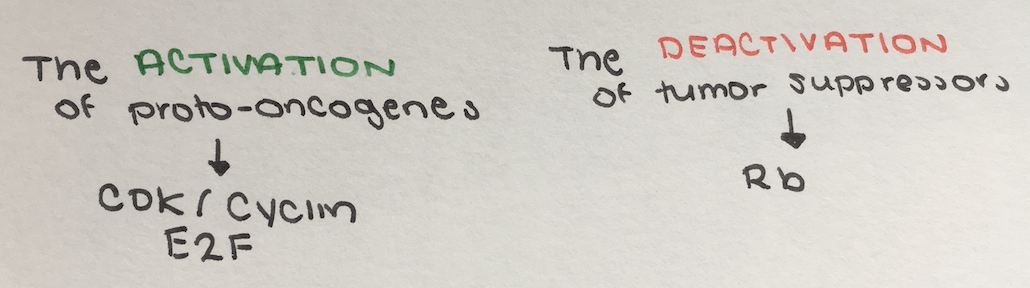
First, the cell needs to deactivate tumor suppressors. Tumor suppressors are molecules that are usually active in a cell. Normally, tumor suppressors are a good thing--they prevent tumors, the cause of cancer! But in order for the cell to pass into the S phase, the cell has to turn off these suppressors. The tumor suppressor that we will be focusing in on is the retinoblastoma protein suppressor, Rb.
Once tumor suppressors are deactivated, nothing is preventing the cell from entering S phase, but at the same time, nothing is promoting the transition. This leads to the second process that must occur: the activation of proto-oncogenes. Proto-oncogenes are molecules that promote cell growth. Proto-oncogenes are normally deactivated in the body, and therefore need to be activated. We will be focusing in on three proto-oncogenes: The Cyclin-dependent Kinase (CDK), Cyclin, and the E2F transcription factor.
Essentially, proto oncogenes have the opposite of function of tumor-suppressors.
To summarize, this is what we will be focusing in on:
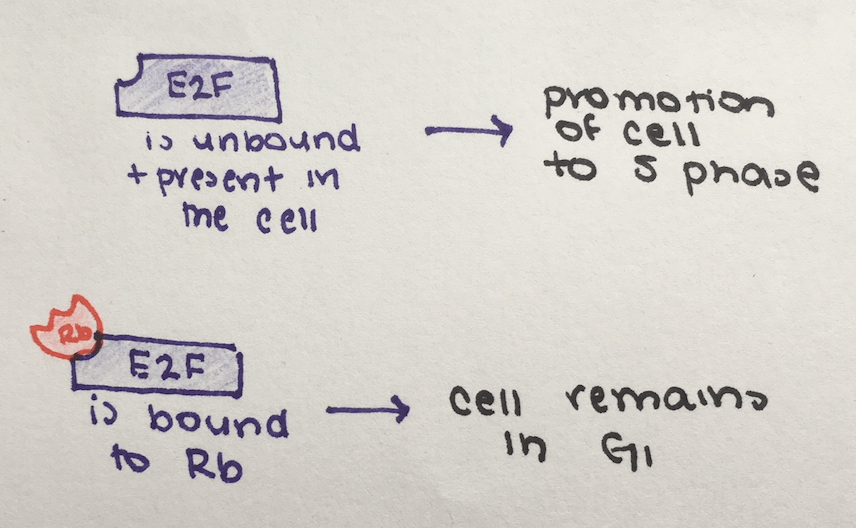
As mentioned before, tumor suppressors are usually active in the cell. Rb is no exception to this. Rb works by binding to E2F (one of the proto-oncogenes discussed above). When Rb is bound to E2F, E2F is not able to function, and therefore cannot promote DNA replication.
Check in: What could happen if there was no tumor suppressor in a cell?
When the cell is ready to transition into S phase, though, it needs to remove Rb from E2F. In order to do so, the cell needs an external chemical signal called a growth factor. Once the cell receives this growth factor, the growth factor promotes a signal transduction pathway that leads to the synthesis of Cyclin.
*Don’t understand what a signal transduction pathway is? Check out the bottom of this page for links to better your understanding. *
The newly synthesized Cyclin then binds to a Cylin-Depedant Kinase (CDK). Although Cyclin is not always present in the cell and needs a signal to activate its synthesis, CDK molecules are always present. The Cyclin/CDK complex plays a major role in the transition between phases of the cell cycle.
Cyclin binds to CDK through an allosteric site. This means that Cyclin does not bind to the active site of the molecule, but rather a different area that has the correct shape for cyclin. When cyclin binds, CDK changes shape, exposing the active site of CDK. This active site is able to phosphorylate, or add a phosphate group to, other molecules.
Want to learn more about the CDK/Cyclin complex? Check out the bottom of this page for links to dive into more information!
Don’t understand allosteric and active site bonding? Don’t worry! Check out the bottom of this page for links to better your understanding.
The activated CDK phosphorylases Rb. When a phosphate group is added to Rb, it changed the shape of Rb, preventing it from binding to E2F.
Now E2F is not bound to Rb, allowing it to act as a proto-oncogenes and promote the transcription of proteins involved in DNA replication.
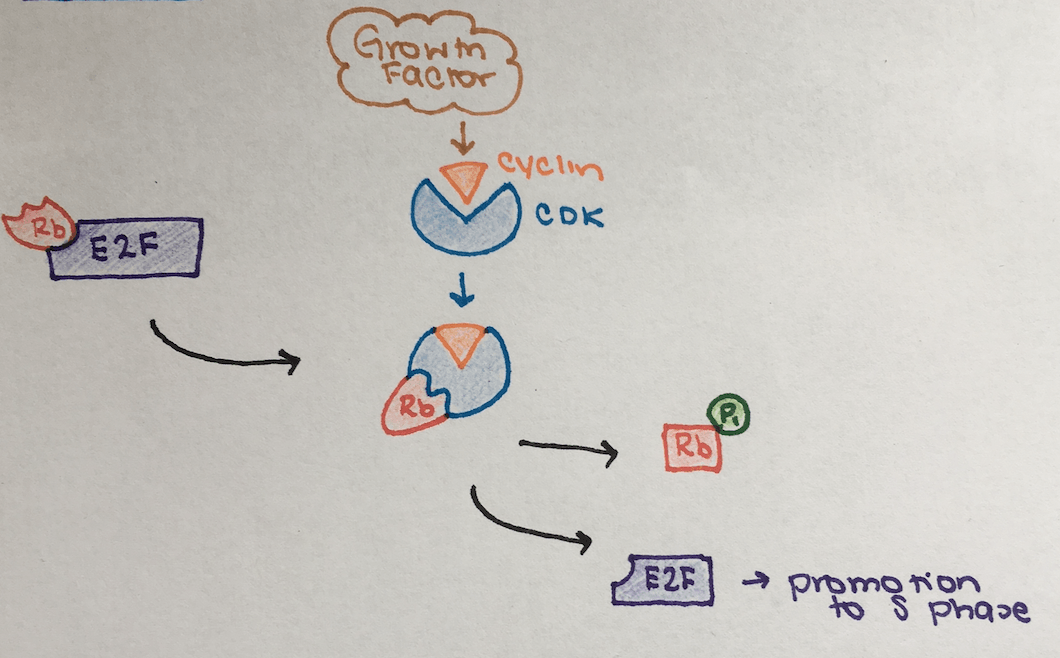
CHECK IN: this system has a lot of moving parts--try recreating this diagram on your own. In order to internalize the information, imagine what would happen if different parts of the system weren’t active. What if cyclin wasn’t synthetized? What if E2F was being deactivated by another molecule?
At this point, you may be curious where E2F comes from, since it is not always present inside the cell. The signal transduction pathway that produces cyclin also produced E2F. However, Rb binds to E2F immediately after it becomes present in the system.
Links to further your understanding:
The cell cycle: https://www.expii.com/t/what-is-the-cell-cycle-10153
Signal Transduction Pathways: https://www.youtube.com/watch?v=FtVb7r8aHco&t=84s (no need to understand specifics, just a general understanding of the idea and why we need signal transduction pathways—only need to understand till 0:40)
CDK/Cyclin: https://www.youtube.com/watch?v=542CMooowNY -- great link if you want to dive into more information about the CDK/Cyclin system, but don’t need to know the specifics beyond what is mentioned in this article to understand this checkpoint concept
Active sites: https://www.expii.com/t/substrates-10086
Allosteric Sites: https://www.youtube.com/watch?v=ok9esggzN18