Video · + 1 min read
+5 contributors




(Video) Translating Absolute Value Functions
by Keith Mann

There are two ways we will learn to translate a function: Horizontal and Vertical. Keith Mann explains both. Skip to for vertical translations. Skip to for horizontal translations.
This video explains both vertical and horizontal translations of absolute value functions.
For a challenge, let's compose these translations so that our new function is shifted units down and unit left!
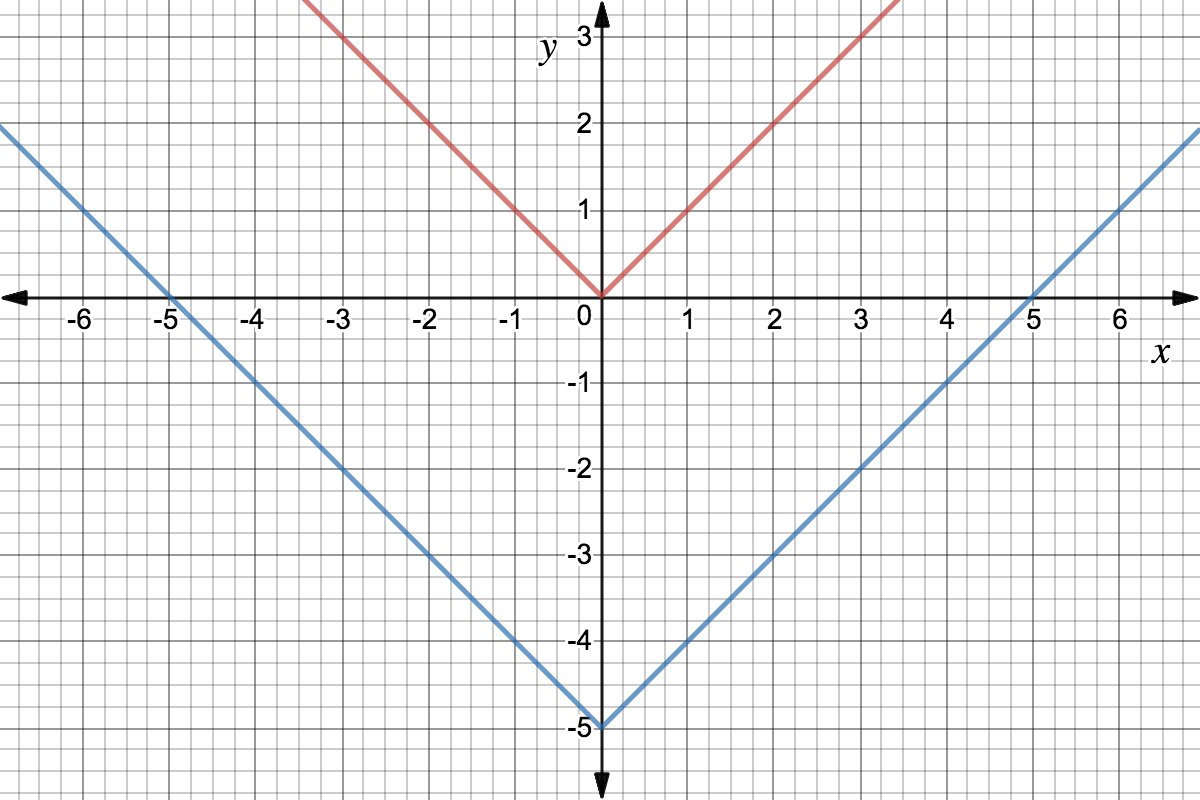
First, let's translate the original absolute value function, , five units down. This means we move every point on the original absolute function down five units.
Here are the graphs of the functions:
Graph courtesy of Desmos
The red function is and the blue function is Notice that looks similar to our original function, except it is shifted vertically downward by units.
We can represent vertical shifts downwards by subtracting a positive number from our function outside of the absolute value signs. We can represent vertical shifts upwards by adding a positive number to our function outside of the absolute value signs.
Now, let's translate out new absolute value function, , one unit to the left. After watching the video, we see that this clearly means we move every point on to the left by one unit.
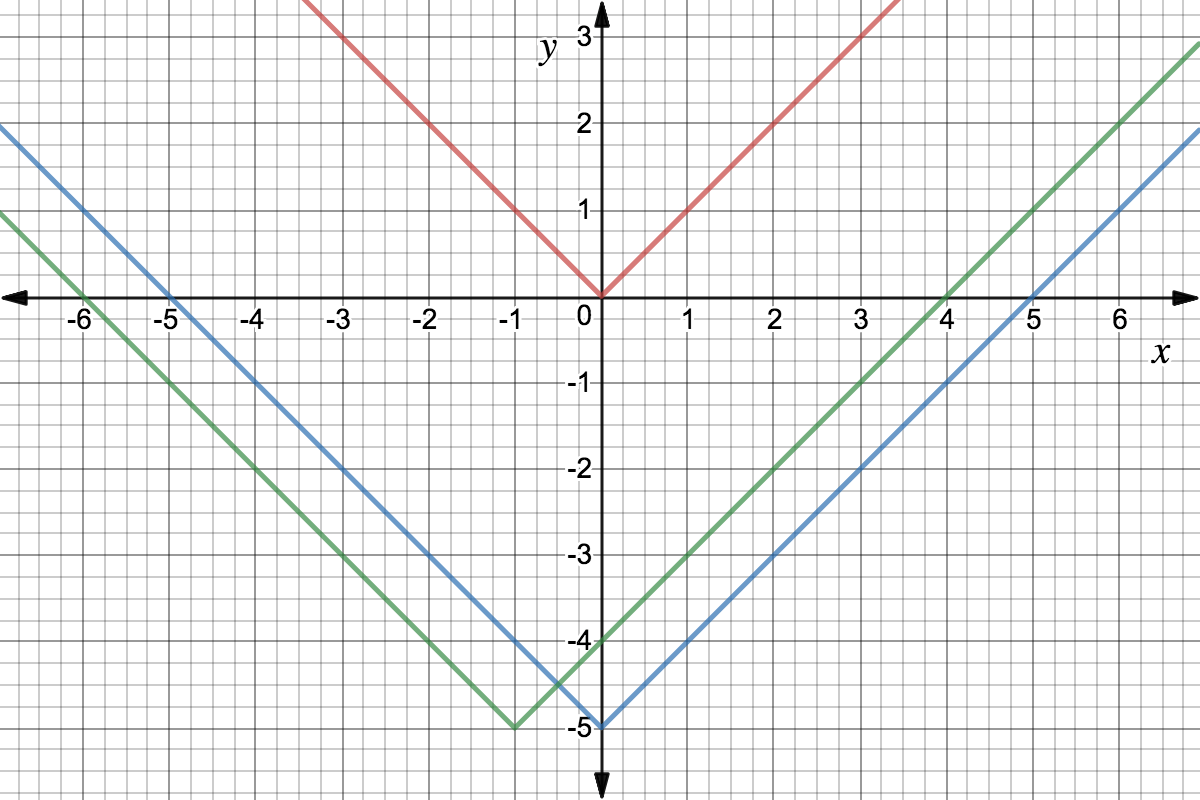
Graph courtesy of Desmos
The red function, and the blue function, are the same as before. We obtained the green function, , by horizontally translating by one unit to the left. Notice that looks similar to our original functions, except its vertex is at .
When we are working with absolute value functions, we can represent horizontal shifts to the left by adding a positive number to our function inside of the absolute value signs. We can represent horizontal shifts to the right by subtracting a positive number=from our function inside of the absolute value signs.