Interactive · 1 question

+2 contributors


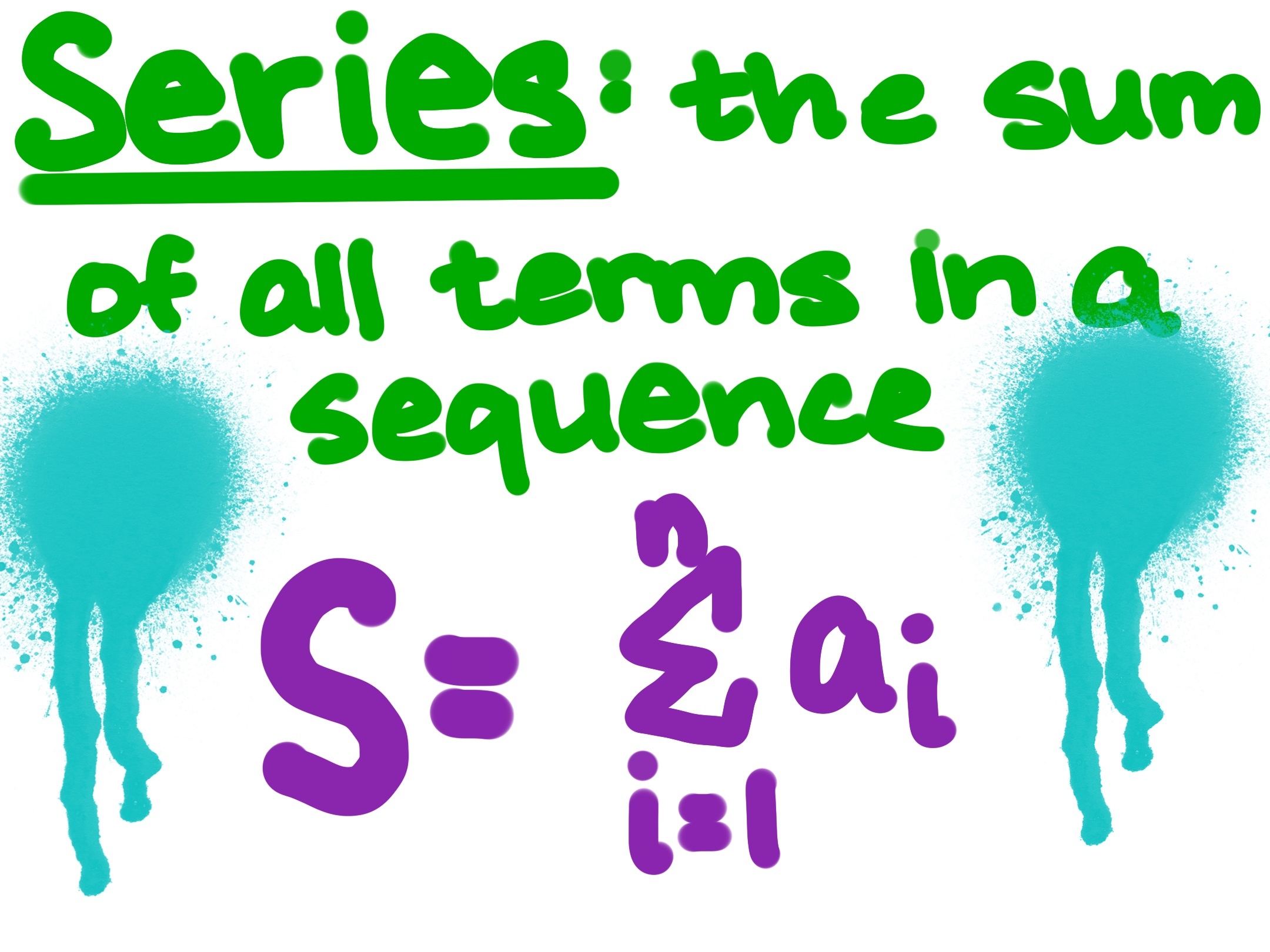
At its core, a series is a sum of terms denoted something like this: This notation means that we are allowing the variable to iterate through all values from to , resulting in so we can essentially think of a series as a sum of terms in a sequence .
Let's look at a concrete example. Consider the series This is the sum of the terms in the sequence so we're just taking things to the next level here.
Series are some really cool things to investigate, and looking at the behavior of series comprises a large part of higher math. The reason is because we can consider how they behave as we add more and more terms of the series.
Let's look at a sequence of partial sums. True to their name, they are the sums obtained when you only add together part of a series. For example, consider the series In order, the partial sums are As we continue writing out these terms, it turns out that they get infinitely close to . Since they are approaching a specific number — — we would call this series convergent (convergent series).
If a series does not end up approaching a specific number, we would call it divergent (divergent series).
Let's consider again the series . Is it convergent or divergent?
It turns out that this series is actually divergent! The series is known as the harmonic series. Even though each term in the corresponding sequence is getting infinitely close to , the series doesn't actually converge.
The reason for this divergence can be shown via many methods later on in your math journey, so keep on learning if you're interested in the deeper machinations of series.
To check out more, go explore some of the other sections explaining how series work!