What Is a Suspension? — Overview & Examples

Illustrated · 1 min

Suspensions

A suspension is another type of chemical mixture. Unlike a solution, the particles of the solute and solvent are not tiny. Rather, the particles of the solute are large enough that they can be seen floating in the solvent. Suspensions are made of two different phases of matter mixed together. It can be a solid mixed into a liquid, a gas mixed into a liquid, and any other combination of two phases.

Suspensions are heterogeneous mixtures.

An image of two test tubes is shown. The one on the left is filled with a solid blue liquid. This is a solution. The test tube on the right is filled with a green liquid. Big, blue particles are visible throughout the liquid. This is a suspension.

See? Big particles.

Image source: By ZooFari, ZabMilenko [Public domain], via Wikimedia Commons

Suspensions are typically cloudy and you cannot see through them. Additionally, if you let a suspension sit for a few days, you will often be able to see some of the particles settle to the bottom of the container.

Think of pulpy orange juice. If you don't shake it, you're going to have nothing but pulp when you get to the bottom of the carton. Ew.

Vocabulary Review:\color{#8925AE}{\text{Vocabulary Review:}}

Solution\color{#8925AE}{\text{Solution}} : A homogeneous mixture made of two or more substances

Solute\color{#8925AE}{\text{Solute}} : The substance dissolved in another substance

Solvent\color{#8925AE}{\text{Solvent}} : The substance doing the dissolving. It is the majority of the solution

Suspension\color{#8925AE}{\text{Suspension}} : A heterogeneous mixture containing solid particles floating (suspended) in the solute

Illustrated · 1 min

What Is a Suspension?

A suspension is a heterogeneous mixture of two states of matter. Most often, you'll hear about a suspension of solid particles in a liquid. This means that the solid has not completely dissolved in the liquid solvent.

You can also have a suspension of liquid droplets or tiny solid particles in gas. This type of suspension is usually called an aerosol.

Suspensions are often cloudy since the solids have not entirely dissolved.

Image source: By Meganbeckett27 CC BY-SA 3.0, via Wikimedia Commons

Key Vocabulary:

  1. Suspension
  2. Heterogeneous
  3. State (of matter)

Video

(Video) The Science of Macaroni Salad: What's in a Mixture?

by Josh Kurz on TED-Ed

Did you know you eat a mixture of mixtures every time you go to a barbecue? This video uses macaroni salad to explain the difference between suspensions, colloids, and solutions.

Chemistry dad joke. This is an image of a hotdog with text next to it.
"I'll have my hotdog with a suspension, please!"

Image source: By gnokii at openclipart.org CC0, via Wikimedia Commons

Illustrated · 1 min

Difference Between a Solution and a Suspension

In a solution, the solute particles that are in the solvent are evenly mixed and so small that you can't see them.

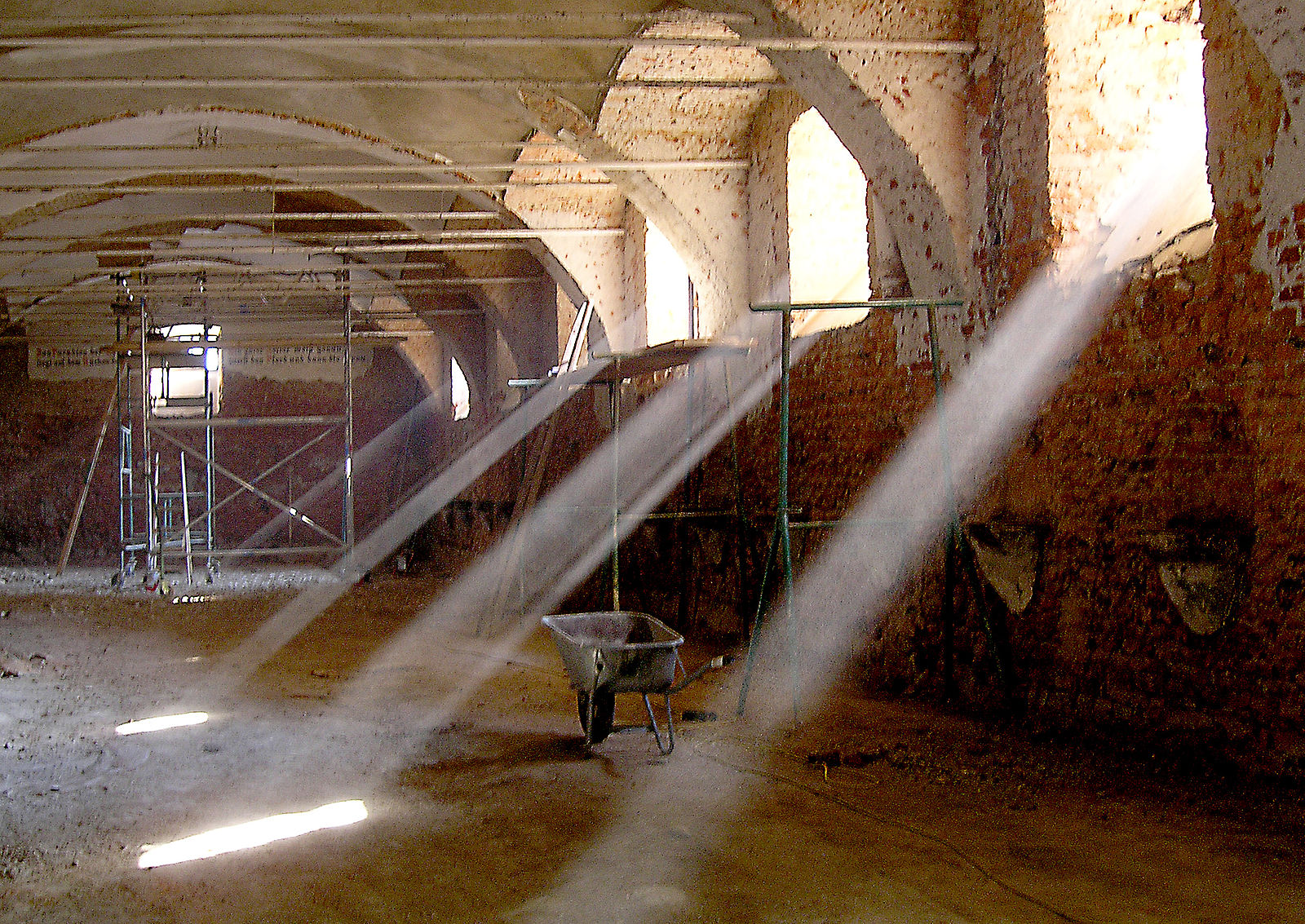
In a suspension, the pieces of solute are large and can be seen floating throughout the solvent. For example, dust floating through the air is a suspension.

The image shows dust in the sunlight. Dust in air is a suspension.

Dust dancing in the sunlight.

Image source: By E.mil.mil CC BY-SA 4.0, via Wikimedia Commons

Sometimes the pieces of solute sink to the bottom. The pieces at the bottom are referred to as sediment. If they stay floating in a liquid solvent, then the mixture is called a colloid. For example, milk is a colloid made of fat and proteins suspended in water. However, if milk goes sour, the fats and proteins separate and become sediment at the bottom of the jug.

Type a concept, like “slope” or “photosynthesis”.

↑ ↓ to choose · Enter to openSearch explanations and problems