Illustrated · 2 min
+1 contributors

What is a Titration?
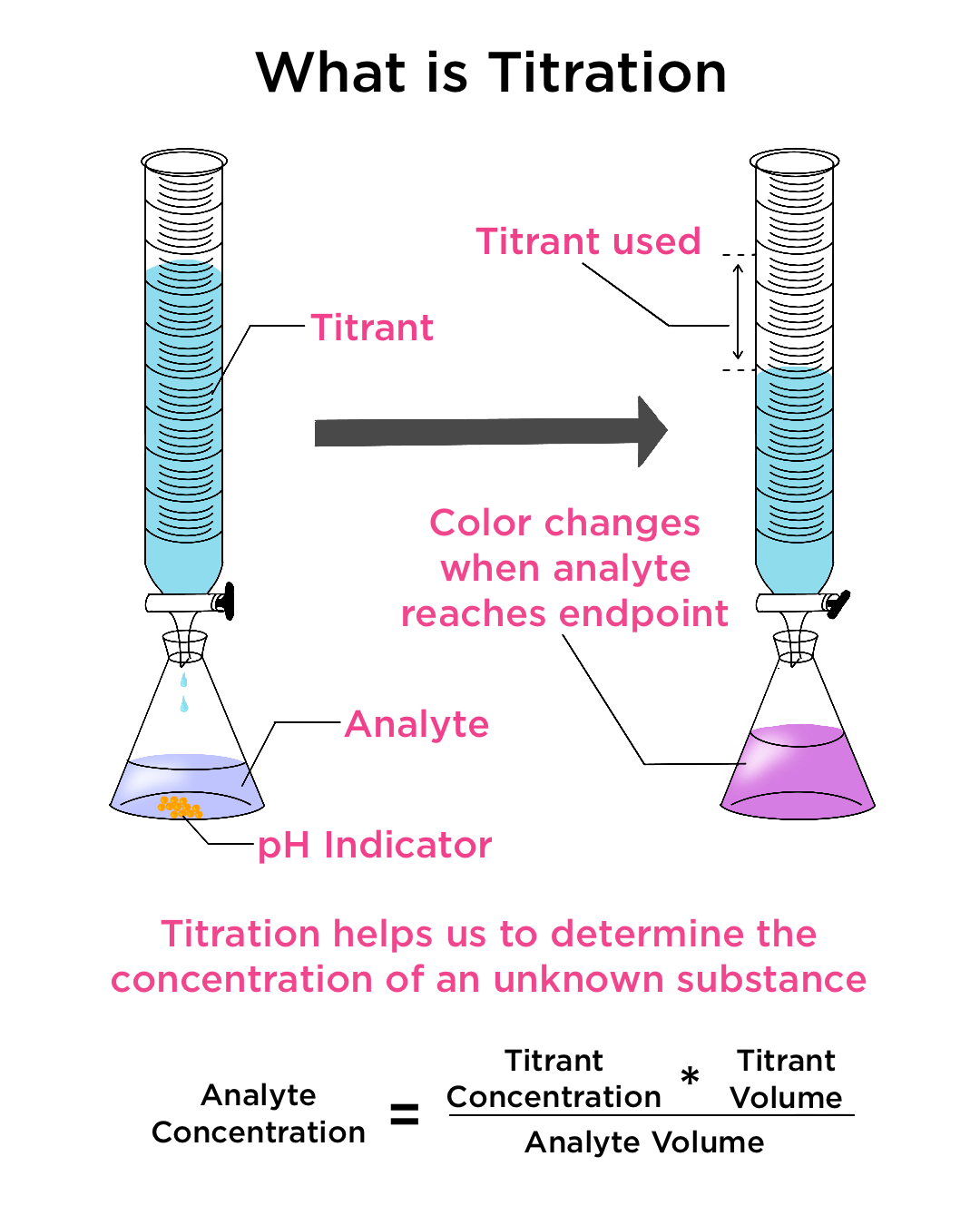
A titration is a technique to determine the unknown concentration of a substance. Most commonly this technique is used on acid/base reactions where an acid or base is added quantitatively (measured) into a base or acid (respectively). For example, if you have an unknown concentration of an acid solution, a known concentration of base can be added to the acid until the end of the reaction (endpoint) is reached. As long as the amounts of each are both known and the concentration of one, the unknown concentration can be determined.
Other types of reactions that titration is useful for include redox reactions and complexometric (complex formation) titrations.
Parts of a Titrantion
There are a few main parts of a titration:
-
Analyte: substance being analyzed for unknown concentration
-
Titrant: substance added to the analyte that has a known concentration
-
Titration apparatus: commonly this is a burette which is a glass instrument which can be filled with titrant. The burette allows control over the amount of titrant released and has measurements to track the amount added.
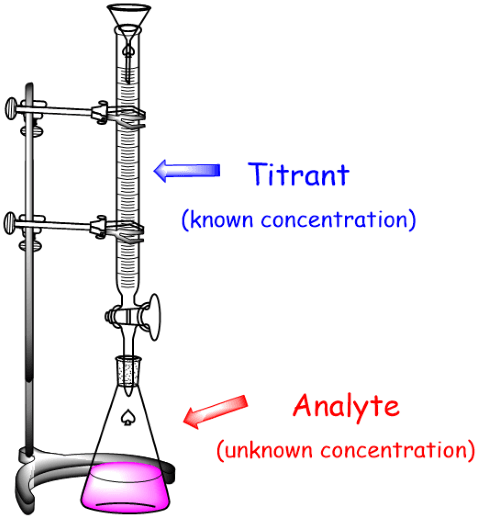
Titration apparatus set-up
Image source: By Cassie Gates
Endpoint Determination
The endpoint is when the analyte has reacted completely with titrant. There are many way to determine endpoint and often it depends on the type of reaction being monitored. Some methods include monitoring pH, conductivity, precipitation (solid formation), and spectrophotometry (measurement of light and absorption). The most common endpoint determination method are colorimetric indicators. These indicators change color under certain conditions and when chosen correctly, indicate when the endpoint is reached. Acid/base indicators change color at a specific pH and if the pH of the endpoint is known, an indicator which changes color in that range is optimal.
Calculating Unknown Concentration
If the analyte and titrant react in a 1:1 mole ration, the unknown concentration can be determined with a simple equation: stands for concentration and stands for volume. If the unknown concentration is , the known volume for the analyte is . The known titrant concentration is and the volume to reach the end point is .
Solve for :
If the mole ratio is not 1:1, stoichiometry calculations are used to determine the unknown concentration.
Titration Example
An unknown concentration of hydrochloric acid () is titrated with a known concentration of sodium hydroxide (). is a strong acid and is a strong base, this means the endpoint will occur at pH=7 (neutral pH). The pH indicator phenolphthalein can be used which is colorless in acidic conditions (pH<7), but changes to pink at about pH=8 (basic pH). Since our indicator changes color just after the acid and base react completely, the volume added before the pink color change is the endpoint.
The is 1M (mol/L concentration) and 50.0 mL are added to 30.0 mL of to reach the endpoint. The balanced chemical reaction equation is: Since, this is a 1:1 mole ratio we can calculate using: We can solve for or concentration of :