Illustrated · 1 min

Conditional Probability

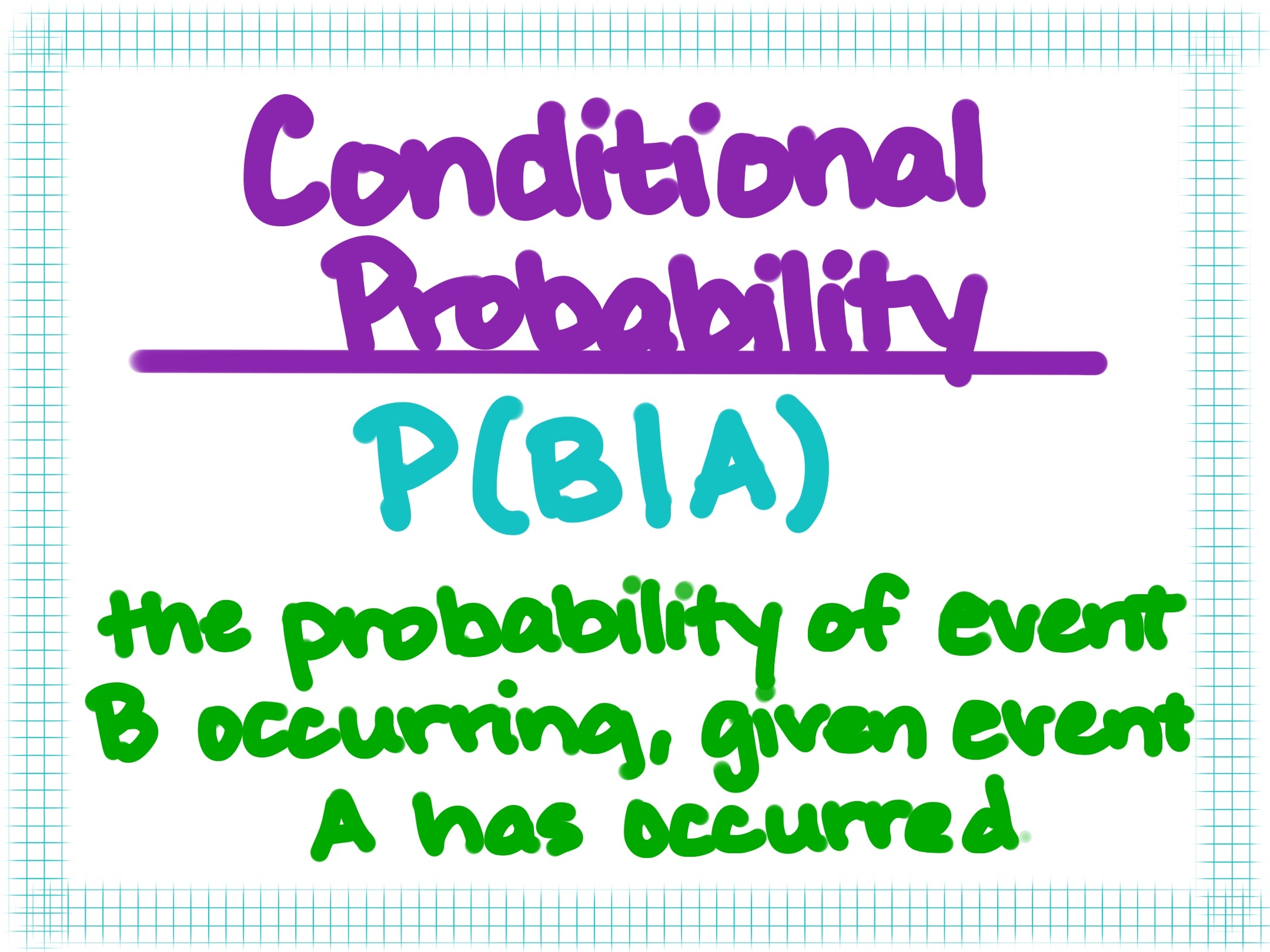
Conditional Probability is the probability of event BB occurring given that another event AA has occurred.

We say this as "the conditional probability of BB given AA", written as P(B∣A)P(B \mid A)

Sometimes, the concept of conditional probability can be fuzzy to some learners, since there does not necessarily need to be a relationship between AA and BB, nor do they have to occur simultaneously.

Independent Events

If both events occur independently, the conditional probability of event BB given event AA is just the probability of event BB (denoted as P(B)P(B)) occurring. You will soon learn about using conditional probability to determine independence.

Dependent Events

If events AA and BB are dependent, then the probability both events occur is written as: P(A and B)=P(A)P(B∣A)P(A \thinspace and \thinspace B) = P(A)P(B \mid A)

We can rearrange this to get: P(B∣A)=P(A and B)P(A)P(B \mid A) = \frac{P(A \thinspace and \thinspace B)}{P(A)}

Let's do an example.

Suppose you are waiting to hear from your top college about your acceptance. You have an 8585% chance of being accepted, but dorms are only provided for 7575% of all accepted students. What are the chances you are accepted and will receive a room in a dorm?

P(Accepted and Dorm)=P(Dorm∣Accepted)P(Accepted)P(Accepted \thinspace and \thinspace Dorm)= P(Dorm\mid Accepted)P(Accepted) =(0.75)×(0.85)=0.64= (0.75)\times(0.85) = 0.64

Here, we just have to multiply the probability of getting a dorm, given that you are accepted, and also the probability that you are accepted in the first place.
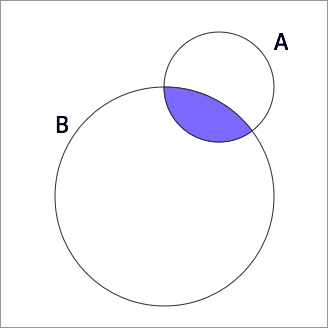
Two circles, one labelled A and one labelled B.  They are overlapping, and the overlapped area is shaded with blue

Image source: by Sarah Walker

No recipe to follow

These problems have no steps to copy. You have to understand the idea well enough to bend it to a new purpose. These are real problems from the AMC 8 and AMC 12, the national math competitions for middle and high school students, each with a worked solution on LIVE by Po-Shen Loh.

Illustrated · 1 min

Conditional Probability

We can take our skills of probability to the next level with conditional probability!

In a given sample space, you may encounter a time when one event is dependent on the other. This is when conditional probability comes into play! While these events are not occurring at the same time, they are still related to each other.

Consider a deck of 52 cards. If you select one card and don't replace it in the deck, the probability of the next card you pick will be dependent on the first card that you pick. So: given that you selected a red heart in the your first pick, you can use conditional probability to calculate the probability of selecting a red heart again in your second pick.

Conditional Probability
P(B|A) = the probability of event B occurring, given event A has occurred

Image source: by Anusha Rahman

We can notate conditional probability as: P(B∣A)P(B|A)

, which we say as: "the probability of event B occurring, given event A has occurred".

####Looking Further

In the next lesson on calculating conditional probability, you will learn how to use Bayes' Theorem and the formula for conditional probability. In the next lesson, you will also learn about two way tables!

We will round out this set of lessons with binomial probability.

Video

(Video) Intro to Conditional Probability

by Trefor Bazett

In this video by Dr. Trefor Bazett, you will learn about the basics of conditional probability.

Type a concept, like “slope” or “photosynthesis”.

↑ ↓ to choose · Enter to openSearch explanations and problems