Interactive · 6 questions
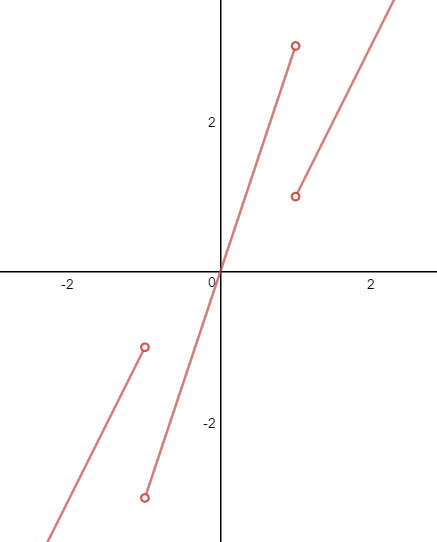
Take a look at the following two functions:
Which function would you say is "continuous" at ?
We say that a function is continuous at a point if is close to for all values of close to . For example, for the functions above:
is continuous at , since for all values of close to 2, is close to -1. In particular, , and , which are close to -1.
is not continuous at , since for some values of close to 2, is not close to 2. In particular, , which is not close to 2.
Now we have to ask, what do we mean when we say that is close to , or when we say that is close to ? Our goal now is to make our definition clear, and we'll go through a few attempts that don't work before we find one that does.
Attempt #1: is continuous at a point if is within 0.1 of for all values of within 0.1 of .
Let , and let . Under this definition, which of these functions are continuous at ?
Here's an explanation:
Since , this definition requires to be within 0.1 of 0 for all values of within 0.1 of 0, which is clearly true. Therefore, under this definition, is continuous at .
Since , this definition requires to be within 0.1 of 0 for all values of within 0.1 of 0, which is not true; for example, if , then , which is not within of . Therefore, under this definition, is not continuous at .
But looks continuous at :
So this definition doesn't work. We might try to fix it by adjusting one of the 0.1's, like this:
Attempt #2: is continuous at a point if is within 0.1 of for all values of within 0.01 of .
Find a function that looks like it should be continuous at , but doesn't fit this definition.
So this definition doesn't work either. We'll have to do something a little more clever; here's our next attempt:
Attempt #3: is continuous at a point if we can find a number such that is within 0.1 of for all values of within of .
( is a variable; it's the lowercase Greek letter delta.)
Let , , and . Under this definition, which of these functions are continuous at ?
It may look like we've fixed our problem, but there's still an issue with our definition. Consider the following function:
This function has a tiny jump at :
Our definition says this function is continuous at , since whenever is close enough to , is within 0.1 of 2.56, even if is to the left of the jump. But, this function just doesn't look like it should be continuous! So, how should we change our definition?
Would it work to replace the 0.1 with 0.01?
What do you think the definition should be?
Here's the standard definition; see how yours compares:
Definition: is continuous at a point if, for all , we can find a number such that is within of for all values of within of .
( is also a variable; it's the lowercase Greek letter epsilon)