What Is Genetic Engineering? — Definition & Examples

Illustrated · 1 min

What's Genetic Engineering?

It's the process of altering a small piece of the DNA of an organism. This is done with recombinant DNA technology, where a new piece of DNA is inserted into the genome. The organisms produced through this method are known as GMOs. They're also called genetically modified organisms. The diagram below illustrates the role of engineering in plant breeding.

The traditional plant breeding process introduces a number of genes into the plant. These genes may include the gene responsible for the desired characteristic. They might also include genes responsible for unwanted characteristics. Genetic engineering enables specific genes to be introduced to the plant. By narrowing this down to a few identified genes, scientists can introduce the desired trait without also introducing genes responsible for unwanted traits.

Image source: By The U.S. Food and Drug Administration [Public domain], via flickr.com

Applications of Genetic Engineering

Plant breeding is the most common form of genetic modification today. Most of our crops have undergone some form of engineering. The modifications that have been made are diverse. Some plants are insect-resistant, some are herbicide-resistant, and others are just altered to grow larger and faster than they would normally. There are benefits to genetically modified food, but many people are still against the idea because the side effects are relatively unknown.

There are many other applications of this technology as well. Animals are commonly modified to further improve our food supply. Many researchers are also looking for ways to use engineering methods in medicine, such as by altering the human genome with gene therapy. The goal would be to treat diseases caused by small mutations in a person's DNA. One of the first applications of genetic engineering in medicine happened when scientists experimented with the gene for human insulin to provide treatments for people with diabetes. The organisms they used in the experiments were actually genetically modified bacteria. Those experiments allowed scientists to create a much larger supply of insulin for people who need it.

Illustrated · 1 min

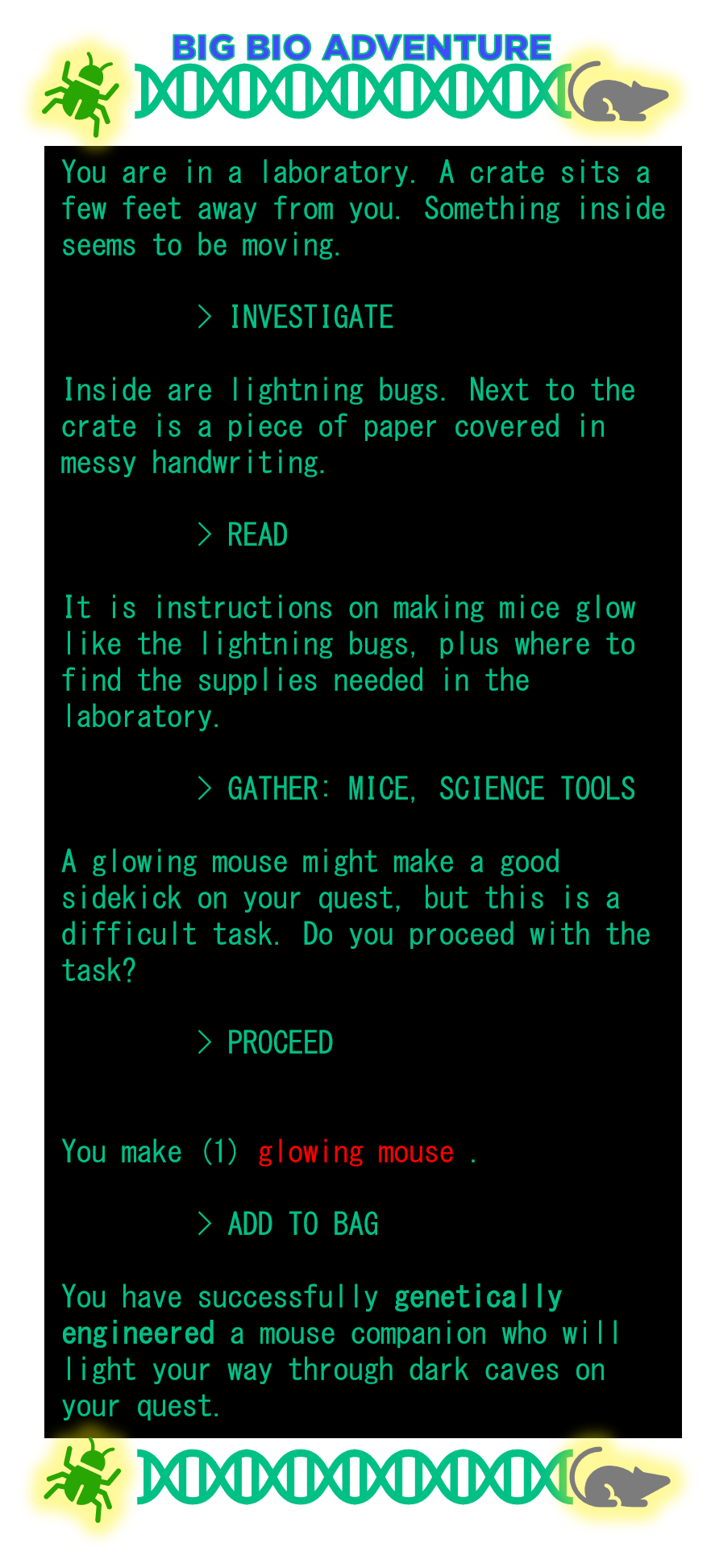
The image shows a text-based game called Big Bio Adventure. It looks like an old computer game.
"You are in a laboratory. A crate sits a few feet away from you. Something inside seems to be moving.
> INVESTIGATE
Inside are lightning bugs. Next to the crate is a piece of paper covered in messy handwriting.
> READ
It is instructions on making mice glow like the lightning bugs, plus where to find the supplies needed in the laboratory.
> GATHER: MICE, SCIENCE TOOLS
A glowing mouse might make a good sidekick on your quest, but this is a difficult task. Do you proceed with the task?
> PROCEED
You make (1) glowing mouse.
> ADD TO BAG
You have successfully genetically engineered a mouse companion who will light your way through dark caves on your quest."

Image source: By Valeri Natole

Illustrated · 1 min

Changing the Genetic Code

Genetic engineering is the deliberate changing of an organism's genome. Altering the genetic code of an organism is usually done to change some traits of that organism.

Ever since scientists discovered the genetic code, they have been trying to modify it. Genetic engineering is a huge industry and is constantly expanding as new genes are discovered.

This technology can make better crops and livestock to expand and improve our food supply. These special crops and livestock are called genetically modified organisms, or GMOs. The technology could also cure diseases, although we're not quite there yet.

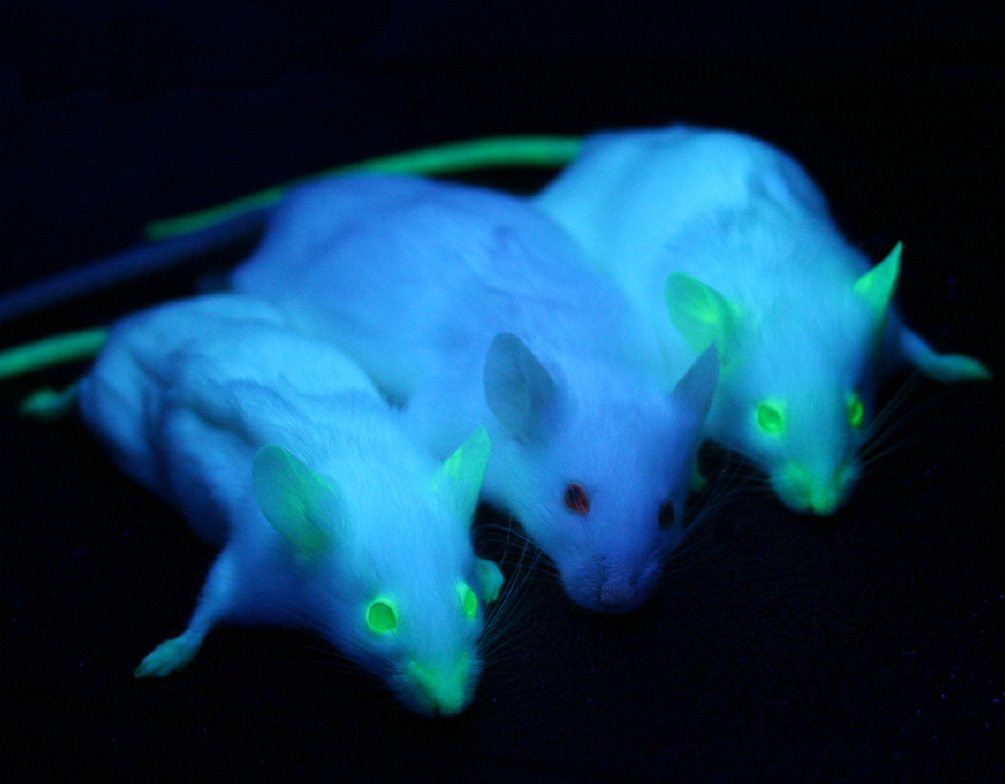
Fluorescent mice are GMOs (genetically modified organisms).

Image source: By Ingrid Moen, Charlotte Jevne, Jian Wang, Karl-Henning Kalland, Martha Chekenya, Lars A Akslen, Linda Sleire, Per Ø Enger, Rolf K Reed, Anne M Øyan, and Linda EB Stuhr CC BY 2.0, via Wikimedia Commons

The picture above can seem a bit scary, but it's only one example of genetic modification. Making animals glow in the dark isn't science's number-one goal.

Why Study Genetic Engineering?

In reality, scientists are trying to find ways to support our growing population. Many hypothesize that there are ways to treat and cure most deadly diseases through gene therapy. They're trying to improve our impact on the environment. They're trying to design more sustainable food sources. Finding ways to edit the genome is one technique that can be used to do all these things.

What Is the Controversy?

There are many arguments surrounding large-scale use of this technology because most people don't understand it very well. And since it's so new, there are a million questions we still can't answer. The hope is that further genome research can clear up all the confusion and show us a way to modify the genetic code safely.

Video · + 1 min read

(Video) What Is Genetic Engineering?

by Eco-Wise Videos

Genetic engineering alters the genetic makeup of an organism. Scientists can change the genetics of an organism through selective breeding, the insertion of genetic material from other organisms, and gene therapy. These methods can be used to increase genetic variation in a species. They can also improve how that species is adapted to its environment.

In this video, Eco-Wise Videos explains how all of this works.

Vocabulary Review:\color{#8925ae}{\text{Vocabulary Review:}}

Genetic Engineering\color{#8925ae}{\text{Genetic Engineering}} : The process of changing the genetic material of an organism

Selective Breeding\color{#8925ae}{\text{Selective Breeding}} : The process of breeding organisms to create offspring with desired traits. This is also known as artificial selection

Cloning\color{#8925ae}{\text{Cloning}} : Creating a genetically identical copy of an organism

Genetically Modified Organisms\color{#8925ae}{\text{Genetically Modified Organisms}} : Organisms that have had their genome altered in some way

Gene Therapy\color{#8925ae}{\text{Gene Therapy}} : Inserting normal genes in place of missing or defective ones to fix genetic disorders

Type a concept, like “slope” or “photosynthesis”.

↑ ↓ to choose · Enter to openSearch explanations and problems