What Is Interphase? — Overview & Diagrams

Illustrated · 1 min

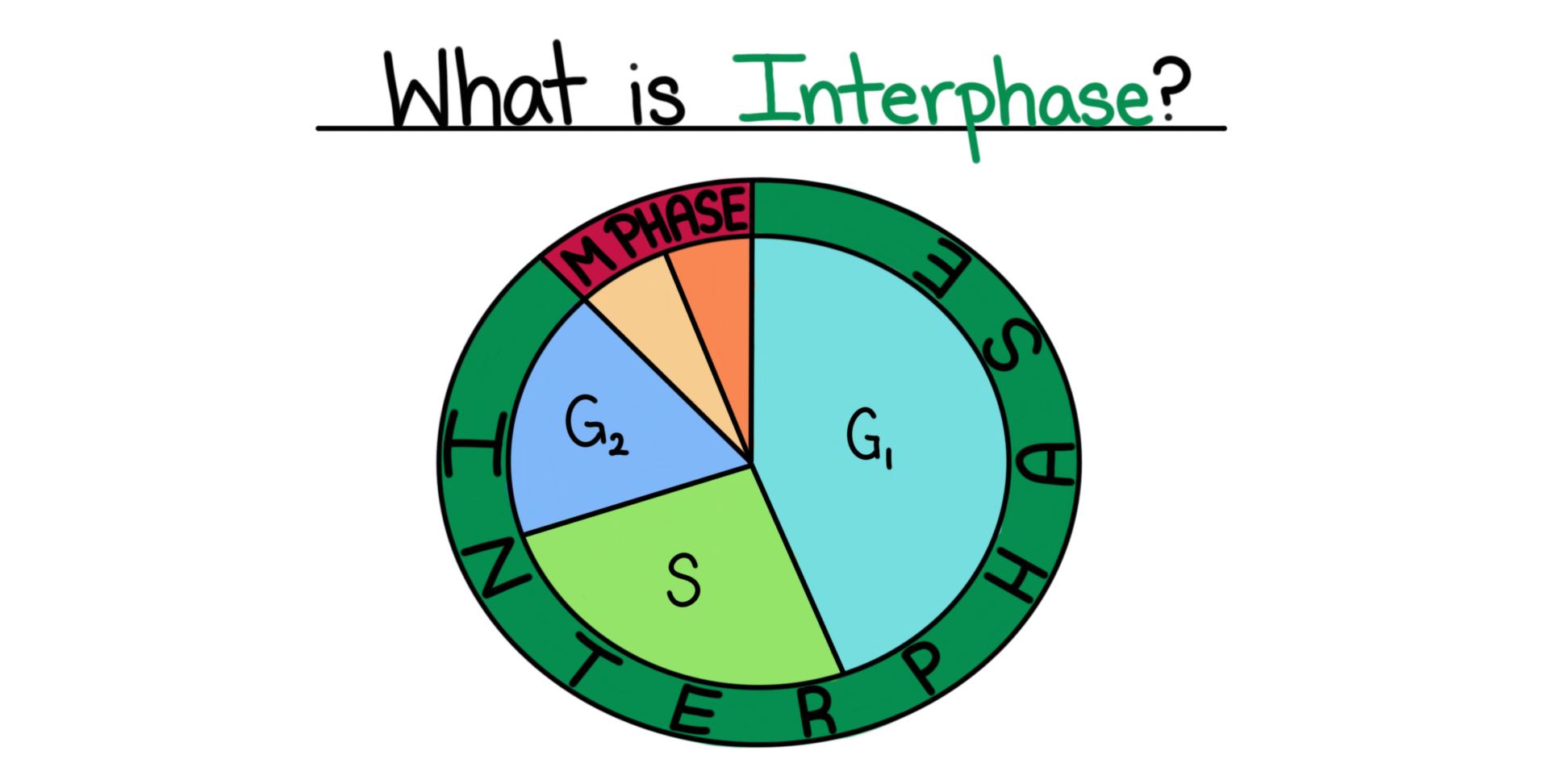
A diagram of the cell cycle

Image source: By Gabi Slizewska

Cells are constantly going through the cell cycle. Once a cell divides, its daughter cells just repeat the cycle.

The part of the cycle between cell divisions is called interphase. During this period, the cell grows and prepares for mitosis. It consists of three phases: G1_1, S, and G2_2.

G1_1 Phase: During this phase, the cell grows. Not only does it get larger, it also produces lots of organelles and proteins.

S Phase: During this phase, chromosomes in the nucleus are replicated and the cell ends up with twice as much DNA.

G2_2 Phase: Once DNA has been replicated, the cell produces many organelles and molecules which will be needed for cell division. Then, the cell enters the next phase of the cell cycle: either mitosis or meiosis.

Illustrated · 1 min

Stages of Interphase

The image shows a cell sleeping and letting out some Zzzs.

Image source: By Sarah Morgan

Interphase is what happens before and after mitosis. It is a sort of "resting period" between replications. While the cell is not doing anything as dramatic as splitting in half, it still does some important things in order to prepare for the stages of mitosis. In fact, cells spend most of their time in interphase. It happens in both plant and animal cells.

The image shows stage G1, where the cell makes more organelles and proteins; stage S, where DNA replicates; and stage G2, where the cell continues to make more organelles and proteins.

Image source: By Sarah Morgan

There are three main parts: gap 1 (G1_1), synthesis (S), and gap 2 (G2_2).

In G1_1, the cell makes lots of proteins and expands organelles like the endoplasmic reticulum and the Golgi body. It also grows in size by increasing the volume of its cytoplasm.

Some cells, like brain cells, do not replicate very often and will go into a stage called G0_0. This basically means that they do not move forward into stage S.

In stage S, the DNA is replicated, and the cell ends up with two complete copies of its genome.

In G2_2, more organelles and proteins are made. Chloroplasts and mitochondria are doubled during this stage. After this stage, the cell is just about ready to do mitosis again.

Illustrated · 1 min

What Are the Checkpoints of Interphase?

The cell cycle is a very important process, which is why it needs to be done correctly every time. Checkpoints help with this.

This is an image showing the cell cycle. After G1 phase, there is a check for cell size and resources. After G2 phase, there is a check for DNA errors, cell size, and resources.

Image source: By Gabi Slizewska

G1_1 Checkpoint

The first checkpoint happens during the G1_1 phase. At this point, the cell has to check if it's a good idea to divide. Cell division takes a lot of the cell's resources, so it would not be smart to divide if there aren't enough nutrients around, the cell is too small, or the body is sick.

If the cell passes this checkpoint, there is no going back. The cell will complete the rest of the cycle and divide. If the cell does not pass the checkpoint, it can stay in G1_1 phase to fix the problem, or it can enter a dormant state called G0_0 phase until it's time to divide. In G0_0, the cell continues to do its job, but it's not preparing to divide.

G2_2 Checkpoint

The second checkpoint is in G2_2 phase. G2_2 happens directly after DNA replication, so the cell needs to make sure there were no replication errors. The cell also double checks that it's big enough to divide and that there are enough resources to spare.

If the cell doesn't pass the test, it has to go back and repair the DNA before it can move on and divide.

Once the cell begins to actually divide, it will have to pass one more checkpoint during metaphase of mitosis or meiosis.

Video

(Video) Mitosis: Splitting Up Is Complicated

by CrashCourse

In this clip, Hank from Crash Course talks about what cells do during interphase.

Type a concept, like “slope” or “photosynthesis”.

↑ ↓ to choose · Enter to openSearch explanations and problems