Illustrated · 1 min
+2 contributors

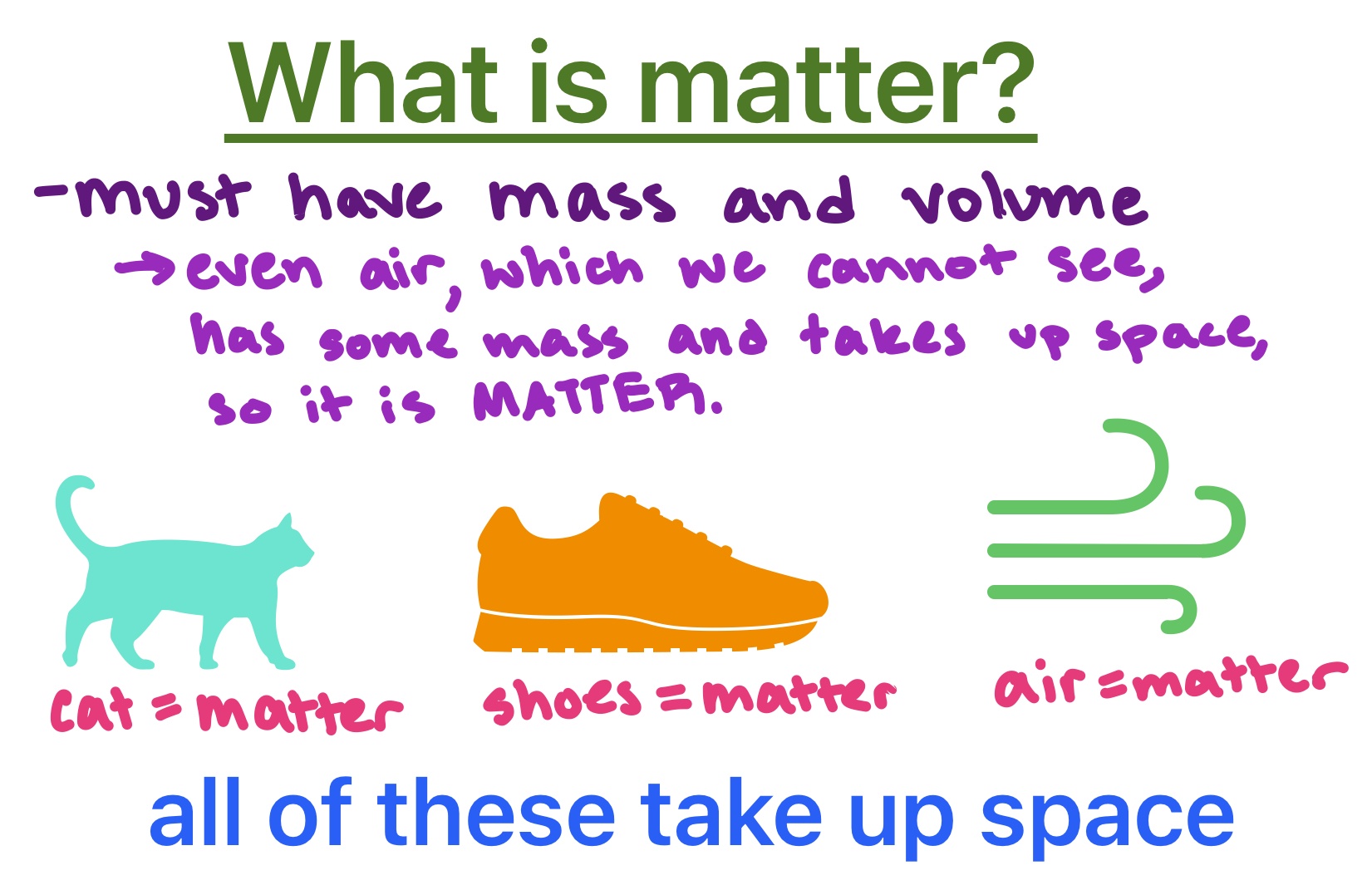
Matter is defined as anything occupying space and having mass. It is the material of the universe. While it may seem simple since everything around us is composed of matter, it is quite complex and has many levels of organization.
Some substances are not considered matter because they have no mass. These include photons, light, and sound.
Traditionally, matter exists in three states: solid, liquid, and gas. Some textbooks also include plasma as a fourth state of matter. When a substance's phase changes, so does the arrangement and movement of particles, as well as its volume and shape.
A solid has a fixed volume and shape. Its atoms are densely packed and held firmly in place.
A liquid has a fixed volume, but not a fixed shape - it assumes the shape of the container. Its atoms are less densely packed.
A gas has no fixed volume or shape - it assumes both the volume and the shape of the container. Its atoms fly in all directions at great speeds.
A plasma is an ionized gas at a very high temperature. The characteristics of plasmas are significantly different from those of ordinary gases, so that plasmas are sometimes considered a distinct state of matter.

Figure 1: States of Matter. (Source: Britannica)