What Is Mitosis? — Definition & Overview

Video

(Video) What Is Mitosis? | Genetics | Biology | FuseSchool

by FuseSchool - Global Education

Mitosis is an essential part of the cell cycle. It's how a single cell divides to create new cells. Cell division is important because new cells are needed to replace old or damaged cells. Cells also divide because more cells are needed to allow an organism to grow.

This process occurs in all of our body cells, also called somatic cells. It does not occur in sex cells, which are sperm and eggs.

Mitosis produces two cells which are identical to the original parent cell. Normal body cells have two copies of each chromosome. This state is called diploid (2n2n). Mitosis begins with one diploid cell, and it produces two diploid cells. The new cells are called daughter cells.

This process consists of several phases: prophase, metaphase, anaphase, and telophase. Telophase is accompanied by a process called cytokinesis.

The steps of mitosis

Image source: By LadyofHats [Public domain], via Wikimedia Commons
Illustrated · 2 min

Steps of Cell Division

How do your tissues grow? How does your body replace old, worn-out cells?

Mitosis is the answer. It's the process that splits a single cell into two daughter cells.

There are a few key differences between mitosis and meiosis:

  • Mitosis happens in body cells and has an end product of two cells. The daughter cells match the parent cell if everything goes right. (If things do not go right, a critter might end up with cancer cells.)

  • Meiosis finishes with four sex cells, or gametes. The four sex cells are genetically distinct. They are not identical to one another or the parent cell.

Before we get started on how this whole process works, here are two important things to remember:

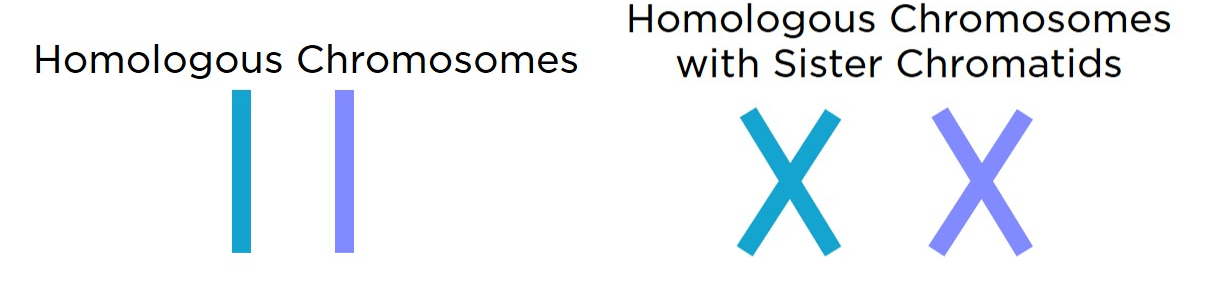
  • A body cell has pairs of homologous chromosomes. These are chromosomes that carry DNA for the same trait but might have different alleles.
  • When DNA copies itself during a part of the cell cycle called S phase, each homologous chromosome gets copied. Copies of the same chromosome are sister chromatids.
Chromosomes vs. Chromatids

Image source: By Valeri Natole

So, what are the steps of mitosis?

(1) Interphase

  • DNA in the nucleus of the parent cell copies itself so that there are two of each chromosome
  • Each chromosome now has a twin, an identical sister chromatid
  • Spindle fibers pop out from the centrioles
Interphase

Image source: By Valeri Natole

(2) Prophase

  • Chromosomes condense and line up
  • The nuclear membrane dissolves and the spindle fibers extend as the centrioles move to opposite sides of the cell
Prophase

Image source: By Valeri Natole

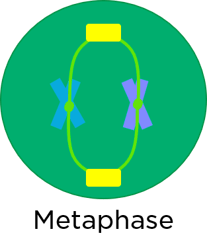
(3) Metaphase

  • Spindle fibers attach to the centers of the chromosomes, which have lined up at the center of the cell (called the metaphase plate)
Metaphase

Image source: By Valeri Natole

(4) Anaphase

  • The sister chromatids of each chromosome are pulled to opposite sides of the cell by the spindle fibers
Anaphase

Image source: By Valeri Natole

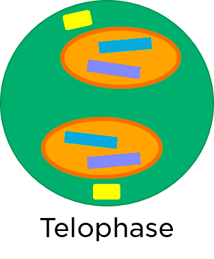
(5) Telophase

  • Two new nuclear membranes form around each new set of homologous chromosomes
Telophase

Image source: By Valeri Natole

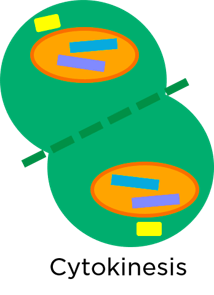
(6) Cytokinesis

  • The cell pinches in the middle and separates into two new daughter cells, each with one nucleus and a full set of genetic information
Cell Splitting

Image source: By Valeri Natole

Interactive · 1 question

How Do Cells Divide?

Mitosis is the process of one nucleus dividing into two identical nuclei during cell division.

You might be thinking, "What's so special about that?"

Well, haven't you ever wondered how you grew from a tiny kindergartner into the person you are now? Or have you wondered how a cut can heal all by itself?

These are both examples of mitosis at work. Your body divides one diploid somatic cell into two daughter cells, identical copies of that original diploid cell. These cells then divide again, and it just keeps going. Somatic cells are any cells that are not sex cells. So, skin cells, liver cells, and muscle cells are all somatic cells. Diploid cells have two of each chromosome.

A diagram of the cell cycle

Image source: By Kelvinsong [CC0], via Wikimedia Commons

Chromosomes form during cell division so the genetic information can be properly duplicated and divided. Each chromosome is actually made of two identical sister chromatids that are connected at a centromere. The sister chromatids contain the same genetic information, allowing the cell to produce identical daughter cells when it divides.

Before DNA is duplicated, the chromosome is made of one chromatid. After duplication, the duplicated chromosome is made of two sister chromatids. After these chromatids undergo mitosis, two daughter chromosomes are formed.

Image source: By Deena Hauze

There are four parts in total: prophase, metaphase, anaphase, and telophase.


Here's a hint to remember the order of these phases.

Prophase →\rightarrow Prepare

Metaphase →\rightarrow Middle

Anaphase →\rightarrow Apart

Telephase →\rightarrow Two


These four stages are the steps the cell uses to separate the 96 chromosome pairs from interphase. After the genetic material is divided up, the two separate nuclei contain 43 pairs each. Mitosis is the shortest part of the cell cycle, with interphase being longer by far.

Cytokinesis takes place next and divides the cell into two identical daughter cells, each containing one of the new nuclei.

Fill in the blank: During mitosis, a woah‾\underline{\phantom{woah}} cell is divided into woah‾\underline{\phantom{woah}}.

Choose one answer

Illustrated · 1 min

What Is Mitosis?

It is the separation of genetic material contained in the nucleus of somatic cells, resulting in two identical cells.

A somatic cell is any cell that is not a sex cell. Sex cells are sperm and eggs. All other cells like muscle cells, liver cells, and bone cells are somatic cells. They go through interphase, mitosis, and cytokinesis to replicate themselves.

Mitosis is separated into four stages that separate and divide all of the genetic material necessary to make a new cell. The stages are prophase, metaphase, anaphase, and telophase.

A normal human cell has a total of 4646 single chromosomes. They appear as a single rod and are usually in a loose mass inside of the nucleus of a cell. During interphase the chromatin tightens up, forming the 4646 chromosomes. These chromosomes undergo replication during S phase of interphase, forming an XX-shape. There are now 9292 total single-stranded chromosomes, or 4646 double-stranded chromosomes, in the cell. This number is said to be 2n2n because the cell now contains twice the normal amount of chromosomes. Not every species has the same number of chromosomes as humans, so 2n2n depends on the type of animal cell.

The role of mitosis is to take these 9292 chromosomes and separate them so that there are now two cells containing 4646 chromosomes each.

The steps of the cycle known as mitosis

Image source: By Marek Kultys CC BY-SA 3.0, via Wikimedia Commons

Video

(Video) Mitosis: Splitting Up Is Complicated

by CrashCourse

Mitosis is the process that animal cells and plant cells undergo to produce new daughter cells. Find out all about how this happens in this video by Crash Course.

Type a concept, like “slope” or “photosynthesis”.

↑ ↓ to choose · Enter to openSearch explanations and problems